Salk Institute researchers launch ShortStop, a machine learning framework that explores overlooked DNA regions in search of microproteins that may play roles in disease
Proteins sustain life as we know it, serving many important structural and functional roles throughout the body. But these large molecules have cast a long shadow over a smaller subclass of proteins called microproteins. Microproteins have been lost in the 99% of DNA disregarded as “noncoding”, hiding in vast, dark stretches of unexplored genetic code. But despite being small and elusive, their impact may be just as big as larger proteins.
Salk Institute scientists are now exploring the mysterious dark side of the genome in search of microproteins. With their new tool ShortStop, researchers can probe genetic databases and identify DNA stretches in the genome that likely code for microproteins. Importantly, ShortStop also predicts which microproteins are most likely to be biologically relevant, saving time and money in the search for microproteins involved in health and disease.
The ShortStop classification framework
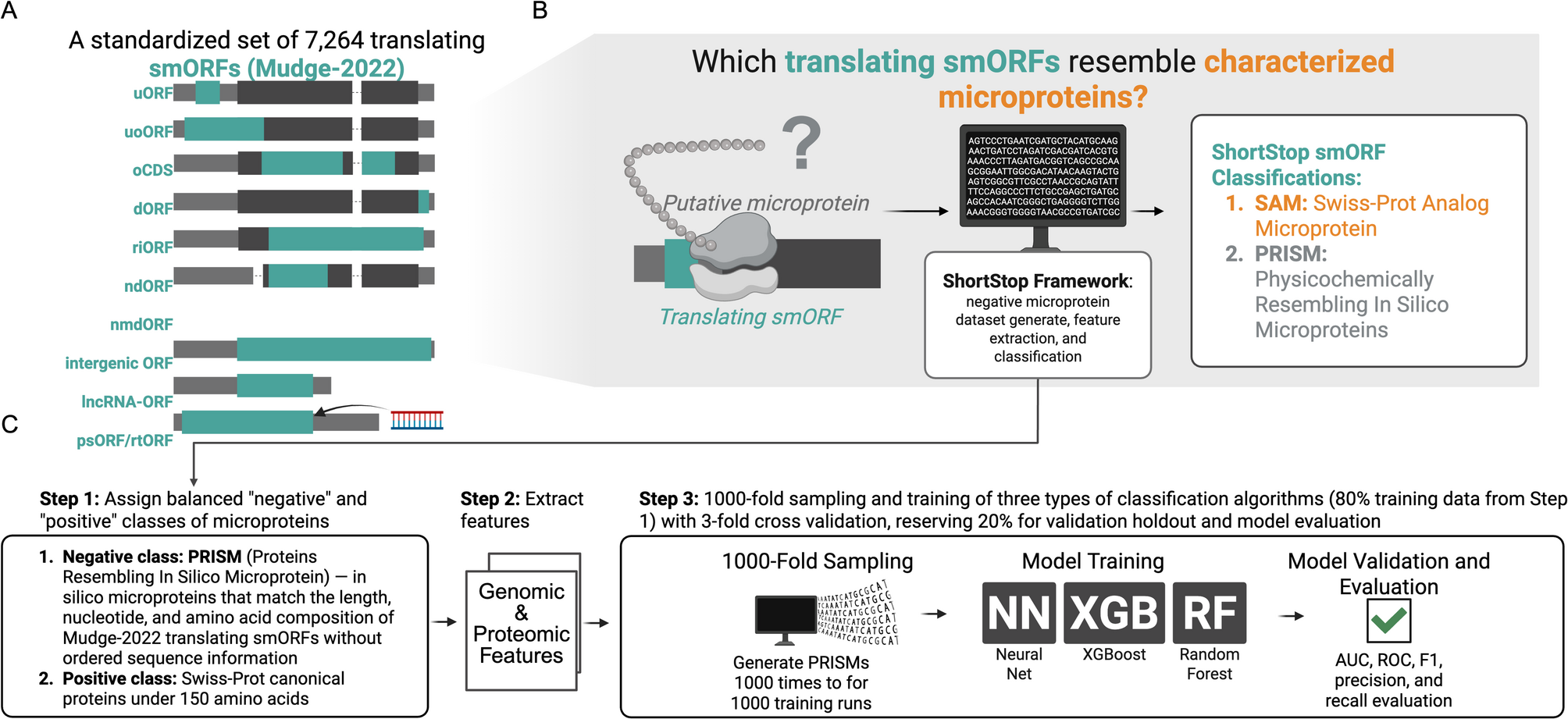
A 7,264 translating smORFs make up Mudge-2022. The types of smORFs are illustrated in teal. B Schematic of the purpose of the ShortStop computational framework. The output of ShortStop is the classification of translating smORFs as SAMs (Swiss-Prot Analog Microproteins) or PRISMs (Physicochemically Resembling In Silico Microproteins). C Steps 1–3 of the ShortStop training process. Step 1 starts with generating PRISMs and defining the positive dataset of Swiss-Prot microproteins (i.e., proteins downloadable from Swiss-Prot under 151 amino acids). Step 2 involves extracting nucleotide features: k-mer representations (e.g., k = 4) from the 5′ and 3′ regions and the first 50 nucleotides of the CDS; and protein features: CTDD, CKSAAP, and APAAC representations. Step 3 involves a 1000-fold sample generation of PRISMs to train neural networks, XGBoost, and random forest algorithms for validation and evaluation
ShortStop shines a new light on existing datasets, spotlighting microproteins formerly impossible to find. In fact, the Salk team has already used the tool to analyze a lung cancer dataset to find 210 entirely new microprotein candidates, with one standout validated microprotein, that may make good therapeutic targets in the future.
“Most of the proteins in our body are well known, but recent discoveries suggest we’ve been missing thousands of small, hidden proteins, called microproteins, coded by overlooked regions of our genome,” says senior author Alan Saghatelian, professor and holder of the Dr. Frederik Paulsen Chair at Salk. “For a long time, scientists only really studied the regions of DNA that coded for large proteins and dismissed the rest as ‘junk DNA,’ but we’re now learning that these other regions are actually very important, and the microproteins they produce could play critical roles in regulating health and disease.”
More about microproteins
It is difficult to detect and catalog microproteins, owing mostly to their size. Compared to standard proteins that can range from hundreds to thousands of amino acids long, microproteins typically contain fewer than 150 amino acids, making them harder to detect using standard protein analysis methods. Therefore, instead of searching for the microproteins themselves, scientists search large, publicly available datasets for the DNA sequences that make them.
Scientists have now learned that certain stretches of DNA called small open reading frames (smORFs) can contain the instructions for making microproteins. Current experimental methods have already cataloged thousands of smORFs, but these tools remain time-consuming and expensive. Furthermore, their inability to separate potentially functional microproteins from nonfunctional microproteins has stalled their discovery and characterization.
How ShortStop works
Not all smORFs translate to biologically meaningful microproteins. Existing methods can’t discriminate between functional and nonfunctional microprotein-generating smORFs. This means that scientists must independently test each microprotein to determine whether it is functional or not.
ShortStop radically alters this workflow, optimizing smORF discovery by sorting microproteins into functional and nonfunctional categories. The key to ShortStop’s two-class sorting is how it’s trained as a machine learning system. Its training relies on a negative control dataset of computer-generated random smORFs. ShortStop compares found smORFs against these decoys to quickly decide whether a new smORF is likely to be functional or nonfunctional.
ShortStop cannot definitively say whether a smORF will code for a biologically relevant microprotein, but this two-class system narrows down the experimental pool immensely. Now researchers can spend less time manually sorting through datasets and failing at the bench.
When the researchers applied ShortStop to a previously published smORF dataset, they identified 8% as likely functional microproteins, prioritizing them for targeted follow-up. This accelerates microprotein characterization by filtering out sequences unlikely to have biological relevance. ShortStop could also identify microproteins that were overlooked by other methods, including one that was validated by being detected in human cells and tissues.
“What makes ShortStop especially powerful is that it works with common data types, like RNA sequencing datasets, which many labs already use,” says first author Brendan Miller, a postdoctoral researcher in Saghatelian’s lab. “This means we can now search for microproteins across healthy and diseased tissues at scale, which will reveal new insights into human biology and unlock new paths for diagnosing and treating diseases, such as cancer and Alzheimer’s disease.”
ShortStop spots microprotein associated with lung cancer
The researchers have already used ShortStop to identify a microprotein that was upregulated in lung cancer tumors. They analyzed genetic data from human lung tumors and adjacent normal tissue to create a list of potential functional smORFs. Among the smORFs ShortStop found, one stood out—it was expressed more in tumor tissue than normal tissue, suggesting it may serve as a biomarker or functional microprotein for lung cancer
The identification of this lung cancer-related microprotein demonstrates the value of ShortStop and machine learning to prioritize candidates for future research and therapeutic development.
“There’s so much data that already exists that we can now process with ShortStop to find novel microproteins associated with health and disease, stretching from Alzheimer’s to obesity and beyond,” says Saghatelian. “My team is really good at making methods, and with data from other Salk faculty, we can integrate these methods and accelerate the science.”
Source – Salk Institute
Availability – ShortStop can be downloaded and installed from out GitHub repository (https://github.com/brendan-miller-salk/ShortStop) for personal use.


Salk Institute researchers launch ShortStop, a machine learning framework that explores overlooked DNA regions in search of microproteins that may play roles in disease
Proteins sustain life as we know it, serving many important structural and functional roles throughout the body. But these large molecules have cast a long shadow over a smaller subclass of proteins called microproteins. Microproteins have been lost in the 99% of DNA disregarded as “noncoding”, hiding in vast, dark stretches of unexplored genetic code. But despite being small and elusive, their impact may be just as big as larger proteins.
Salk Institute scientists are now exploring the mysterious dark side of the genome in search of microproteins. With their new tool ShortStop, researchers can probe genetic databases and identify DNA stretches in the genome that likely code for microproteins. Importantly, ShortStop also predicts which microproteins are most likely to be biologically relevant, saving time and money in the search for microproteins involved in health and disease.
The ShortStop classification framework
A 7,264 translating smORFs make up Mudge-2022. The types of smORFs are illustrated in teal. B Schematic of the purpose of the ShortStop computational framework. The output of ShortStop is the classification of translating smORFs as SAMs (Swiss-Prot Analog Microproteins) or PRISMs (Physicochemically Resembling In Silico Microproteins). C Steps 1–3 of the ShortStop training process. Step 1 starts with generating PRISMs and defining the positive dataset of Swiss-Prot microproteins (i.e., proteins downloadable from Swiss-Prot under 151 amino acids). Step 2 involves extracting nucleotide features: k-mer representations (e.g., k = 4) from the 5′ and 3′ regions and the first 50 nucleotides of the CDS; and protein features: CTDD, CKSAAP, and APAAC representations. Step 3 involves a 1000-fold sample generation of PRISMs to train neural networks, XGBoost, and random forest algorithms for validation and evaluation
ShortStop shines a new light on existing datasets, spotlighting microproteins formerly impossible to find. In fact, the Salk team has already used the tool to analyze a lung cancer dataset to find 210 entirely new microprotein candidates, with one standout validated microprotein, that may make good therapeutic targets in the future.
More about microproteins
It is difficult to detect and catalog microproteins, owing mostly to their size. Compared to standard proteins that can range from hundreds to thousands of amino acids long, microproteins typically contain fewer than 150 amino acids, making them harder to detect using standard protein analysis methods. Therefore, instead of searching for the microproteins themselves, scientists search large, publicly available datasets for the DNA sequences that make them.
Scientists have now learned that certain stretches of DNA called small open reading frames (smORFs) can contain the instructions for making microproteins. Current experimental methods have already cataloged thousands of smORFs, but these tools remain time-consuming and expensive. Furthermore, their inability to separate potentially functional microproteins from nonfunctional microproteins has stalled their discovery and characterization.
How ShortStop works
Not all smORFs translate to biologically meaningful microproteins. Existing methods can’t discriminate between functional and nonfunctional microprotein-generating smORFs. This means that scientists must independently test each microprotein to determine whether it is functional or not.
ShortStop radically alters this workflow, optimizing smORF discovery by sorting microproteins into functional and nonfunctional categories. The key to ShortStop’s two-class sorting is how it’s trained as a machine learning system. Its training relies on a negative control dataset of computer-generated random smORFs. ShortStop compares found smORFs against these decoys to quickly decide whether a new smORF is likely to be functional or nonfunctional.
ShortStop cannot definitively say whether a smORF will code for a biologically relevant microprotein, but this two-class system narrows down the experimental pool immensely. Now researchers can spend less time manually sorting through datasets and failing at the bench.
When the researchers applied ShortStop to a previously published smORF dataset, they identified 8% as likely functional microproteins, prioritizing them for targeted follow-up. This accelerates microprotein characterization by filtering out sequences unlikely to have biological relevance. ShortStop could also identify microproteins that were overlooked by other methods, including one that was validated by being detected in human cells and tissues.
ShortStop spots microprotein associated with lung cancer
The researchers have already used ShortStop to identify a microprotein that was upregulated in lung cancer tumors. They analyzed genetic data from human lung tumors and adjacent normal tissue to create a list of potential functional smORFs. Among the smORFs ShortStop found, one stood out—it was expressed more in tumor tissue than normal tissue, suggesting it may serve as a biomarker or functional microprotein for lung cancer
The identification of this lung cancer-related microprotein demonstrates the value of ShortStop and machine learning to prioritize candidates for future research and therapeutic development.
Source – Salk Institute
Availability – ShortStop can be downloaded and installed from out GitHub repository (https://github.com/brendan-miller-salk/ShortStop) for personal use.
Miller B, Vieira de Souza E, Pai VJ, Kim H, Vaughan JM, Lau CJ, Diedrich JK, Saghatelian A. (2025) ShortStop: a machine learning framework for microprotein discovery. BMC Methods [Epub ahead of print][article]
Related Posts
RNAmel simplifies RNA sequencing data analysis with a reproducible, integrated platform
Heart failure reshapes bone marrow to create inflammation-related immune memory
Overlooked DNA regions surrounding ‘microexons’ hold missing pieces of autism’s genetic puzzle
RiboBA improves detection of hidden protein-coding regions using ribosome profiling
An anti-senescence gene may fight spinal disc deterioration
Scientists identify the neuroblastoma cells that signal poor outcomes
Novel biosensor uses DNA ‘barcodes’ to uncover disease signals in cells
CellART extracts single-cell information from high-resolution spatial transcriptomics
Cell2space restores spatial context to single-cell RNA sequencing data
Urine test may improve bladder cancer diagnosis and guide treatment decisions
DeCoRE – a computational method to resolve RNA structural heterogeneity from RNA structure probing data by direct RNA sequencing
Tracing 700 million years of cell evolution
How should biological replicates be handled in long-read RNA sequencing?
RNA-Seq reveals a new way the developing heart controls its growth
The Human RNome Project Consortium seeks to publish first-ever complete sequence of the body’s RNA
scFlowReport brings multiple single-cell RNA sequencing analyses into one workflow
Long-read RNA sequencing reveals how neurons choose alternative RNA endings
DeOPUS improves cell-type estimates from bulk RNA sequencing
ResolVI improves accuracy in spatial transcriptomics analysis
RNA sequencing reveals transcriptional allele differences in prostate cancer stem cells
Stay Connected
Submit a Post to the Blog
Recent Posts
Subscribe to the RNA-Seq Blog
RNA-Seq Products & Services