Astrocytes, known for their crucial role in supporting neurons and maintaining brain health, have been predominantly studied in gray matter (GM), which is involved in information processing. However, white matter astrocytes, which support long-range neural connections, remain poorly understood. This study fills a major knowledge gap by showing that WM astrocytes are not a uniform population but consist of distinct subtypes with specialized roles. The team was led by Dr. Judith Fischer-Sternjak from Helmholtz Munich and Ludwig-Maximilians-Universität (LMU) München, alongside Prof. Magdalena Götz from Helmholtz Munich, LMU and the Munich Cluster for Systems Neurology (SyNergy).
“Our findings challenge the traditional view that white matter astrocytes are a homogeneous population,” says Judith Fischer-Sternjak. “Instead, we see clear evidence of specialized subtypes, including one with significant proliferative capacity, which could be harnessed for brain repair.”
“As we have shown previously that proliferating astrocytes can be harnessed for repair, we are very excited to find these even in the WM of healthy brains,” adds Magdalena Götz.
A Potential Brain Repair Reservoir
The study identified two distinct types of cortical white matter astrocytes. One is more widely distributed throughout the brain and has been evolutionarily conserved, probably being involved in supporting nerve fibers, facilitating cell communication, and regulating metabolism. The other is a highly specialized subtype found primarily in the cortical white matter. This subtype has a remarkable ability to proliferate and is influenced by specific pathways involving interactions with other brain cells.
Notably, the researchers discovered that some of these proliferating astrocytes can migrate from the white matter into the gray matter. This suggests that certain white matter regions may serve as a hidden reservoir for generating new astrocytes, potentially contributing to brain maintenance.
Isolation of single cells from cortical GM, WM and the SEZ
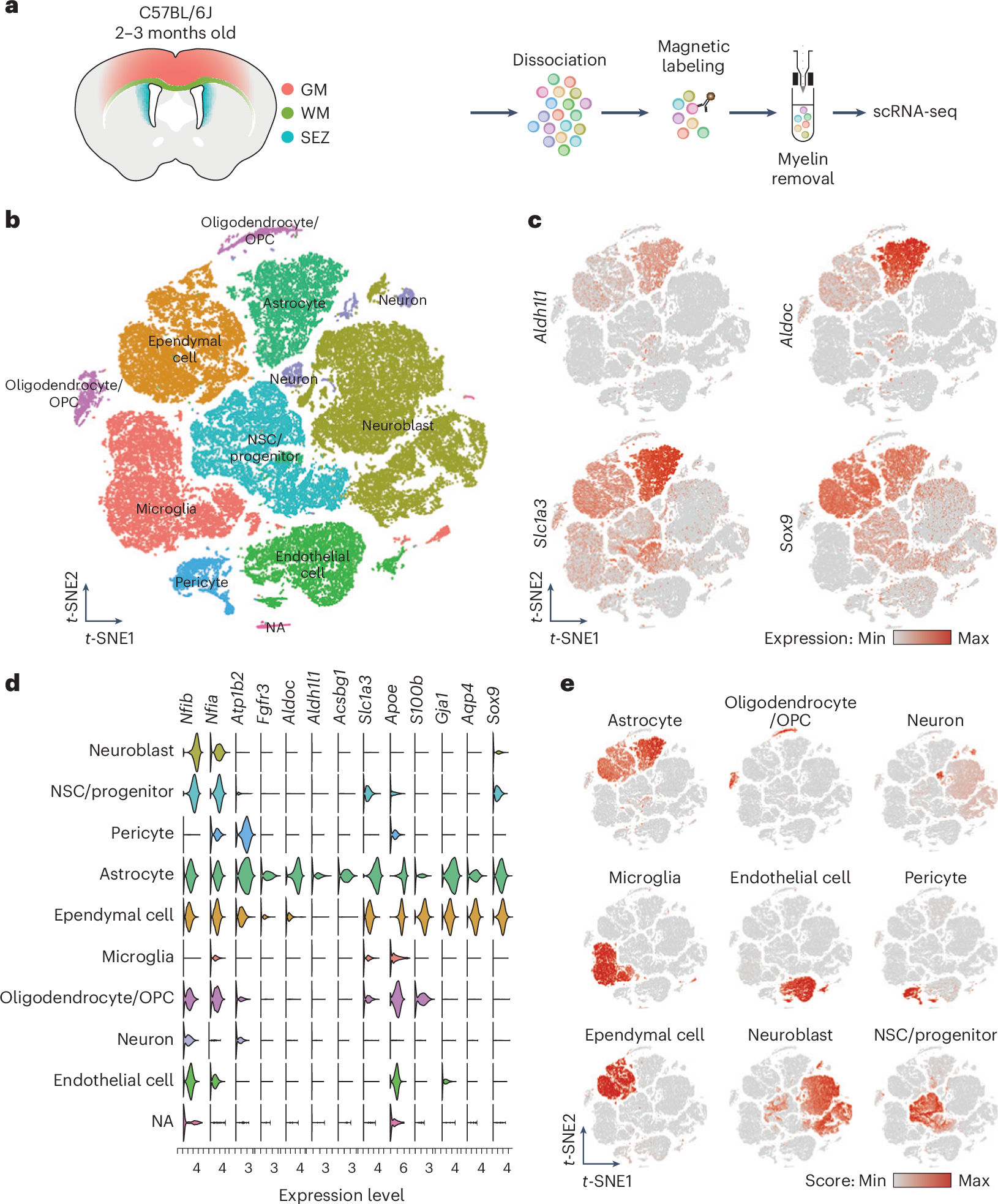
a, Schematic representation of the workflow used to dissect all three regions from 2–3-month-old C57BL/6J mice to generate the single-cell suspension for scRNA-seq. b, t-distributed stochastic neighbor embedding (t-SNE) visualization of scRNA-seq data from the three regions, with cells color-coded based on their cell types. c, t-SNE visualization showing expression levels (normalized) of common markers for astrocytes. d, Gene expression profiles obtained from scRNA-seq data, segregated according to the cell types identified in b and representing genes used to calculate the astrocyte score. e, Cell type scores used to annotate the scRNA-seq dataset in b.
Toward Therapeutic Applications
The discovery of proliferative astrocytes in the WM raises possibilities for regenerative medicine. By understanding the mechanisms that regulate astrocyte proliferation, researchers could develop new therapies for brain injuries and neurodegenerative diseases such as multiple sclerosis, where WM integrity is compromised.
“This study opens up exciting possibilities for regenerative medicine”, says Dr. Riccardo Bocchi, the first author of the study. “The discovery of proliferative astrocytes in the WM unveils exciting opportunities, particularly in conditions involving WM damage or degeneration.”
Source – Ludwig-Maximilians-Universität (LMU) München


Astrocytes, known for their crucial role in supporting neurons and maintaining brain health, have been predominantly studied in gray matter (GM), which is involved in information processing. However, white matter astrocytes, which support long-range neural connections, remain poorly understood. This study fills a major knowledge gap by showing that WM astrocytes are not a uniform population but consist of distinct subtypes with specialized roles. The team was led by Dr. Judith Fischer-Sternjak from Helmholtz Munich and Ludwig-Maximilians-Universität (LMU) München, alongside Prof. Magdalena Götz from Helmholtz Munich, LMU and the Munich Cluster for Systems Neurology (SyNergy).
A Potential Brain Repair Reservoir
The study identified two distinct types of cortical white matter astrocytes. One is more widely distributed throughout the brain and has been evolutionarily conserved, probably being involved in supporting nerve fibers, facilitating cell communication, and regulating metabolism. The other is a highly specialized subtype found primarily in the cortical white matter. This subtype has a remarkable ability to proliferate and is influenced by specific pathways involving interactions with other brain cells.
Notably, the researchers discovered that some of these proliferating astrocytes can migrate from the white matter into the gray matter. This suggests that certain white matter regions may serve as a hidden reservoir for generating new astrocytes, potentially contributing to brain maintenance.
Isolation of single cells from cortical GM, WM and the SEZ
a, Schematic representation of the workflow used to dissect all three regions from 2–3-month-old C57BL/6J mice to generate the single-cell suspension for scRNA-seq. b, t-distributed stochastic neighbor embedding (t-SNE) visualization of scRNA-seq data from the three regions, with cells color-coded based on their cell types. c, t-SNE visualization showing expression levels (normalized) of common markers for astrocytes. d, Gene expression profiles obtained from scRNA-seq data, segregated according to the cell types identified in b and representing genes used to calculate the astrocyte score. e, Cell type scores used to annotate the scRNA-seq dataset in b.
Toward Therapeutic Applications
The discovery of proliferative astrocytes in the WM raises possibilities for regenerative medicine. By understanding the mechanisms that regulate astrocyte proliferation, researchers could develop new therapies for brain injuries and neurodegenerative diseases such as multiple sclerosis, where WM integrity is compromised.
Source – Ludwig-Maximilians-Universität (LMU) München
Bocchi R, Thorwirth M, Simon-Ebert T, Koupourtidou C, Clavreul S, Kolf K, Della Vecchia P, Bottes S, Jessberger S, Zhou J, Wani G, Pilz GA, Ninkovic J, Buffo A, Sirko S, Götz M, Fischer-Sternjak J. (2025) Astrocyte heterogeneity reveals region-specific astrogenesis in the white matter. Nat Neurosci [Epub ahead of print]. [article]
Related Posts
Novel biosensor uses DNA ‘barcodes’ to uncover disease signals in cells
CellART extracts single-cell information from high-resolution spatial transcriptomics
Cell2space restores spatial context to single-cell RNA sequencing data
Urine test may improve bladder cancer diagnosis and guide treatment decisions
DeCoRE – a computational method to resolve RNA structural heterogeneity from RNA structure probing data by direct RNA sequencing
Tracing 700 million years of cell evolution
How should biological replicates be handled in long-read RNA sequencing?
RNA-Seq reveals a new way the developing heart controls its growth
The Human RNome Project Consortium seeks to publish first-ever complete sequence of the body’s RNA
scFlowReport brings multiple single-cell RNA sequencing analyses into one workflow
Long-read RNA sequencing reveals how neurons choose alternative RNA endings
DeOPUS improves cell-type estimates from bulk RNA sequencing
ResolVI improves accuracy in spatial transcriptomics analysis
RNA sequencing reveals transcriptional allele differences in prostate cancer stem cells
Unmasking “zombie cells” in aging tissue with an AI-powered barcode
RNA variant imaging for cancer diagnosis
Autism-risk mutations reveal two opposing patterns of brain gene activity
A real-data approach to evaluating RNA transcript analysis methods
Detection and sequencing of Ap2N-capped RNAs in human cells
Single-cell RNA sequencing provides a closer look at the Aedes aegypti midgut
Stay Connected
Submit a Post to the Blog
Recent Posts
Subscribe to the RNA-Seq Blog
RNA-Seq Products & Services