Sox9, a master regulator of cartilage formation, switches its target genes dynamically during embryonic limb development instead of following a fixed program, as reported by researchers from Science Tokyo. They analyzed mouse embryonic forelimb cells across different developmental stages using single-cell-level gene expression analysis and a state-of-the-art technique to detect Sox9’s DNA binding sites. The findings lay the foundation for future research on skeletal diseases and regenerative medicine.
In mammals, the development of limbs during early embryonic stages is a complex, carefully coordinated process that transforms simple groups of cells into the structures that make up arms and legs. The formation of cartilage is one of the earliest and most critical events during limb development, as cartilage serves as the structural template from which bones will eventually take shape. This process, known as chondrogenesis, depends on the precise activation of specific genetic programs within developing cells, regulated in large part by a protein called Sox9.
Scientists have known for decades that Sox9 is an indispensable master regulator of chondrogenesis. What has remained far less clear, however, is whether Sox9 follows a constant and uniform regulatory role throughout development or if it dynamically adapts, targeting different genes in different cell types and at different points in time. Understanding this distinction matters enormously, as it shapes how we interpret skeletal development and, ultimately, how we might address diseases when this process goes wrong.
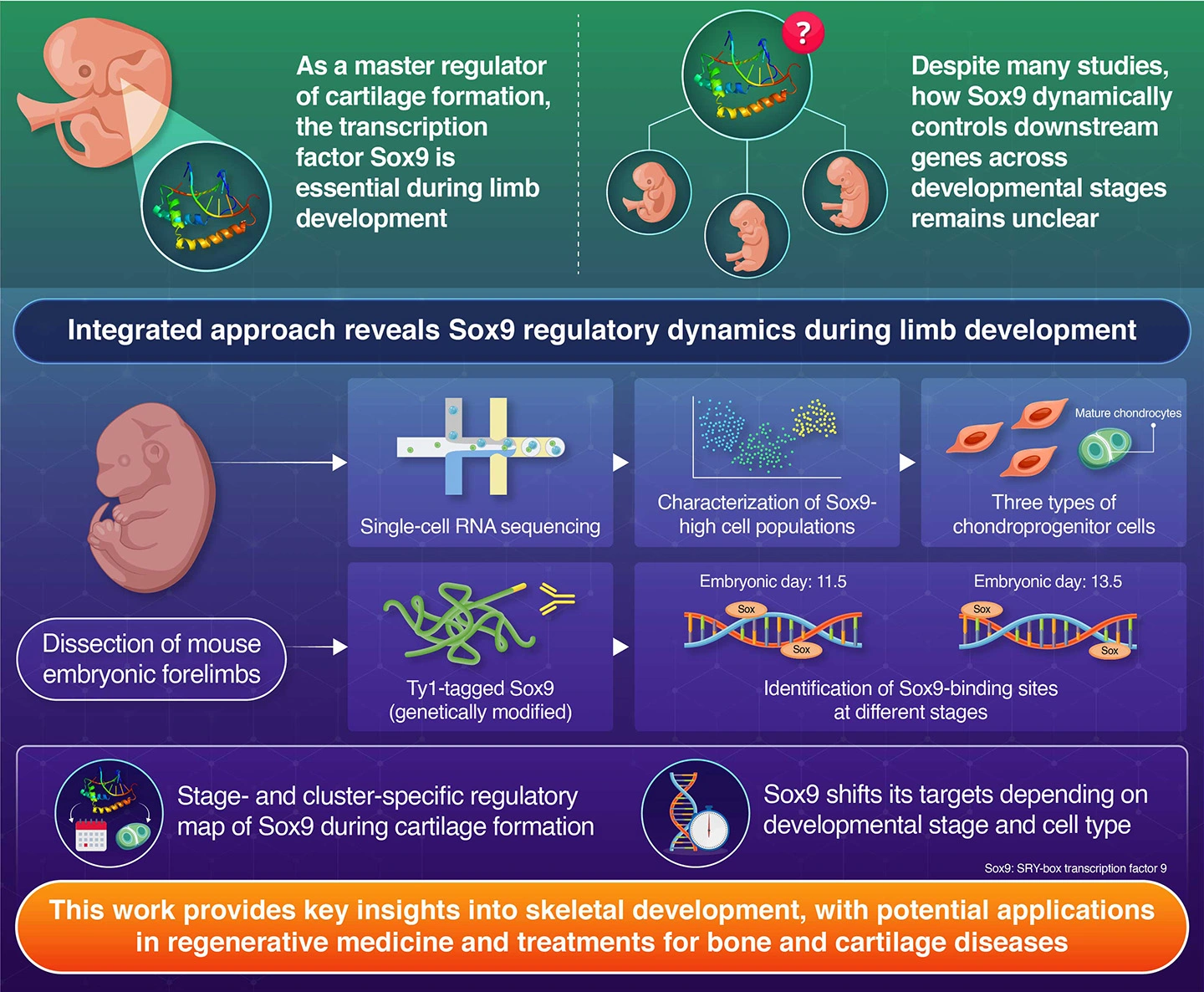
To tackle this question, a research team led by Assistant Professor Yutaro Uchida from Department of Systems BioMedicine, Graduate School of Medical and Dental Sciences, Institute of Science Tokyo (Science Tokyo), Japan, performed a detailed study on mouse embryonic limb development, focusing on Sox9. Their work, available online on February 18, 2026, and published in Volume 29, Issue 3 of the journal iScience on March 20, 2026, combined two powerful approaches. The first is single-cell RNA sequencing (scRNA-seq), which captures the activity of thousands of genes across individual cells. The second is CUT&RUN, a revolutionary technique that can map where a specific protein (Sox9, in this case) physically binds in the genome. To enable the latter, the team engineered a novel genetically modified mouse in which Sox9 carries a small molecular tag, allowing for highly precise mapping of its DNA binding sites from the limited tissue available in embryonic limbs.
After analyzing nearly 20,000 mouse embryonic forelimb cells across five developmental stages using scRNA-seq, the researchers found that Sox9-high cells fall into four distinct populations. These included three types of chondroprogenitor cells, each with a different molecular identity and spatial location in the limb, and mature chondrocytes, which are the specialized cells that form and maintain cartilage. Notably, trajectory analysis suggested that each progenitor type follows its own independent path toward mature cartilage, rather than all converging through a single route.
When the team mapped Sox9’s binding targets at two developmental timepoints and cross-referenced these with gene activity data, a striking pattern emerged. While Sox9 consistently regulated a core set of cartilage-matrix genes across all populations, its broader set of targets varied considerably.
“Our findings reveal that Sox9 does not operate through a single fixed program but instead exhibits flexible gene regulation by dynamically switching its targets depending on developmental timing and cell type,” explains Uchida.
These shifting targets included genes involved in cell division, limb patterning, signaling pathways, and tissue boundary formation, thus pointing to a far richer and more adaptive regulatory role for Sox9 than previously appreciated.
“This study provides an important foundation for understanding the mechanisms of skeletal development, and we expect it to contribute to future research on bone and cartilage diseases as well as applications in regenerative medicine,” remarks Uchida.
Source – Science Tokyo


Sox9, a master regulator of cartilage formation, switches its target genes dynamically during embryonic limb development instead of following a fixed program, as reported by researchers from Science Tokyo. They analyzed mouse embryonic forelimb cells across different developmental stages using single-cell-level gene expression analysis and a state-of-the-art technique to detect Sox9’s DNA binding sites. The findings lay the foundation for future research on skeletal diseases and regenerative medicine.
In mammals, the development of limbs during early embryonic stages is a complex, carefully coordinated process that transforms simple groups of cells into the structures that make up arms and legs. The formation of cartilage is one of the earliest and most critical events during limb development, as cartilage serves as the structural template from which bones will eventually take shape. This process, known as chondrogenesis, depends on the precise activation of specific genetic programs within developing cells, regulated in large part by a protein called Sox9.
Scientists have known for decades that Sox9 is an indispensable master regulator of chondrogenesis. What has remained far less clear, however, is whether Sox9 follows a constant and uniform regulatory role throughout development or if it dynamically adapts, targeting different genes in different cell types and at different points in time. Understanding this distinction matters enormously, as it shapes how we interpret skeletal development and, ultimately, how we might address diseases when this process goes wrong.
To tackle this question, a research team led by Assistant Professor Yutaro Uchida from Department of Systems BioMedicine, Graduate School of Medical and Dental Sciences, Institute of Science Tokyo (Science Tokyo), Japan, performed a detailed study on mouse embryonic limb development, focusing on Sox9. Their work, available online on February 18, 2026, and published in Volume 29, Issue 3 of the journal iScience on March 20, 2026, combined two powerful approaches. The first is single-cell RNA sequencing (scRNA-seq), which captures the activity of thousands of genes across individual cells. The second is CUT&RUN, a revolutionary technique that can map where a specific protein (Sox9, in this case) physically binds in the genome. To enable the latter, the team engineered a novel genetically modified mouse in which Sox9 carries a small molecular tag, allowing for highly precise mapping of its DNA binding sites from the limited tissue available in embryonic limbs.
After analyzing nearly 20,000 mouse embryonic forelimb cells across five developmental stages using scRNA-seq, the researchers found that Sox9-high cells fall into four distinct populations. These included three types of chondroprogenitor cells, each with a different molecular identity and spatial location in the limb, and mature chondrocytes, which are the specialized cells that form and maintain cartilage. Notably, trajectory analysis suggested that each progenitor type follows its own independent path toward mature cartilage, rather than all converging through a single route.
When the team mapped Sox9’s binding targets at two developmental timepoints and cross-referenced these with gene activity data, a striking pattern emerged. While Sox9 consistently regulated a core set of cartilage-matrix genes across all populations, its broader set of targets varied considerably.
These shifting targets included genes involved in cell division, limb patterning, signaling pathways, and tissue boundary formation, thus pointing to a far richer and more adaptive regulatory role for Sox9 than previously appreciated.
Source – Science Tokyo
Sega M, Uchida Y, Chiba T, Matsushima T, Kita K, Miyasaka N, Asahara H. (2026) Stage- and cluster-specific regulation of chondrogenic gene programs by Sox9 in mouse embryonic limb buds. iScience 29(3): 115074. [article]
Related Posts
RNAmel simplifies RNA sequencing data analysis with a reproducible, integrated platform
Heart failure reshapes bone marrow to create inflammation-related immune memory
Overlooked DNA regions surrounding ‘microexons’ hold missing pieces of autism’s genetic puzzle
RiboBA improves detection of hidden protein-coding regions using ribosome profiling
An anti-senescence gene may fight spinal disc deterioration
Scientists identify the neuroblastoma cells that signal poor outcomes
Novel biosensor uses DNA ‘barcodes’ to uncover disease signals in cells
CellART extracts single-cell information from high-resolution spatial transcriptomics
Cell2space restores spatial context to single-cell RNA sequencing data
Urine test may improve bladder cancer diagnosis and guide treatment decisions
DeCoRE – a computational method to resolve RNA structural heterogeneity from RNA structure probing data by direct RNA sequencing
Tracing 700 million years of cell evolution
How should biological replicates be handled in long-read RNA sequencing?
RNA-Seq reveals a new way the developing heart controls its growth
The Human RNome Project Consortium seeks to publish first-ever complete sequence of the body’s RNA
scFlowReport brings multiple single-cell RNA sequencing analyses into one workflow
Long-read RNA sequencing reveals how neurons choose alternative RNA endings
DeOPUS improves cell-type estimates from bulk RNA sequencing
ResolVI improves accuracy in spatial transcriptomics analysis
RNA sequencing reveals transcriptional allele differences in prostate cancer stem cells
Stay Connected
Submit a Post to the Blog
Recent Posts
Subscribe to the RNA-Seq Blog
RNA-Seq Products & Services