
A hallmark of Type 2 diabetes is the progressive loss of beta cell mass: cells in the pancreas that produce and release insulin. The endoplasmic reticulum stress response, a cellular pathway that maintains protein homeostasis, plays a critical role in beta cell function and survival, and the protein ATF6α is one of the key regulators of this stress response. However, the significance of ATF6α signaling in the stress-adaptive regulation of beta cell mass has remained unclear, prompting a team of researchers at Kyoto University to investigate.
“Our previous single-cell RNA-sequencing data suggested transient ATF6α upregulation during adaptive beta-cell proliferation, which sparked our interest in its potential role,” says first author Daisuke Otani.
The team generated mice lacking ATF6α, specifically in beta cells. They assessed beta cell mass, proliferation and apoptosis, or cell death, of the mice under chronic stress conditions, including high-fat diet and pregnancy. The team also performed complementary in vitro experiments using chronically stressed beta cell lines, and single-cell RNA sequencing using the high-fat diet model.
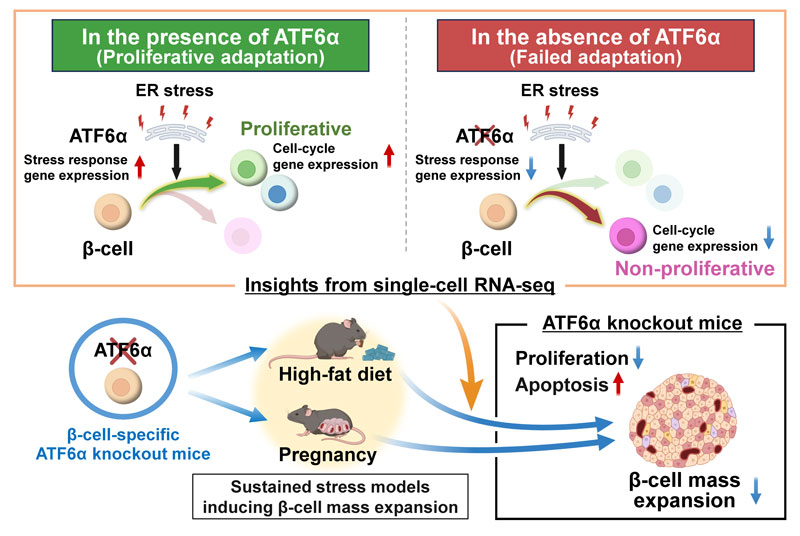
Schematic illustration of stress-adaptive β-cell mass expansion regulated by ATF6α. ATF6α coordinates both proliferation and survival under sustained stress conditions such as high-fat diet and pregnancy. (KyotoU / Daisuke Otani)
The results revealed that loss of ATF6α consistently reduced beta cell proliferation and increased apoptosis, leading to impaired beta cell mass expansion under sustained stress across in vivo and in vitro models. These findings demonstrate the role of ATF6α in enabling the survival and proliferation of beta cells under sustained stress, establishing the protein as a central regulator of stress-adaptive expansion of beta cell mass.
“We were particularly intrigued to find that ATF6α signaling was commonly required for both beta cell survival and proliferation in two distinct in vivo models, while having minimal effects under normal physiological conditions,” says Otani.
This study provides a novel insight into how endoplasmic reticulum stress-related pathways support pancreatic beta-cell adaptation by coordinating survival and proliferation under chronic stress.
The team next plans to explore the downstream pathways regulated by ATF6α and to evaluate the potential of targeting this pathway for therapeutic intervention. Whether these findings from mouse models can be recapitulated in human beta cell models will also be investigated.
“Our findings highlight the potential for developing new therapeutic strategies aimed at preserving and restoring beta cell mass in diabetes,” says the corresponding author Takaaki Murakami. ” We will further continue to elucidate this mechanism and advance efforts toward the development of innovative treatments with the ultimate goal of achieving a cure for diabetes.”
Source – Kyoto University


A hallmark of Type 2 diabetes is the progressive loss of beta cell mass: cells in the pancreas that produce and release insulin. The endoplasmic reticulum stress response, a cellular pathway that maintains protein homeostasis, plays a critical role in beta cell function and survival, and the protein ATF6α is one of the key regulators of this stress response. However, the significance of ATF6α signaling in the stress-adaptive regulation of beta cell mass has remained unclear, prompting a team of researchers at Kyoto University to investigate.
The team generated mice lacking ATF6α, specifically in beta cells. They assessed beta cell mass, proliferation and apoptosis, or cell death, of the mice under chronic stress conditions, including high-fat diet and pregnancy. The team also performed complementary in vitro experiments using chronically stressed beta cell lines, and single-cell RNA sequencing using the high-fat diet model.
Schematic illustration of stress-adaptive β-cell mass expansion regulated by ATF6α. ATF6α coordinates both proliferation and survival under sustained stress conditions such as high-fat diet and pregnancy. (KyotoU / Daisuke Otani)
The results revealed that loss of ATF6α consistently reduced beta cell proliferation and increased apoptosis, leading to impaired beta cell mass expansion under sustained stress across in vivo and in vitro models. These findings demonstrate the role of ATF6α in enabling the survival and proliferation of beta cells under sustained stress, establishing the protein as a central regulator of stress-adaptive expansion of beta cell mass.
This study provides a novel insight into how endoplasmic reticulum stress-related pathways support pancreatic beta-cell adaptation by coordinating survival and proliferation under chronic stress.
The team next plans to explore the downstream pathways regulated by ATF6α and to evaluate the potential of targeting this pathway for therapeutic intervention. Whether these findings from mouse models can be recapitulated in human beta cell models will also be investigated.
Source – Kyoto University
Otani D, Murakami T, Fauzi M, Botagarova A, Sekito S, Tatsuoka H, Tokumoto S, Usui R, Ogura M, Toyoda T, Murakawa Y, Yabe D, Inagaki N. (2026) Activating Transcription Factor 6α Governs Stress-Adaptive Pancreatic β-Cell Mass Expansion by Coordinating Proliferation and Survival. Diabetes [Epub ahead of print]. [article]
Related Posts
Novel biosensor uses DNA ‘barcodes’ to uncover disease signals in cells
CellART extracts single-cell information from high-resolution spatial transcriptomics
Cell2space restores spatial context to single-cell RNA sequencing data
Urine test may improve bladder cancer diagnosis and guide treatment decisions
DeCoRE – a computational method to resolve RNA structural heterogeneity from RNA structure probing data by direct RNA sequencing
Tracing 700 million years of cell evolution
How should biological replicates be handled in long-read RNA sequencing?
RNA-Seq reveals a new way the developing heart controls its growth
The Human RNome Project Consortium seeks to publish first-ever complete sequence of the body’s RNA
scFlowReport brings multiple single-cell RNA sequencing analyses into one workflow
Long-read RNA sequencing reveals how neurons choose alternative RNA endings
DeOPUS improves cell-type estimates from bulk RNA sequencing
ResolVI improves accuracy in spatial transcriptomics analysis
RNA sequencing reveals transcriptional allele differences in prostate cancer stem cells
Unmasking “zombie cells” in aging tissue with an AI-powered barcode
RNA variant imaging for cancer diagnosis
Autism-risk mutations reveal two opposing patterns of brain gene activity
A real-data approach to evaluating RNA transcript analysis methods
Detection and sequencing of Ap2N-capped RNAs in human cells
Single-cell RNA sequencing provides a closer look at the Aedes aegypti midgut
Stay Connected
Submit a Post to the Blog
Recent Posts
Subscribe to the RNA-Seq Blog
RNA-Seq Products & Services