

Messenger RNA (mRNA) carries genetic instructions from DNA to the cellular machinery responsible for producing proteins. Traditionally, scientists have understood that individual mRNA molecules are produced from a single gene, although RNA processing can generate different versions of the same transcript.
However, researchers have discovered that RNA molecules originating from separate genes can sometimes join together to create entirely new transcripts. This process, known as trans-splicing, produces chimeric mRNAs containing genetic information from different locations in the genome.
Researchers at the Department of Immunology at Harvard Medical School investigated whether these unusual RNA molecules produce functional proteins involved in immune responses. Their findings, published in Nature, demonstrate that chimeric mRNAs can influence inflammation and the body’s ability to fight infections.
Identifying chimeric RNA using long-read RNA sequencing
Most mRNA molecules are processed through cis-splicing, in which sections of RNA produced from the same gene are joined together. Trans-splicing differs because it combines RNA segments originating from separate genes, sometimes located on different chromosomes.
To investigate these events, the researchers developed a computational and experimental approach combining long-read direct RNA sequencing with additional validation methods.
Inflammation drives chRNA expression
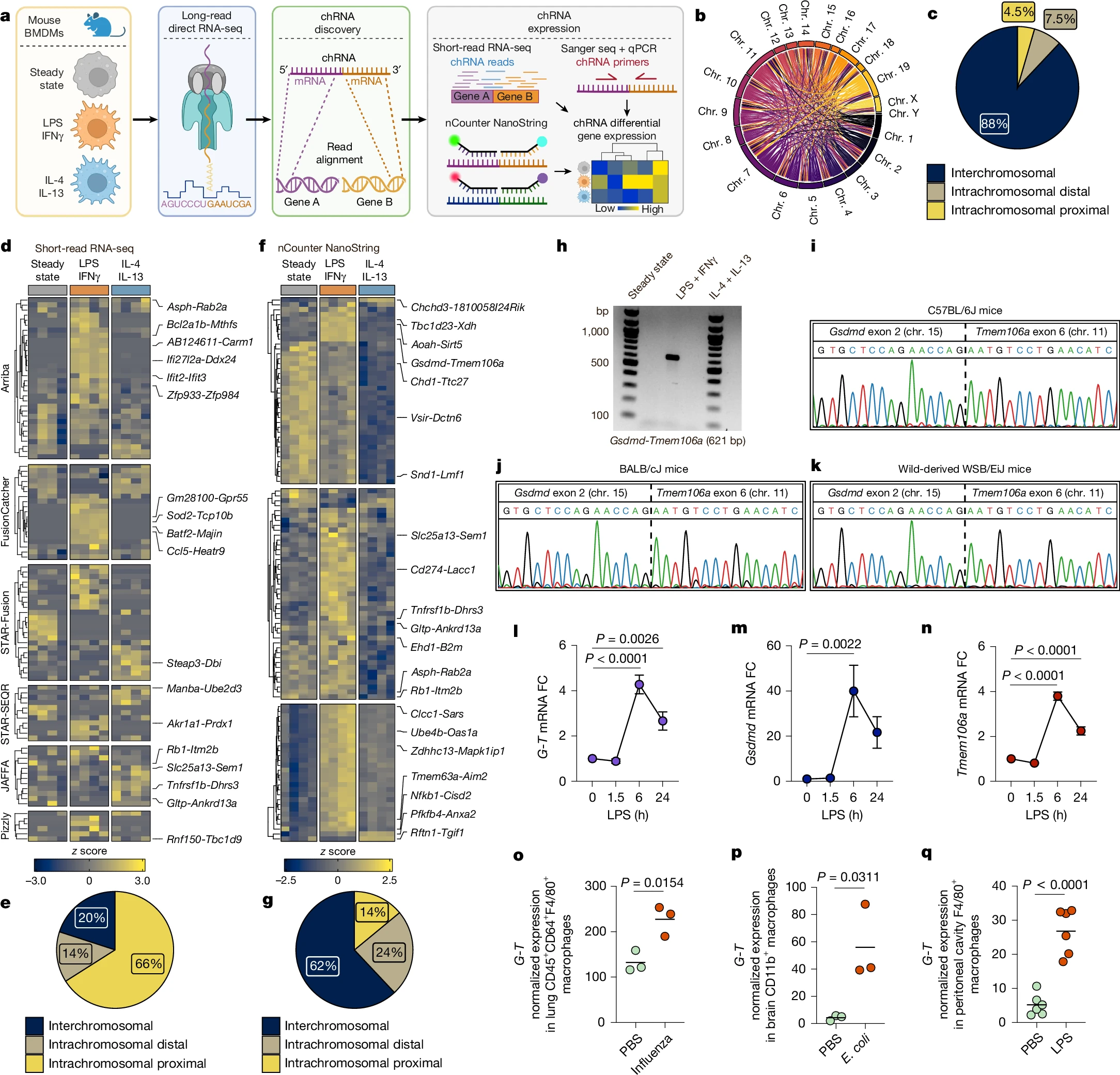
a, Schematic of chRNA identification and differential expression analysis in mouse BMDMs. b, The chromosomal distribution of 30,390 exon–exon chRNAs detected for downstream analysis. c, Classes of chRNA species identified using long-read RNA-seq. d, Scaled normalized short-read fusion fragments per million (FFPM)-like values for chRNAs co-detected in long-read and short-read RNA-seq data in BMDMs stimulated as indicated for 24 h. Selected chRNAs are highlighted. e, Classes of chRNA species co-detected in long-read and short-read RNA-seq. f, Scaled normalized counts for chRNAs using NanoString nCounter analysis in BMDMs stimulated as indicated for 24 h. Selected chRNAs are highlighted. g, Classes of chRNA species co-detected using NanoString nCounter and long-read RNA-seq. h, PCR analysis of Gsdmd-Tmem106a (G-T) cDNA expression in BMDMs. The gel image is representative of three independent experiments. i, Chromatogram of the Gsdmd-Tmem106a junction in cDNA from C57BL/6J BMDMs. For i–k, the dotted line denotes the division between Gsdmd- and Tmem106a-derived sequences. j,k, Chromatograms of the Gsdmd-Tmem106a junction in cDNA from BMDMs from BALB/cJ (j) and WSB/EiJ (k) mice. l–n, BMDMs were treated as indicated and the gene expression of Gsdmd-Tmem106a (l), Gsdmd (m) and Tmem106a (n) was analysed using RT–qPCR. Gene expression normalized to Polr2a fold change (FC) over steady state is depicted. Data are mean ± s.e.m. n = 5 biological replicates. o–q, RNA extracted from macrophages after infection or mock infection for NanoString nCounter analysis. The mean of normalized counts is shown. The line represents the mean; each datapoint represents a biologically independent animal. o, Mice were treated intranasally with influenza A virus or PBS (7 days) and CD45+F4/80+CD64+ cells were isolated from the lungs. p, Mice were infected intracisternally with E. coli or PBS (18 h) and CD11b+ cells were isolated from the brain. q, Mice were treated intraperitoneally with LPS or PBS (16 h) and F4/80+ cells were isolated from peritoneal lavage. P values were determined using one-way analysis of variance (ANOVA) (l–n) and unpaired Student’s two-tailed t-tests (o–q).
Unlike conventional short-read RNA sequencing, long-read sequencing can examine much longer RNA molecules, making it particularly useful for identifying unusual transcripts that contain sequences from multiple genes.
Using this approach, the researchers identified chimeric RNAs in macrophages, immune cells that help detect pathogens and coordinate inflammatory responses.
They also discovered that inflammation can bring distant regions of DNA closer together within the cell nucleus, potentially allowing RNA transcripts from different chromosomes to combine more easily.
A newly identified protein regulates inflammation
One particularly important discovery involved a chimeric mRNA formed from two genes, Gsdmd and Tmem106a, in mice.
The resulting transcript produces a previously unrecognized protein called GSDMD-TMEM106A.
Gasdermin D, the protein normally produced by Gsdmd, helps immune cells respond to infections by forming pores in their membranes. These pores allow inflammatory signaling molecules, including interleukin-1 beta (IL-1β), to be released.
The researchers found that GSDMD-TMEM106A interacts with conventional gasdermin D protein fragments, accelerating pore formation and increasing inflammatory signaling.
This demonstrated that chimeric mRNAs are not necessarily accidental products of RNA processing. Some can encode functional proteins that directly influence cellular behavior.
Balancing infection protection and harmful inflammation
To investigate the biological importance of GSDMD-TMEM106A, the researchers examined mice in which production of the chimeric protein was disrupted or increased.
Mice lacking the protein showed reduced inflammatory responses and greater protection against lethal sepsis, a dangerous condition involving an uncontrolled response to infection. However, these animals also had a reduced ability to defend against bacterial infections.
Conversely, increasing GSDMD-TMEM106A production improved antibacterial protection but also increased the severity of inflammatory damage during sepsis.
These findings suggest that the chimeric protein helps regulate the balance between protective immunity and excessive inflammation.
Expanding our understanding of RNA function
The discovery provides new evidence that RNA processing can generate functional proteins from combinations of genes that were previously considered separate.
By combining long-read RNA sequencing with molecular and functional experiments, the researchers identified an unexpected mechanism that regulates immune responses.
The findings also highlight the importance of examining full-length RNA transcripts rather than relying exclusively on conventional gene annotations.
Although additional research is needed to determine how widespread these mechanisms are in humans, understanding chimeric mRNA formation could provide new insights into inflammation, infection and immune-related diseases.
Venezia O, Kane H, Du G, Coughlan HD, Johanson TM, Wang H, Tilstam P, Kazer SW, Gunner G, Hoagland DA, Basavappa MG, Ravichandran K, Ada E, Zhakyp A, Kumar S, Duizer C, Searle O, Provido CG, Joannas L, Yang S, Healy LB, Wang Q, Capocchi J, Dhillon BS, Slavoff S, Shan L, Henao-Mejia J, Franklin RA, Chiu IM, Ordovas-Montanes J, Jeffrey KL, Lieberman J, Allan RS, Kagan JC, Wu H, Jackson R. (2026) Functional chimeric mRNAs encode proteins in mammalian immunity. Nature 658: 1015–1024. [article]
Related Posts


Messenger RNA (mRNA) carries genetic instructions from DNA to the cellular machinery responsible for producing proteins. Traditionally, scientists have understood that individual mRNA molecules are produced from a single gene, although RNA processing can generate different versions of the same transcript.
However, researchers have discovered that RNA molecules originating from separate genes can sometimes join together to create entirely new transcripts. This process, known as trans-splicing, produces chimeric mRNAs containing genetic information from different locations in the genome.
Researchers at the Department of Immunology at Harvard Medical School investigated whether these unusual RNA molecules produce functional proteins involved in immune responses. Their findings, published in Nature, demonstrate that chimeric mRNAs can influence inflammation and the body’s ability to fight infections.
Identifying chimeric RNA using long-read RNA sequencing
Most mRNA molecules are processed through cis-splicing, in which sections of RNA produced from the same gene are joined together. Trans-splicing differs because it combines RNA segments originating from separate genes, sometimes located on different chromosomes.
To investigate these events, the researchers developed a computational and experimental approach combining long-read direct RNA sequencing with additional validation methods.
Inflammation drives chRNA expression
a, Schematic of chRNA identification and differential expression analysis in mouse BMDMs. b, The chromosomal distribution of 30,390 exon–exon chRNAs detected for downstream analysis. c, Classes of chRNA species identified using long-read RNA-seq. d, Scaled normalized short-read fusion fragments per million (FFPM)-like values for chRNAs co-detected in long-read and short-read RNA-seq data in BMDMs stimulated as indicated for 24 h. Selected chRNAs are highlighted. e, Classes of chRNA species co-detected in long-read and short-read RNA-seq. f, Scaled normalized counts for chRNAs using NanoString nCounter analysis in BMDMs stimulated as indicated for 24 h. Selected chRNAs are highlighted. g, Classes of chRNA species co-detected using NanoString nCounter and long-read RNA-seq. h, PCR analysis of Gsdmd-Tmem106a (G-T) cDNA expression in BMDMs. The gel image is representative of three independent experiments. i, Chromatogram of the Gsdmd-Tmem106a junction in cDNA from C57BL/6J BMDMs. For i–k, the dotted line denotes the division between Gsdmd- and Tmem106a-derived sequences. j,k, Chromatograms of the Gsdmd-Tmem106a junction in cDNA from BMDMs from BALB/cJ (j) and WSB/EiJ (k) mice. l–n, BMDMs were treated as indicated and the gene expression of Gsdmd-Tmem106a (l), Gsdmd (m) and Tmem106a (n) was analysed using RT–qPCR. Gene expression normalized to Polr2a fold change (FC) over steady state is depicted. Data are mean ± s.e.m. n = 5 biological replicates. o–q, RNA extracted from macrophages after infection or mock infection for NanoString nCounter analysis. The mean of normalized counts is shown. The line represents the mean; each datapoint represents a biologically independent animal. o, Mice were treated intranasally with influenza A virus or PBS (7 days) and CD45+F4/80+CD64+ cells were isolated from the lungs. p, Mice were infected intracisternally with E. coli or PBS (18 h) and CD11b+ cells were isolated from the brain. q, Mice were treated intraperitoneally with LPS or PBS (16 h) and F4/80+ cells were isolated from peritoneal lavage. P values were determined using one-way analysis of variance (ANOVA) (l–n) and unpaired Student’s two-tailed t-tests (o–q).
Unlike conventional short-read RNA sequencing, long-read sequencing can examine much longer RNA molecules, making it particularly useful for identifying unusual transcripts that contain sequences from multiple genes.
Using this approach, the researchers identified chimeric RNAs in macrophages, immune cells that help detect pathogens and coordinate inflammatory responses.
They also discovered that inflammation can bring distant regions of DNA closer together within the cell nucleus, potentially allowing RNA transcripts from different chromosomes to combine more easily.
A newly identified protein regulates inflammation
One particularly important discovery involved a chimeric mRNA formed from two genes, Gsdmd and Tmem106a, in mice.
The resulting transcript produces a previously unrecognized protein called GSDMD-TMEM106A.
Gasdermin D, the protein normally produced by Gsdmd, helps immune cells respond to infections by forming pores in their membranes. These pores allow inflammatory signaling molecules, including interleukin-1 beta (IL-1β), to be released.
The researchers found that GSDMD-TMEM106A interacts with conventional gasdermin D protein fragments, accelerating pore formation and increasing inflammatory signaling.
This demonstrated that chimeric mRNAs are not necessarily accidental products of RNA processing. Some can encode functional proteins that directly influence cellular behavior.
Balancing infection protection and harmful inflammation
To investigate the biological importance of GSDMD-TMEM106A, the researchers examined mice in which production of the chimeric protein was disrupted or increased.
Mice lacking the protein showed reduced inflammatory responses and greater protection against lethal sepsis, a dangerous condition involving an uncontrolled response to infection. However, these animals also had a reduced ability to defend against bacterial infections.
Conversely, increasing GSDMD-TMEM106A production improved antibacterial protection but also increased the severity of inflammatory damage during sepsis.
These findings suggest that the chimeric protein helps regulate the balance between protective immunity and excessive inflammation.
Expanding our understanding of RNA function
The discovery provides new evidence that RNA processing can generate functional proteins from combinations of genes that were previously considered separate.
By combining long-read RNA sequencing with molecular and functional experiments, the researchers identified an unexpected mechanism that regulates immune responses.
The findings also highlight the importance of examining full-length RNA transcripts rather than relying exclusively on conventional gene annotations.
Although additional research is needed to determine how widespread these mechanisms are in humans, understanding chimeric mRNA formation could provide new insights into inflammation, infection and immune-related diseases.
Venezia O, Kane H, Du G, Coughlan HD, Johanson TM, Wang H, Tilstam P, Kazer SW, Gunner G, Hoagland DA, Basavappa MG, Ravichandran K, Ada E, Zhakyp A, Kumar S, Duizer C, Searle O, Provido CG, Joannas L, Yang S, Healy LB, Wang Q, Capocchi J, Dhillon BS, Slavoff S, Shan L, Henao-Mejia J, Franklin RA, Chiu IM, Ordovas-Montanes J, Jeffrey KL, Lieberman J, Allan RS, Kagan JC, Wu H, Jackson R. (2026) Functional chimeric mRNAs encode proteins in mammalian immunity. Nature 658: 1015–1024. [article]
Related Posts
Recent Posts
 PANGEA – an integrated cell atlas across diverse biological contexts enables systematic profiling of multicellular responses in human diseases
 UMIche – a UMI-centric analysis platform for enhancing molecular quantification accuracy in bulk and single-cell sequencing
 New AI tool uses RNA sequencing to uncover gene interactions in Alzheimer’s disease
 New RNA sequencing tool reveals how stem cells develop into heart cells
 Estimating the completeness of large-scale single-cell sequencing projects
 New RNA sequencing tool improves transcriptome reconstruction using machine learning
RNA-Seq Products & Services



Stay Connected