Researchers discover how muscle stem cells shift the role of macrophages, normally responsible for immune function, to promote regeneration of tadpole tails.
Researchers Sumika Kato, Takeo Kubo, and Taro Fukazawa of the University of Tokyo have discovered that c1qtnf3, a secreting factor, namely a protein molecule that is secreted by a cell and influence functions of other cells, is expressed in putative muscle stem cells and shifts macrophages from immune to regenerative functions in the regenerating tails of tadpoles. The discovery offers a crucial insight into the regenerative capabilities of certain animals and paves the way for further research into potential applications in mammals. The findings are published in the Proceedings of the National Academy of Sciences of the United States of America (PNAS).

An African clawed frog tadpole, the subject of the study
While regeneration is a superpower that would be useful to any living creature, it is possessed by only a special few. Such is the African clawed frog, Xenopus laevis, the tadpoles of which can regrow fully functioning tails with a spinal cord and muscles. For this to happen, stem cells, cells that have the potential to become a specific tissue, need to jump into action. However, studying these early steps of the regenerative process has been challenging because stem cells are present only in small numbers, making it difficult to observe them.
“We have previously established a method for efficiently enriching tissue stem cells,” says Fukazawa. “Building on this technique, we planned to clarify the behavior of tissue stem cells during tail regeneration by examining genes specifically expressed in the tissue stem cells.”
So, the researchers performed single cell RNA-sequencing to determine which genes were actively expressed in each cell. Through this process, they identified various cell types and chose to focus on putative muscle stem cells. They found that these putative muscle stem cells expressed the complement c1q tumor necrosis factor-related protein 3 (c1qtnf3) more than other cell types. To understand the function of the gene in the regeneration process, the researchers performed “knockdown” experiments in which they blocked the gene to infer its function.
“The knockdown of c1qtnf3 resulted in impaired tail regeneration,” explains Kato, “indicating that the function of c1qtnf3 is essential for successful tail regeneration. We also found that the number of macrophages at the tail stump was reduced in the knocked-down tadpoles, suggesting that macrophage function may be impaired.”
This finding led to the hypothesis that macrophages played a role in regeneration facilitated by muscle stem cells via c1qtnf3, but more evidence was needed. The researchers then “restarted” macrophages using another gene and molecular route; neutrophil cytosolic factor 1, a gene involved in macrophage function.
“When I found that forced expression of the gene, and consequently rising macrophage numbers, rescued tail regeneration in tadpoles,” says Kato, “it felt like the dots connected.”
Thus, the proposed mechanism of tadpole tail regeneration is as follows: putative muscle stem cells secrete a factor called C1qtnf3, which leads to the accumulation of macrophages in the tail stub, promoting tail regeneration. In the future, the researchers aim to uncover how macrophages promote regeneration under the influence of c1qtnf3 and the precise cellular and molecular mechanisms at work within regenerating tissues.
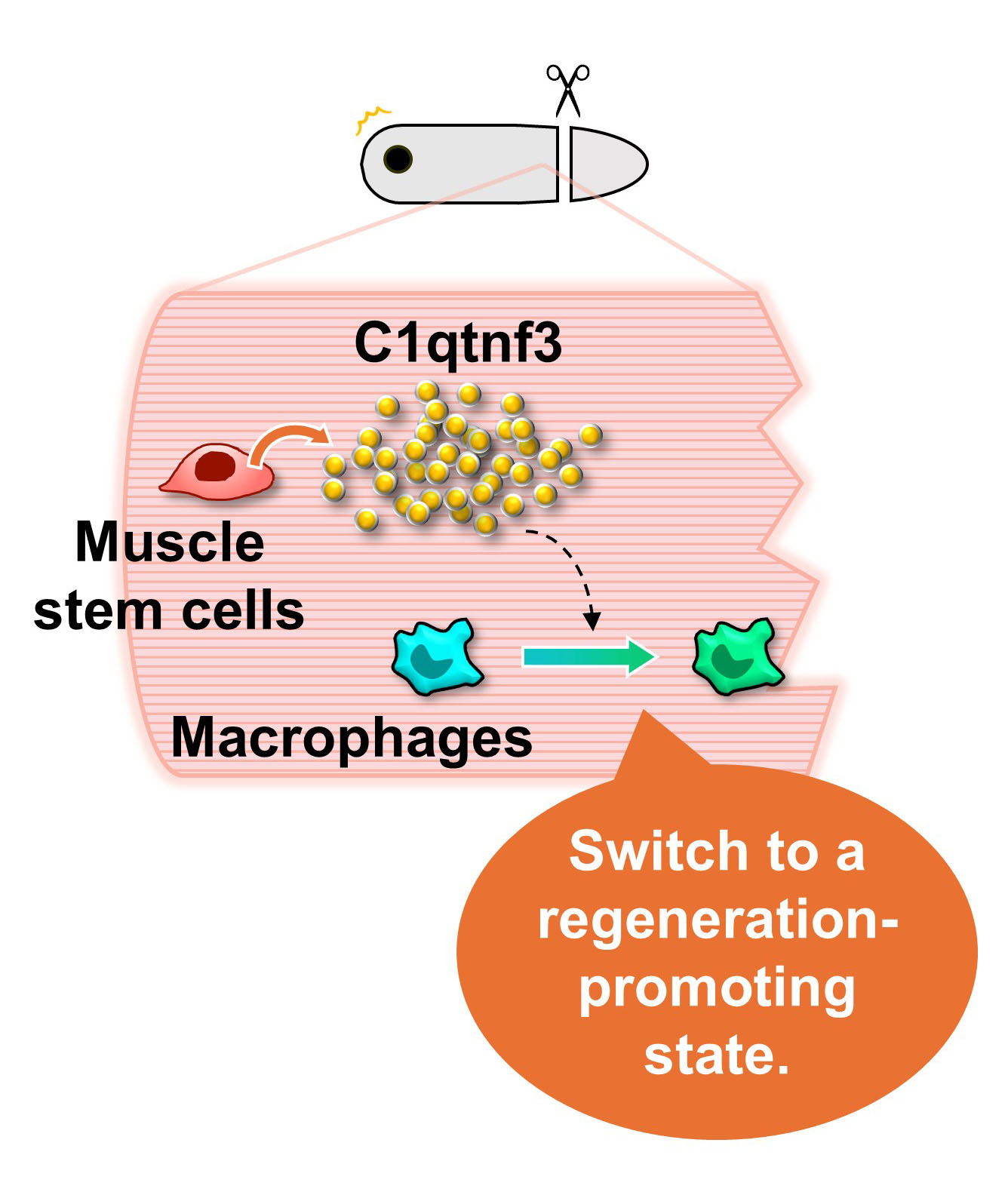
Summary of tail regeneration in African clawed frog tadpoles


Researchers discover how muscle stem cells shift the role of macrophages, normally responsible for immune function, to promote regeneration of tadpole tails.
Researchers Sumika Kato, Takeo Kubo, and Taro Fukazawa of the University of Tokyo have discovered that c1qtnf3, a secreting factor, namely a protein molecule that is secreted by a cell and influence functions of other cells, is expressed in putative muscle stem cells and shifts macrophages from immune to regenerative functions in the regenerating tails of tadpoles. The discovery offers a crucial insight into the regenerative capabilities of certain animals and paves the way for further research into potential applications in mammals. The findings are published in the Proceedings of the National Academy of Sciences of the United States of America (PNAS).
An African clawed frog tadpole, the subject of the study
While regeneration is a superpower that would be useful to any living creature, it is possessed by only a special few. Such is the African clawed frog, Xenopus laevis, the tadpoles of which can regrow fully functioning tails with a spinal cord and muscles. For this to happen, stem cells, cells that have the potential to become a specific tissue, need to jump into action. However, studying these early steps of the regenerative process has been challenging because stem cells are present only in small numbers, making it difficult to observe them.
So, the researchers performed single cell RNA-sequencing to determine which genes were actively expressed in each cell. Through this process, they identified various cell types and chose to focus on putative muscle stem cells. They found that these putative muscle stem cells expressed the complement c1q tumor necrosis factor-related protein 3 (c1qtnf3) more than other cell types. To understand the function of the gene in the regeneration process, the researchers performed “knockdown” experiments in which they blocked the gene to infer its function.
This finding led to the hypothesis that macrophages played a role in regeneration facilitated by muscle stem cells via c1qtnf3, but more evidence was needed. The researchers then “restarted” macrophages using another gene and molecular route; neutrophil cytosolic factor 1, a gene involved in macrophage function.
Thus, the proposed mechanism of tadpole tail regeneration is as follows: putative muscle stem cells secrete a factor called C1qtnf3, which leads to the accumulation of macrophages in the tail stub, promoting tail regeneration. In the future, the researchers aim to uncover how macrophages promote regeneration under the influence of c1qtnf3 and the precise cellular and molecular mechanisms at work within regenerating tissues.
Summary of tail regeneration in African clawed frog tadpoles
Kato S, Kubo T, Fukazawa T. (2025) Putative muscle stem cells promote Xenopus tail regeneration by modifying macrophage function via c1qtnf3. Proceedings of the National Academy of Sciences [Online ahead of print]. [https://www.pnas.org/]
Related Posts
RNAmel simplifies RNA sequencing data analysis with a reproducible, integrated platform
Heart failure reshapes bone marrow to create inflammation-related immune memory
Overlooked DNA regions surrounding ‘microexons’ hold missing pieces of autism’s genetic puzzle
RiboBA improves detection of hidden protein-coding regions using ribosome profiling
An anti-senescence gene may fight spinal disc deterioration
Scientists identify the neuroblastoma cells that signal poor outcomes
Novel biosensor uses DNA ‘barcodes’ to uncover disease signals in cells
CellART extracts single-cell information from high-resolution spatial transcriptomics
Cell2space restores spatial context to single-cell RNA sequencing data
Urine test may improve bladder cancer diagnosis and guide treatment decisions
DeCoRE – a computational method to resolve RNA structural heterogeneity from RNA structure probing data by direct RNA sequencing
Tracing 700 million years of cell evolution
How should biological replicates be handled in long-read RNA sequencing?
RNA-Seq reveals a new way the developing heart controls its growth
The Human RNome Project Consortium seeks to publish first-ever complete sequence of the body’s RNA
scFlowReport brings multiple single-cell RNA sequencing analyses into one workflow
Long-read RNA sequencing reveals how neurons choose alternative RNA endings
DeOPUS improves cell-type estimates from bulk RNA sequencing
ResolVI improves accuracy in spatial transcriptomics analysis
RNA sequencing reveals transcriptional allele differences in prostate cancer stem cells
Stay Connected
Submit a Post to the Blog
Recent Posts
Subscribe to the RNA-Seq Blog
RNA-Seq Products & Services