A team led by researchers at the University of Tennessee, Knoxville, and University of Maryland shows viral infection of blue-green algae in the ocean stimulates productivity in the ecosystem and contributes to a rich band of oxygen in the water.
“It is really a microbial planet we live on, and viruses are part of that process,” said Steven Wilhelm, the Kenneth and Blaire Mossman Professor in UT’s Department of Microbiology and one of the study’s senior authors. “Sometimes their activity is as much about stimulating growth and production as it is about sickness and disease.”
Wilhelm served as chief scientist on the National Science Foundation research cruise to the Sargasso Sea that led to the paper published in Nature Communications.In addition to four UT faculty members and three students, the team included collaborations with the Georgia Institute of Technology, Ohio State University, Technion Institute of Technology in Israel, and the University of Maryland.
Traveling on the research vessel Atlantic Explorer in October 2019, they completed around-the-clock RNA sequencing surveys of the microbiology at the Bermuda Atlantic Time-series Study, which for nearly four decades has collected physical, biological, and chemical data on the ocean.
The new study shows how virus infection of a cyanobacteria, Prochlorococcus, releases nutrients that fuel microbial growth, contributing to enhanced oxygen levels tens of meters below the surface.
The SOM resembles the upper mixed layer, with key differences in taxonomic composition
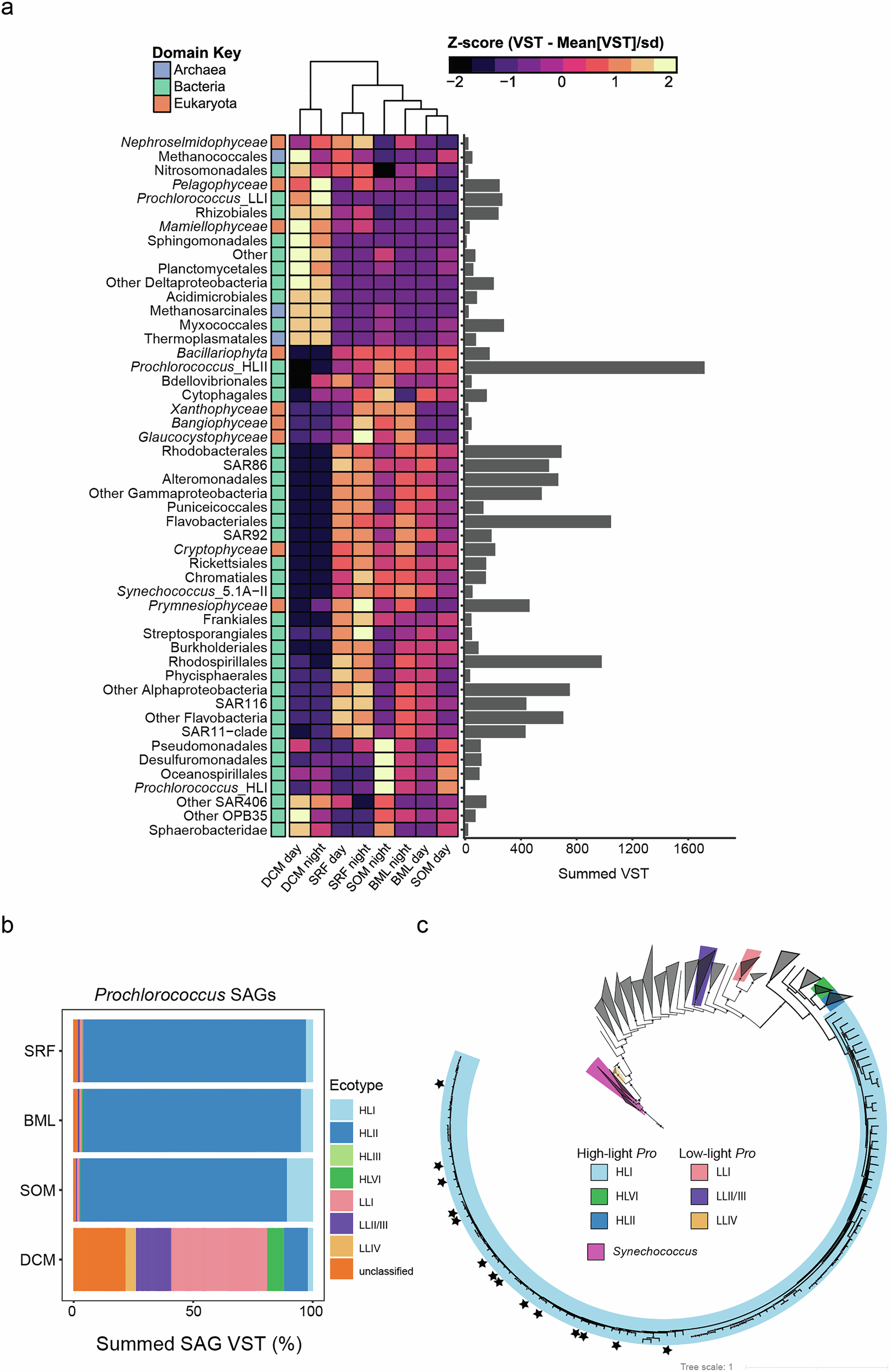
a Hierarchically clustered heatmap of rpoB/RPB1 normalized transcripts (variance stabilizing transformation, VST) averaged across depth/time collected (day = 8 am, night = 8 pm) and standardized by row (Z-score, ([Observed VST – Mean VST]/standard deviation). VST values are summed across order-level taxonomy for prokaryotes, except for Prochlorococcus and Synechococcus, which are summed to the ecotype-level. VST values are summed across class-level taxonomy for eukaryotes. Each row is color-coded by domain-level taxonomic information. The bar plot to the left shows the total VST for each row across all samples. b Stacked bar plot showing the distribution of transcripts assigned to single-celled amplified genomes (SAGS) from different Prochlorococcus ecotypes across depth. c Maximum Likelihood phylogeny of cyanobacterial genomes. Prochlorococcus ecotypes and Synechococcus genomes detected in the metatranscriptomes are color coded. Stars indicate SAGs that had significantly (BH-adjusted p ≤ 0.1) highest rpoB transcript abundances at the SOM. Because these all fell into the HLI clade, the other clades are collapsed for visual purposes. SAGs and cyanobacterial genomes are from Berube et al.. Depth layers sampled are surface, defined as 5 m (SRF), base of mixed layer (BML) defined by a change in potential density of 0.125 kg/m3 from a reference pressure of 10 db, the subsurface oxygen maximum (SOM) depth, and the deep chlorophyll maximum (DCM).
“The observations suggest this meters-wide ribbon of oxygenated water that exists 50 meters below the surface for several months per year is at least in part driven by the virus activity,” Wilhelm said.
The paper shows a direct link between two major tenets of oceanographic processes, the “viral shunt,” which Wilhelm and Curtis Suttle (University of British Columbia) first described in 1999, and the microbial loop in the ocean’s food web.
“By analyzing large-scale data on cellular and viral activity over day-night cycles, including the infection status and abundances of viruses that infect cyanobacteria, we are able to identify the imprint of viral infections at system-scales,” said biology Professor Joshua S. Weitz from the University of Maryland. “Viral infection appears to enhance the recycling of carbon and nutrients by other microbes, driving productivity and shedding new light on historical trends that indicate a link between viral activity and ecosystem functioning below the surface.”
Researchers completed the RNA sequencing and additional analyses at UT.
Source – University of Tennessee at Knoxville


A team led by researchers at the University of Tennessee, Knoxville, and University of Maryland shows viral infection of blue-green algae in the ocean stimulates productivity in the ecosystem and contributes to a rich band of oxygen in the water.
Wilhelm served as chief scientist on the National Science Foundation research cruise to the Sargasso Sea that led to the paper published in Nature Communications.In addition to four UT faculty members and three students, the team included collaborations with the Georgia Institute of Technology, Ohio State University, Technion Institute of Technology in Israel, and the University of Maryland.
Traveling on the research vessel Atlantic Explorer in October 2019, they completed around-the-clock RNA sequencing surveys of the microbiology at the Bermuda Atlantic Time-series Study, which for nearly four decades has collected physical, biological, and chemical data on the ocean.
The new study shows how virus infection of a cyanobacteria, Prochlorococcus, releases nutrients that fuel microbial growth, contributing to enhanced oxygen levels tens of meters below the surface.
The SOM resembles the upper mixed layer, with key differences in taxonomic composition
a Hierarchically clustered heatmap of rpoB/RPB1 normalized transcripts (variance stabilizing transformation, VST) averaged across depth/time collected (day = 8 am, night = 8 pm) and standardized by row (Z-score, ([Observed VST – Mean VST]/standard deviation). VST values are summed across order-level taxonomy for prokaryotes, except for Prochlorococcus and Synechococcus, which are summed to the ecotype-level. VST values are summed across class-level taxonomy for eukaryotes. Each row is color-coded by domain-level taxonomic information. The bar plot to the left shows the total VST for each row across all samples. b Stacked bar plot showing the distribution of transcripts assigned to single-celled amplified genomes (SAGS) from different Prochlorococcus ecotypes across depth. c Maximum Likelihood phylogeny of cyanobacterial genomes. Prochlorococcus ecotypes and Synechococcus genomes detected in the metatranscriptomes are color coded. Stars indicate SAGs that had significantly (BH-adjusted p ≤ 0.1) highest rpoB transcript abundances at the SOM. Because these all fell into the HLI clade, the other clades are collapsed for visual purposes. SAGs and cyanobacterial genomes are from Berube et al.. Depth layers sampled are surface, defined as 5 m (SRF), base of mixed layer (BML) defined by a change in potential density of 0.125 kg/m3 from a reference pressure of 10 db, the subsurface oxygen maximum (SOM) depth, and the deep chlorophyll maximum (DCM).
The paper shows a direct link between two major tenets of oceanographic processes, the “viral shunt,” which Wilhelm and Curtis Suttle (University of British Columbia) first described in 1999, and the microbial loop in the ocean’s food web.
Researchers completed the RNA sequencing and additional analyses at UT.
Source – University of Tennessee at Knoxville
Gilbert N E, Muratore D, Gochev C S, LeCleir G R, Cagle S M, Pound H L, Sun C L, Carrillo A, Ndlovu K S, Maidanik I, Coenen A R, Chittick L, DeBruyn J M, Buchan A, Lindell D, Sullivan M B, Weitz J S, Wilhelm S W. (2025) Seasonal enhancement of the viral shunt catalyzes a subsurface oxygen maximum in the Sargasso Sea. Nature Communications 17(1): 352. [article]
Related Posts
RNAmel simplifies RNA sequencing data analysis with a reproducible, integrated platform
Heart failure reshapes bone marrow to create inflammation-related immune memory
Overlooked DNA regions surrounding ‘microexons’ hold missing pieces of autism’s genetic puzzle
RiboBA improves detection of hidden protein-coding regions using ribosome profiling
An anti-senescence gene may fight spinal disc deterioration
Scientists identify the neuroblastoma cells that signal poor outcomes
Novel biosensor uses DNA ‘barcodes’ to uncover disease signals in cells
CellART extracts single-cell information from high-resolution spatial transcriptomics
Cell2space restores spatial context to single-cell RNA sequencing data
Urine test may improve bladder cancer diagnosis and guide treatment decisions
DeCoRE – a computational method to resolve RNA structural heterogeneity from RNA structure probing data by direct RNA sequencing
Tracing 700 million years of cell evolution
How should biological replicates be handled in long-read RNA sequencing?
RNA-Seq reveals a new way the developing heart controls its growth
The Human RNome Project Consortium seeks to publish first-ever complete sequence of the body’s RNA
scFlowReport brings multiple single-cell RNA sequencing analyses into one workflow
Long-read RNA sequencing reveals how neurons choose alternative RNA endings
DeOPUS improves cell-type estimates from bulk RNA sequencing
ResolVI improves accuracy in spatial transcriptomics analysis
RNA sequencing reveals transcriptional allele differences in prostate cancer stem cells
Stay Connected
Submit a Post to the Blog
Recent Posts
Subscribe to the RNA-Seq Blog
RNA-Seq Products & Services