

Viruses are masters of disguise and manipulation. They cannot replicate on their own, so they invade host cells and hijack the host’s biological machinery to make more copies of themselves. In the process, they often cause damage, disrupt normal cell functions, and trigger disease. Our immune system tries to fight back, but many viruses have evolved clever strategies to avoid detection or suppression, leading to chronic infections that are difficult to treat.
To better understand how viruses exploit our cellular systems, researchers study changes in gene expression, in other words, which genes are turned on or off during infection. One of the most powerful tools for this is RNA sequencing, which allows scientists to measure RNA levels across thousands of genes in infected and uninfected cells. This data helps identify differentially expressed genes (DEGs) that may play roles in the body’s response to infection or be manipulated by the virus.
A new protocol published by researchers at Tampere University outlines a comprehensive guide to performing Differential Gene Expression (DGE) analysis using RNA sequencing data.
What sets this work apart is its accessibility. The protocol is designed to work not only with in-house experimental data but also with publicly available RNA-seq datasets, such as those found in the NCBI GEO (Gene Expression Omnibus) repository. This makes it an invaluable resource for both new and experienced researchers interested in uncovering host-pathogen interactions using existing data.
Comparison of gene expression Gene expression profiles in healthy and
COVID-19 samples using various statistical methods
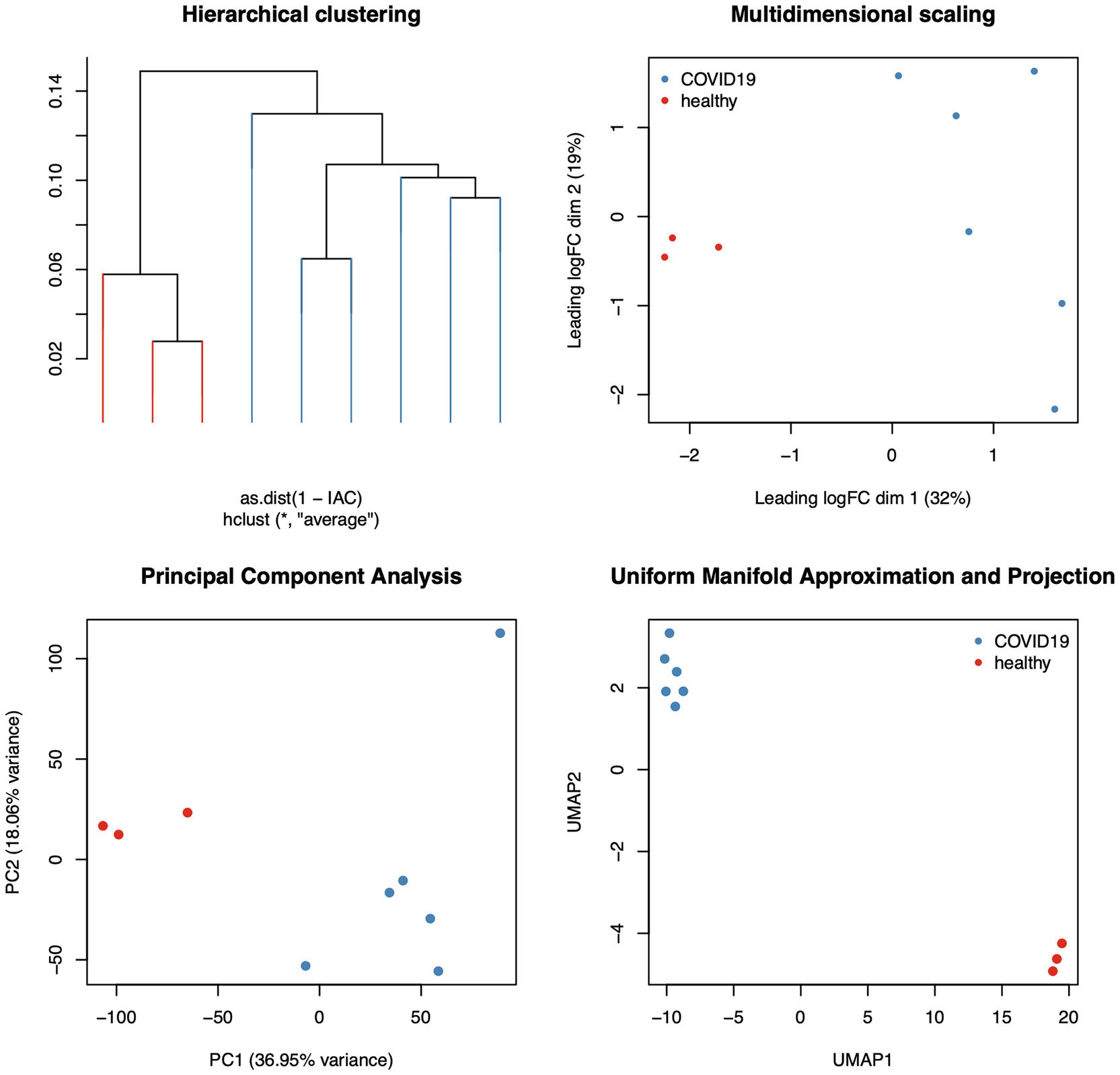
Figure shows four methods for detecting and visualizing gene expressionGene expression differences between three healthy and nine COVID-19COVID-19 samples. Top left panel shows hierarchical clusteringHierarchical clustering of samples based on the correlation of log-transformed counts per millionCounts per million (CPM) values of genes. The dendrogram highlights groupings between healthy and COVID-19COVID-19 samples. The top right panel shows the separation of samples using multidimensional scaling of average log-fold changesLog fold-change (LogFC) between groups. The principal component analysisPrincipal component analysis (PCA) plot visualizes the first and second principal components, displaying further separation of healthy and COVID-19COVID-19 samples (bottom, left). The uniform manifold approximation and projectionUniform manifold approximation and projection (UMAP), with three nearest neighbors, is shown in the bottom right plot. These plots reveal distinct grouping patterns between the two sample groups, suggesting differential gene expressionGene expression between healthy and COVID-19COVID-19 conditions
By identifying which host genes are affected by viruses, and understanding their roles in cellular pathways, scientists can uncover potential targets for new antiviral therapies. Rather than going after the virus directly, which can be tricky due to its rapid mutation, these therapies could aim to block the host mechanisms that viruses rely on, offering new ways to manage or prevent infection.
Le HTT, Ahamad I, Muley VY. (2025) Deciphering Host Differential Gene Expression in Viral Infections Through Public RNA-Seq Data from NCBI GEO. Methods in Molecular Biology 2927: 51-74. [article]
Related Posts






Viruses are masters of disguise and manipulation. They cannot replicate on their own, so they invade host cells and hijack the host’s biological machinery to make more copies of themselves. In the process, they often cause damage, disrupt normal cell functions, and trigger disease. Our immune system tries to fight back, but many viruses have evolved clever strategies to avoid detection or suppression, leading to chronic infections that are difficult to treat.
To better understand how viruses exploit our cellular systems, researchers study changes in gene expression, in other words, which genes are turned on or off during infection. One of the most powerful tools for this is RNA sequencing, which allows scientists to measure RNA levels across thousands of genes in infected and uninfected cells. This data helps identify differentially expressed genes (DEGs) that may play roles in the body’s response to infection or be manipulated by the virus.
A new protocol published by researchers at Tampere University outlines a comprehensive guide to performing Differential Gene Expression (DGE) analysis using RNA sequencing data.
What sets this work apart is its accessibility. The protocol is designed to work not only with in-house experimental data but also with publicly available RNA-seq datasets, such as those found in the NCBI GEO (Gene Expression Omnibus) repository. This makes it an invaluable resource for both new and experienced researchers interested in uncovering host-pathogen interactions using existing data.
Comparison of gene expression Gene expression profiles in healthy and
COVID-19 samples using various statistical methods
Figure shows four methods for detecting and visualizing gene expressionGene expression differences between three healthy and nine COVID-19COVID-19 samples. Top left panel shows hierarchical clusteringHierarchical clustering of samples based on the correlation of log-transformed counts per millionCounts per million (CPM) values of genes. The dendrogram highlights groupings between healthy and COVID-19COVID-19 samples. The top right panel shows the separation of samples using multidimensional scaling of average log-fold changesLog fold-change (LogFC) between groups. The principal component analysisPrincipal component analysis (PCA) plot visualizes the first and second principal components, displaying further separation of healthy and COVID-19COVID-19 samples (bottom, left). The uniform manifold approximation and projectionUniform manifold approximation and projection (UMAP), with three nearest neighbors, is shown in the bottom right plot. These plots reveal distinct grouping patterns between the two sample groups, suggesting differential gene expressionGene expression between healthy and COVID-19COVID-19 conditions
By identifying which host genes are affected by viruses, and understanding their roles in cellular pathways, scientists can uncover potential targets for new antiviral therapies. Rather than going after the virus directly, which can be tricky due to its rapid mutation, these therapies could aim to block the host mechanisms that viruses rely on, offering new ways to manage or prevent infection.
Le HTT, Ahamad I, Muley VY. (2025) Deciphering Host Differential Gene Expression in Viral Infections Through Public RNA-Seq Data from NCBI GEO. Methods in Molecular Biology 2927: 51-74. [article]
Related Posts
Recent Posts
 RNAmel simplifies RNA sequencing data analysis with a reproducible, integrated platform
 Heart failure reshapes bone marrow to create inflammation-related immune memory
 Overlooked DNA regions surrounding ‘microexons’ hold missing pieces of autism’s genetic puzzle
 RiboBA improves detection of hidden protein-coding regions using ribosome profiling
 An anti-senescence gene may fight spinal disc deterioration
 Bulk RNA-seq Analysis: A Complete Beginner’s Guide
RNA-Seq Products & Services


Stay Connected