

Waldenstrom’s Macroglobulinemia (WM) is a rare type of blood cancer that affects the bone marrow and causes the overproduction of IgM antibodies. It often starts as an asymptomatic condition called Asymptomatic Waldenstrom’s Macroglobulinemia (AWM) before progressing into full-blown cancer. Scientists at the Dana-Farber Cancer Institute recently conducted a study using single-cell RNA sequencing to better understand how this disease develops and how the immune system responds to it.
Single-cell RNA and BCR sequencing resolves concurrent lymphoid clones and unveils inter-tumor heterogeneity
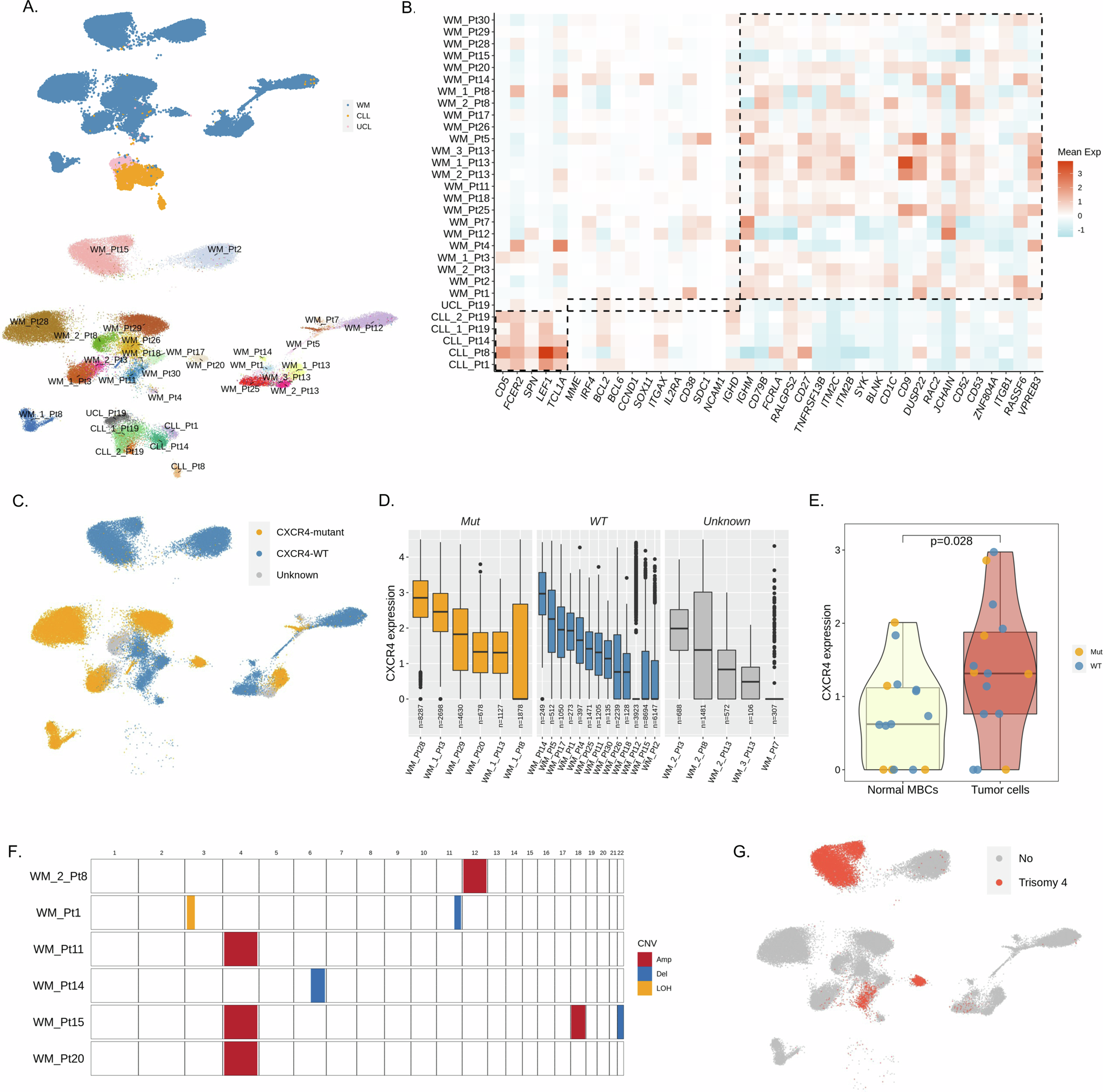
A UMAP embeddings of tumor cells (n = 55,488) labeled by tumor type (top) or tumor instance (bottom). Sample notation: Tumor Type_Tumor Number_Patient Number (for example: WM_1_Pt8 corresponds to the 1st of 2 WM tumors detected in patient Pt8). Tumor number is only noted when multiple tumors of that type exist in that patient. B Heatmap of tumor type-specific gene expression markers (scaled mean expression) used to determine tumor type. C UMAP embedding of WM tumor cells (n = 48,875) colored by CXCR4 mutation status. D Box plots visualizing the level of CXCR4 expression (y-axis) in each WM tumor clone (x-axis). Tumors were grouped into three categories: CXCR4-mutant (n = 6), CXCR4-WT (n = 13), and unknown CXCR4 mutation status (n = 5). Tumors were sorted by median CXCR4 expression in decreasing order. Box: 1st quartile, median, 3rd quartile; whiskers: +/− 1.5*IQR. E Box plots, violin plots, and scatter plots of median CXCR4 expression (y-axis) in WM tumor cells compared to normal memory B cells (MBCs) from the same patients (n = 15) (x-axis). Patients without tumor or normal B cells (n = 5) were removed from this analysis. In patients with multiclonal WM, the primary clone was used to calculate median CXCR4 expression. Patients were colored by CXCR4 mutation status. Violin outline width represents density. Box: 1st quartile, median, 3rd quartile; whiskers: +/− 1.5*IQR. The p-value was computed with a paired two-sided Wilcoxon’s rank-sum test. F Heatmap of CNVs detected in tumor samples. G UMAP embedding of WM tumor cells (n = 48,875) colored by Trisomy 4 status.
Key Findings from the Study
- Early Immune System Changes
Even in the early stages of the disease (AWM), patients already show significant immune system disturbances. This includes abnormalities in healthy B cells (which produce antibodies) and other immune cells, setting the stage for disease progression. - T and NK Cells are Less Responsive to Interferon
T cells and natural killer (NK) cells—both critical for fighting infections and cancer—were found to be less responsive to interferon, a key immune signaling molecule. However, researchers discovered that giving interferon could restore some of their function, suggesting a possible treatment strategy. - Tumor Diversity and Progression Markers
The researchers also looked at genetic mutations in tumor cells, particularly the MYD88 mutation, which is commonly found in WM. They identified different tumor subtypes and genetic signatures that could distinguish between early-stage disease (IgM MGUS) and full-blown WM. These findings could help doctors predict disease progression and refine treatment strategies.
This study sheds new light on how WM develops, revealing immune system weaknesses that could be targeted with new therapies. By identifying specific markers of disease progression, researchers hope to improve early detection and develop better treatments for patients with this rare blood cancer.
Sklavenitis-Pistofidis R, Konishi Y, Heilpern-Mallory D. et al. (2025) Single-cell RNA sequencing defines distinct disease subtypes and reveals hypo-responsiveness to interferon in asymptomatic Waldenstrom’s Macroglobulinemia. Nat Commun [Epub ahead of print]. [article]
Related Posts






Waldenstrom’s Macroglobulinemia (WM) is a rare type of blood cancer that affects the bone marrow and causes the overproduction of IgM antibodies. It often starts as an asymptomatic condition called Asymptomatic Waldenstrom’s Macroglobulinemia (AWM) before progressing into full-blown cancer. Scientists at the Dana-Farber Cancer Institute recently conducted a study using single-cell RNA sequencing to better understand how this disease develops and how the immune system responds to it.
Single-cell RNA and BCR sequencing resolves concurrent lymphoid clones and unveils inter-tumor heterogeneity
A UMAP embeddings of tumor cells (n = 55,488) labeled by tumor type (top) or tumor instance (bottom). Sample notation: Tumor Type_Tumor Number_Patient Number (for example: WM_1_Pt8 corresponds to the 1st of 2 WM tumors detected in patient Pt8). Tumor number is only noted when multiple tumors of that type exist in that patient. B Heatmap of tumor type-specific gene expression markers (scaled mean expression) used to determine tumor type. C UMAP embedding of WM tumor cells (n = 48,875) colored by CXCR4 mutation status. D Box plots visualizing the level of CXCR4 expression (y-axis) in each WM tumor clone (x-axis). Tumors were grouped into three categories: CXCR4-mutant (n = 6), CXCR4-WT (n = 13), and unknown CXCR4 mutation status (n = 5). Tumors were sorted by median CXCR4 expression in decreasing order. Box: 1st quartile, median, 3rd quartile; whiskers: +/− 1.5*IQR. E Box plots, violin plots, and scatter plots of median CXCR4 expression (y-axis) in WM tumor cells compared to normal memory B cells (MBCs) from the same patients (n = 15) (x-axis). Patients without tumor or normal B cells (n = 5) were removed from this analysis. In patients with multiclonal WM, the primary clone was used to calculate median CXCR4 expression. Patients were colored by CXCR4 mutation status. Violin outline width represents density. Box: 1st quartile, median, 3rd quartile; whiskers: +/− 1.5*IQR. The p-value was computed with a paired two-sided Wilcoxon’s rank-sum test. F Heatmap of CNVs detected in tumor samples. G UMAP embedding of WM tumor cells (n = 48,875) colored by Trisomy 4 status.
Key Findings from the Study
- Early Immune System Changes
Even in the early stages of the disease (AWM), patients already show significant immune system disturbances. This includes abnormalities in healthy B cells (which produce antibodies) and other immune cells, setting the stage for disease progression. - T and NK Cells are Less Responsive to Interferon
T cells and natural killer (NK) cells—both critical for fighting infections and cancer—were found to be less responsive to interferon, a key immune signaling molecule. However, researchers discovered that giving interferon could restore some of their function, suggesting a possible treatment strategy. - Tumor Diversity and Progression Markers
The researchers also looked at genetic mutations in tumor cells, particularly the MYD88 mutation, which is commonly found in WM. They identified different tumor subtypes and genetic signatures that could distinguish between early-stage disease (IgM MGUS) and full-blown WM. These findings could help doctors predict disease progression and refine treatment strategies.
This study sheds new light on how WM develops, revealing immune system weaknesses that could be targeted with new therapies. By identifying specific markers of disease progression, researchers hope to improve early detection and develop better treatments for patients with this rare blood cancer.
Sklavenitis-Pistofidis R, Konishi Y, Heilpern-Mallory D. et al. (2025) Single-cell RNA sequencing defines distinct disease subtypes and reveals hypo-responsiveness to interferon in asymptomatic Waldenstrom’s Macroglobulinemia. Nat Commun [Epub ahead of print]. [article]
Related Posts
Recent Posts
 RNAmel simplifies RNA sequencing data analysis with a reproducible, integrated platform
 Heart failure reshapes bone marrow to create inflammation-related immune memory
 Overlooked DNA regions surrounding ‘microexons’ hold missing pieces of autism’s genetic puzzle
 RiboBA improves detection of hidden protein-coding regions using ribosome profiling
 An anti-senescence gene may fight spinal disc deterioration
 Bulk RNA-seq Analysis: A Complete Beginner’s Guide
RNA-Seq Products & Services


Stay Connected