

Hepatocellular carcinoma (HCC), the most common type of liver cancer, has a high recurrence rate even after surgical removal. Detecting which patients are at higher risk of recurrence early on could help improve outcomes and allow doctors to personalize treatment strategies. A recent study led by researchers from the University of Science and Technology of China introduces a powerful new tool, the Tumor Immune Microenvironment Spatial (TIMES) score, designed to predict the likelihood of HCC recurrence.
The researchers analyzed tissue samples from 61 HCC patients, focusing on how natural killer (NK) cells—immune cells that help fight cancer—were distributed within the tumor. Using machine learning techniques, they developed the TIMES score, which evaluates the spatial patterns of five key biomarkers (SPON2, ZFP36L2, ZFP36, VIM, and HLA-DRB1) to assess recurrence risk. Unlike traditional staging systems such as TNM and BCLC, the TIMES score proved to be significantly more accurate, with an 82.2% accuracy rate in a validation study of 231 patients across multiple hospitals.
Development of a TIMES scoring system for HCC recurrence risk stratification
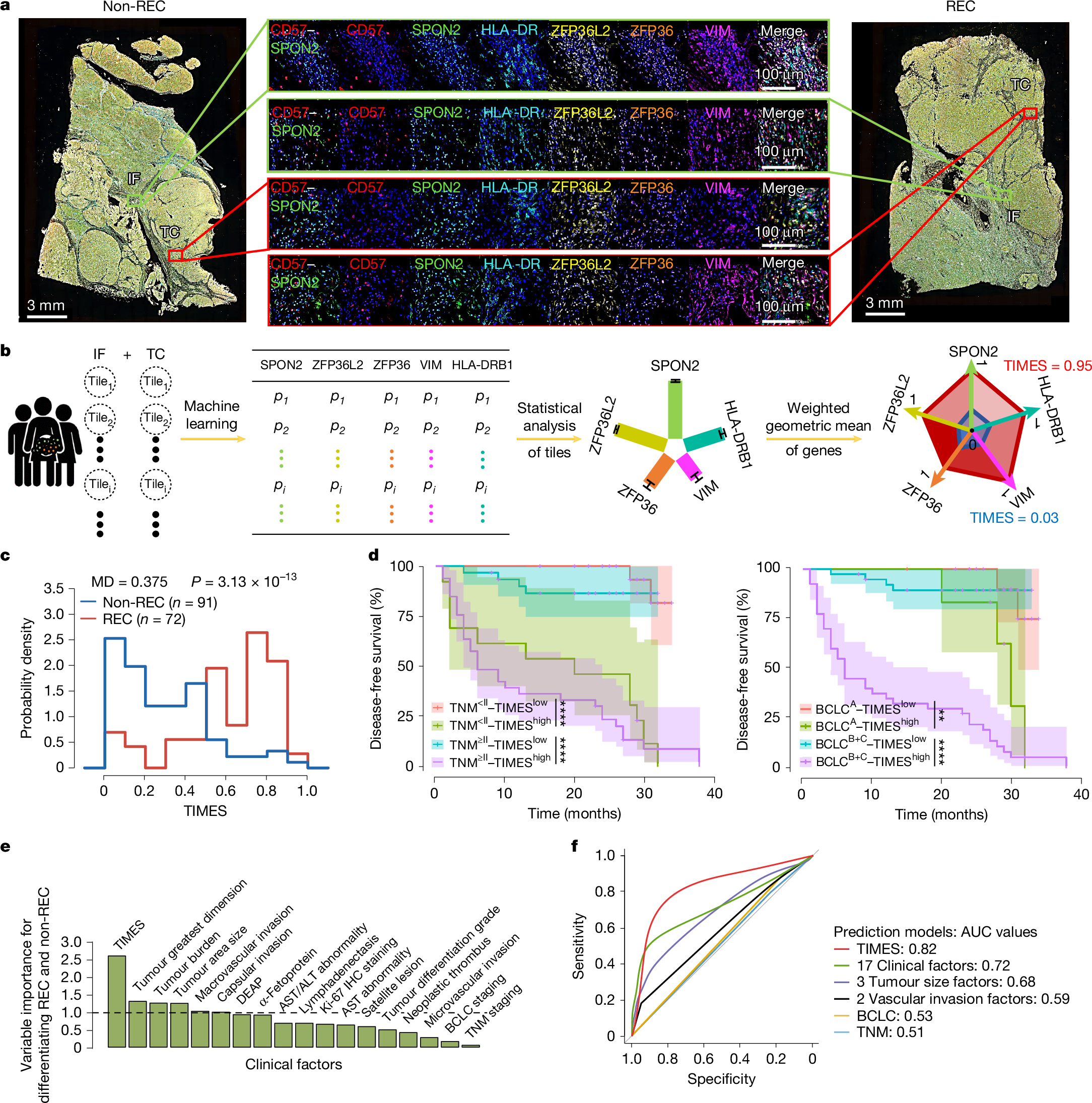
a, Representative mIHC images of non-REC and REC HCC tissues, showing nuclear staining (DAPI in blue) and biomarkers: CD57 (red), SPON2 (green), HLA-DR (cyan), ZFP36L2 (yellow), ZFP36 (orange) and VIM (magenta). b, TIMES scoring development using machine learning to integrate spatial and biomarker information. Model predictions are probability values (Pi), with final TIMES scores (0.03–0.95) presented as pentagons. c, TIMES score distributions for patients with REC (n = 72) and non-REC (n = 91) HCC. Unpaired two-tailed Wilcoxon rank-sum test (P = 3.13 × 10⁻¹³). MD, median difference of scores. d, DFS analysis combining TNM staging with TIMES scores (left) and BCLC with TIMES scores (right). The shaded areas correspond to 95% confidence intervals, and the central lines indicate medians. Log-rank test was used. For comparisons, TNM<II–TIMESlow (n = 30 patients) versus TNM<II–TIMEShigh (n = 23 patients; P = 3.0 × 10⁻⁷), TNM≥II–TIMESlow (n = 50 patients) versus TNM≥II–TIMEShigh (n = 52 patients; P = 2.0 × 10⁻⁸); BCLCA–TIMESlow (n = 17 patients) versus BCLCA–TIMEShigh (n = 9 patients; P = 0.01), and BCLCB+C–TIMESlow (n = 54 patients) versus BCLCB+C–TIMEShigh (n = 50 patients; P = 1.0 × 10⁻¹²). e, Variable importance from discriminant analysis, with values > 1 considered contributory (dashed line indicates variable importance = 1). ALT, alanine aminotransferase; AST, aspartate aminotransferase; DEAP, dynamic enhanced arterial phase. f, Receiver operating characteristic curves and AUC of TIMES, 17 factors (significant factors from univariate Cox regressions), 3-factor tumour size (tumour greatest dimension, area and burden), 2-factor vascular invasion (microvascular and macrovascular invasions), BCLC and TNM models. For statistical significance, **P < 0.01 and ****P < 0.0001.
Further experiments in animal models helped confirm the biological role of SPON2, a protein that enhances NK cell activity and infiltration into tumors. The findings suggest that the spatial organization of immune cells within the tumor environment, rather than the presence of individual biomarkers alone, plays a critical role in determining recurrence risk.
This study introduces TIMES as a publicly accessible tool that could help guide treatment decisions for early-stage HCC patients. By identifying those at higher risk of recurrence, doctors may be able to provide more targeted therapies, ultimately improving patient survival rates.
Availability – A Code Ocean capsule (https://doi.org/10.24433/CO.7364332.v1) containing executable programming scripts and input and output data is accessible
Jia G, He P, Dai T, Goh D, Wang J, Sun M, Wee F, Li F, Lim JCT, Hao S, Liu Y, Lim TKH, Ngo NT, Tao Q, Wang W, Umar A, Nashan B, Zhang Y, Ding C, Yeong J, Liu L, Sun C. (2025) Spatial immune scoring system predicts hepatocellular carcinoma recurrence. Nature [Epub ahead of print]. [article]
Related Posts






Hepatocellular carcinoma (HCC), the most common type of liver cancer, has a high recurrence rate even after surgical removal. Detecting which patients are at higher risk of recurrence early on could help improve outcomes and allow doctors to personalize treatment strategies. A recent study led by researchers from the University of Science and Technology of China introduces a powerful new tool, the Tumor Immune Microenvironment Spatial (TIMES) score, designed to predict the likelihood of HCC recurrence.
The researchers analyzed tissue samples from 61 HCC patients, focusing on how natural killer (NK) cells—immune cells that help fight cancer—were distributed within the tumor. Using machine learning techniques, they developed the TIMES score, which evaluates the spatial patterns of five key biomarkers (SPON2, ZFP36L2, ZFP36, VIM, and HLA-DRB1) to assess recurrence risk. Unlike traditional staging systems such as TNM and BCLC, the TIMES score proved to be significantly more accurate, with an 82.2% accuracy rate in a validation study of 231 patients across multiple hospitals.
Development of a TIMES scoring system for HCC recurrence risk stratification
a, Representative mIHC images of non-REC and REC HCC tissues, showing nuclear staining (DAPI in blue) and biomarkers: CD57 (red), SPON2 (green), HLA-DR (cyan), ZFP36L2 (yellow), ZFP36 (orange) and VIM (magenta). b, TIMES scoring development using machine learning to integrate spatial and biomarker information. Model predictions are probability values (Pi), with final TIMES scores (0.03–0.95) presented as pentagons. c, TIMES score distributions for patients with REC (n = 72) and non-REC (n = 91) HCC. Unpaired two-tailed Wilcoxon rank-sum test (P = 3.13 × 10⁻¹³). MD, median difference of scores. d, DFS analysis combining TNM staging with TIMES scores (left) and BCLC with TIMES scores (right). The shaded areas correspond to 95% confidence intervals, and the central lines indicate medians. Log-rank test was used. For comparisons, TNM<II–TIMESlow (n = 30 patients) versus TNM<II–TIMEShigh (n = 23 patients; P = 3.0 × 10⁻⁷), TNM≥II–TIMESlow (n = 50 patients) versus TNM≥II–TIMEShigh (n = 52 patients; P = 2.0 × 10⁻⁸); BCLCA–TIMESlow (n = 17 patients) versus BCLCA–TIMEShigh (n = 9 patients; P = 0.01), and BCLCB+C–TIMESlow (n = 54 patients) versus BCLCB+C–TIMEShigh (n = 50 patients; P = 1.0 × 10⁻¹²). e, Variable importance from discriminant analysis, with values > 1 considered contributory (dashed line indicates variable importance = 1). ALT, alanine aminotransferase; AST, aspartate aminotransferase; DEAP, dynamic enhanced arterial phase. f, Receiver operating characteristic curves and AUC of TIMES, 17 factors (significant factors from univariate Cox regressions), 3-factor tumour size (tumour greatest dimension, area and burden), 2-factor vascular invasion (microvascular and macrovascular invasions), BCLC and TNM models. For statistical significance, **P < 0.01 and ****P < 0.0001.
Further experiments in animal models helped confirm the biological role of SPON2, a protein that enhances NK cell activity and infiltration into tumors. The findings suggest that the spatial organization of immune cells within the tumor environment, rather than the presence of individual biomarkers alone, plays a critical role in determining recurrence risk.
This study introduces TIMES as a publicly accessible tool that could help guide treatment decisions for early-stage HCC patients. By identifying those at higher risk of recurrence, doctors may be able to provide more targeted therapies, ultimately improving patient survival rates.
Availability – A Code Ocean capsule (https://doi.org/10.24433/CO.7364332.v1) containing executable programming scripts and input and output data is accessible
Jia G, He P, Dai T, Goh D, Wang J, Sun M, Wee F, Li F, Lim JCT, Hao S, Liu Y, Lim TKH, Ngo NT, Tao Q, Wang W, Umar A, Nashan B, Zhang Y, Ding C, Yeong J, Liu L, Sun C. (2025) Spatial immune scoring system predicts hepatocellular carcinoma recurrence. Nature [Epub ahead of print]. [article]
Related Posts
Recent Posts
 Machine learning reveals how RNA splicing is regulated in individual cell types
 Illumina releases SpliceAI2 to help advance rare disease research
 Postdoctoral Fellow – Long-Read RNA Methods Development for Neurodegeneration
 Novel biosensor uses DNA ‘barcodes’ to uncover disease signals in cells
 GP-DHT uses single-cell RNA sequencing to map gene regulatory networks
 Boehringer taps Envisagenics’ AI to mine RNA splicing for cancer targets
RNA-Seq Products & Services



Stay Connected