
Islet-specific endothelial cells (red) form specialized blood vessels that support and nourish pancreatic islets (green). Credit: Dr. Ge Li
The distinct population of endothelial cells that line blood vessels in the insulin-producing “islets” of the human pancreas have been notoriously difficult to study, but Weill Cornell Medicine investigators have now succeeded in comprehensively detailing the unique characteristics of these cells. The resulting atlas advances basic research on the biology of the pancreas and could lead to new treatment strategies for diabetes and other pancreatic diseases.
In the study, published Feb. 6 in Nature Communications, the researchers devised a set of methods for rapidly isolating and profiling endothelial cells called ISECs (islet-specific endothelial cells) from donor pancreases. ISECs provide critical support for islet functions but die very quickly when separated from the pancreas using standard cell-isolation techniques. With their highly streamlined approach, the researchers were able for the first time to analyze large numbers of ISECs, mapping their molecular signatures and interactions with other pancreatic cell types.
“The dataset we generated in this study is the first to capture the full diversity of endothelial cells in the pancreas, and we expect it to be an important resource for our research group and many others,” said senior author Dr. David Redmond, assistant professor of computational biology at the Hartman Institute for Therapeutic Organ Regeneration at Weill Cornell Medicine.
Although ISECs’ precise molecular signatures had been unknown, scientists have had evidence that these cells support the maturation, insulin-secreting activities and survival of islet cells. They are also important for the long-term survival of islet transplants— which are infrequently used to treat type 1 diabetes because of immune complications but could be a cure if current obstacles are overcome.
For the study, first author Dr. Rebecca Craig-Schapiro, an assistant professor of surgery at Weill Cornell Medicine and a transplant surgeon at NewYork-Presbyterian/Weill Cornell Medical Center who works closely with members of the Hartman Institute, obtained three deidentified pancreases from deceased organ donors.
“With our novel approach, and using what was already known about ISECs, we were able to isolate and process these cells in very large numbers—more than 30,000—as well as about 75,000 other pancreatic cells, keeping them all viable long enough to conduct single-cell RNA sequencing,” said Dr. Craig-Schapiro.
The RNA-sequencing data, which provides snapshots of gene activity in each cell, enabled the researchers to determine the characteristic gene activity signatures of ISECs as well as other pancreatic cells including endothelial cells from the non-islet portion of the pancreas.
“Using our RNA sequencing data we also were able to identify support cells that communicate with ISECs and other endothelial cells in their respective pancreatic compartments,” said co-author Kevin Chen, a research technician in the Rafii laboratory.
Although prior studies of pancreatic cells had been incomplete, especially for ISECs, the researchers found that prior data largely matched their findings wherever it overlapped.
“We were able to integrate our data with three other published datasets, extensively corroborating our findings and resulting in a much more complete cell atlas,” said co-author Dr. Ge Li, a research associate in the Rafii lab.
Cell-specific heterogeneity of the acinar and islet compartments of the human pancreas
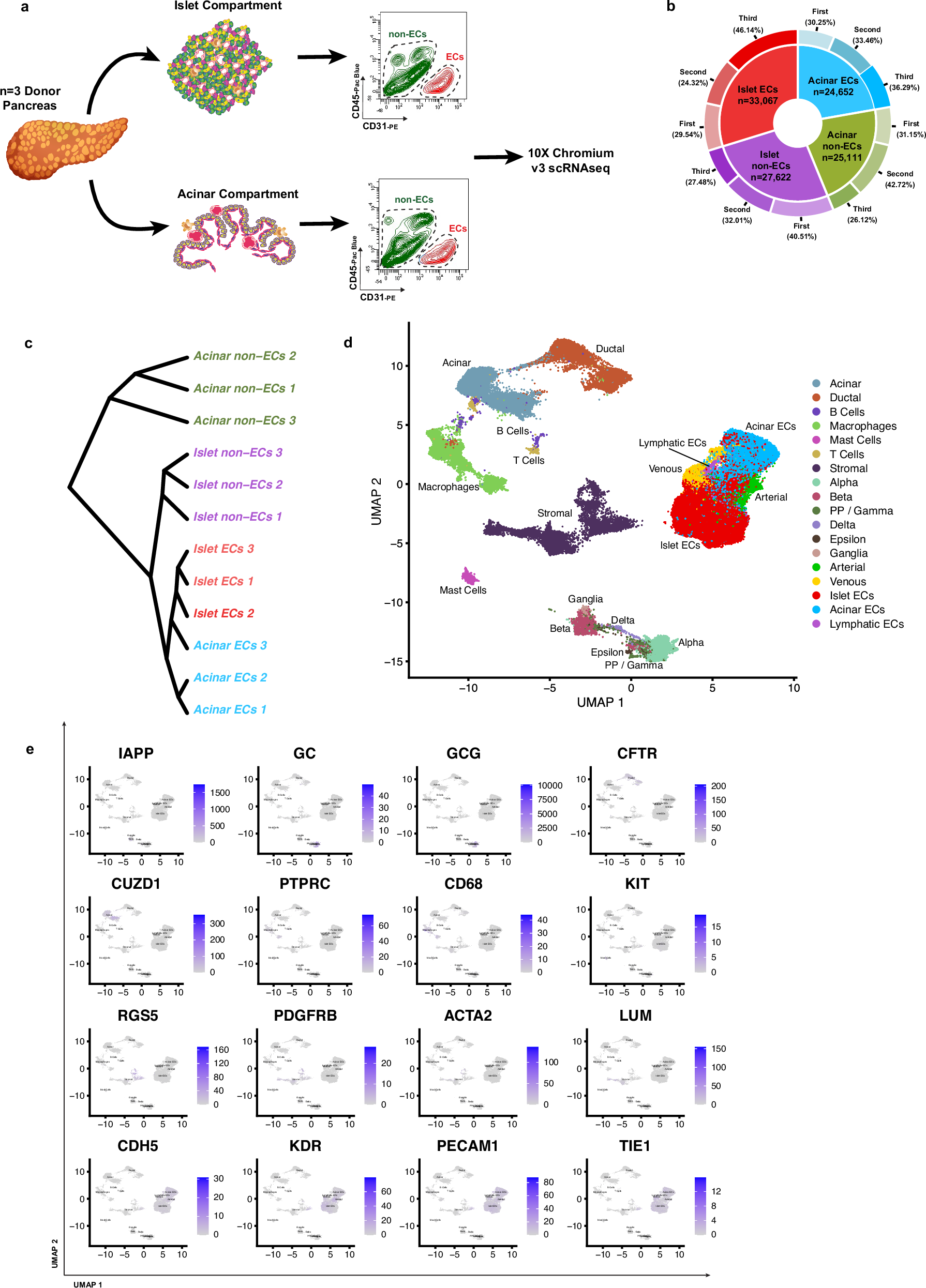
a Schema of experimental design: digestion and purification of pancreas into islet and acinar fractions, followed by flow cytometric sorting into EC and non-EC fractions for scRNA-seq. b Pie chart displaying the number and percentage of cells passing quality control segregated by donor and by endothelial and non-endothelial fractions. c Dendrogram visualization of scRNA-seq samples showing unbiased bulk-style clustering based on whole transcriptome expression. d UMAP visualization and clustering of pancreatic cell types based on canonical gene expression. e Feature plots using UMAP visualization of scaled RNA expression after SoupX-based ambient RNA removal across cell types assigned from canonical markers and clustering.
Since pancreatic islets are where insulin is produced, they are also a major focus for diabetes research. Using the new data, along with existing datasets on gene activity in diabetic pancreas tissue, the researchers catalogued endothelial genes and signaling pathways that appear to be disrupted in diabetes—and might be targets for future therapies.
“This comprehensive atlas gives us a strong foundation for the development of strategies to restore the function of ISECs and other cells in diabetes and other pancreatic diseases,” said senior author Dr. Shahin Rafii, chief of the division of regenerative medicine, director of the Hartman Institute and the Ansary Stem Cell Institute and the Arthur B. Belfer Professor in Genetic Medicine at Weill Cornell Medicine.
Currently the researchers are using their new atlas for several follow-on efforts, including the development of techniques to make ISECs from other cells, said Dr. Rafii, who is also a member of the Englander Institute for Precision Medicine and the Sandra and Edward Meyer Cancer Center at Weill Cornell Medicine.
Source – Weill Cornell Medicine
Availability – A user-friendly web portal for exploration of the scRNA-seq data is available at https://dr-lab.shinyapps.io/pancreast-atlas/.


Islet-specific endothelial cells (red) form specialized blood vessels that support and nourish pancreatic islets (green). Credit: Dr. Ge Li
The distinct population of endothelial cells that line blood vessels in the insulin-producing “islets” of the human pancreas have been notoriously difficult to study, but Weill Cornell Medicine investigators have now succeeded in comprehensively detailing the unique characteristics of these cells. The resulting atlas advances basic research on the biology of the pancreas and could lead to new treatment strategies for diabetes and other pancreatic diseases.
In the study, published Feb. 6 in Nature Communications, the researchers devised a set of methods for rapidly isolating and profiling endothelial cells called ISECs (islet-specific endothelial cells) from donor pancreases. ISECs provide critical support for islet functions but die very quickly when separated from the pancreas using standard cell-isolation techniques. With their highly streamlined approach, the researchers were able for the first time to analyze large numbers of ISECs, mapping their molecular signatures and interactions with other pancreatic cell types.
Although ISECs’ precise molecular signatures had been unknown, scientists have had evidence that these cells support the maturation, insulin-secreting activities and survival of islet cells. They are also important for the long-term survival of islet transplants— which are infrequently used to treat type 1 diabetes because of immune complications but could be a cure if current obstacles are overcome.
For the study, first author Dr. Rebecca Craig-Schapiro, an assistant professor of surgery at Weill Cornell Medicine and a transplant surgeon at NewYork-Presbyterian/Weill Cornell Medical Center who works closely with members of the Hartman Institute, obtained three deidentified pancreases from deceased organ donors.
The RNA-sequencing data, which provides snapshots of gene activity in each cell, enabled the researchers to determine the characteristic gene activity signatures of ISECs as well as other pancreatic cells including endothelial cells from the non-islet portion of the pancreas.
Although prior studies of pancreatic cells had been incomplete, especially for ISECs, the researchers found that prior data largely matched their findings wherever it overlapped.
Cell-specific heterogeneity of the acinar and islet compartments of the human pancreas
a Schema of experimental design: digestion and purification of pancreas into islet and acinar fractions, followed by flow cytometric sorting into EC and non-EC fractions for scRNA-seq. b Pie chart displaying the number and percentage of cells passing quality control segregated by donor and by endothelial and non-endothelial fractions. c Dendrogram visualization of scRNA-seq samples showing unbiased bulk-style clustering based on whole transcriptome expression. d UMAP visualization and clustering of pancreatic cell types based on canonical gene expression. e Feature plots using UMAP visualization of scaled RNA expression after SoupX-based ambient RNA removal across cell types assigned from canonical markers and clustering.
Since pancreatic islets are where insulin is produced, they are also a major focus for diabetes research. Using the new data, along with existing datasets on gene activity in diabetic pancreas tissue, the researchers catalogued endothelial genes and signaling pathways that appear to be disrupted in diabetes—and might be targets for future therapies.
Currently the researchers are using their new atlas for several follow-on efforts, including the development of techniques to make ISECs from other cells, said Dr. Rafii, who is also a member of the Englander Institute for Precision Medicine and the Sandra and Edward Meyer Cancer Center at Weill Cornell Medicine.
Source – Weill Cornell Medicine
Availability – A user-friendly web portal for exploration of the scRNA-seq data is available at https://dr-lab.shinyapps.io/pancreast-atlas/.
Craig-Schapiro R, Li G, Chen K. et al. (2025) Single-cell atlas of human pancreatic islet and acinar endothelial cells in health and diabetes. Nat Commun [Epub ahead of print]. [article]
Related Posts
Scientists identify the neuroblastoma cells that signal poor outcomes
Novel biosensor uses DNA ‘barcodes’ to uncover disease signals in cells
CellART extracts single-cell information from high-resolution spatial transcriptomics
Cell2space restores spatial context to single-cell RNA sequencing data
Urine test may improve bladder cancer diagnosis and guide treatment decisions
DeCoRE – a computational method to resolve RNA structural heterogeneity from RNA structure probing data by direct RNA sequencing
Tracing 700 million years of cell evolution
How should biological replicates be handled in long-read RNA sequencing?
RNA-Seq reveals a new way the developing heart controls its growth
The Human RNome Project Consortium seeks to publish first-ever complete sequence of the body’s RNA
scFlowReport brings multiple single-cell RNA sequencing analyses into one workflow
Long-read RNA sequencing reveals how neurons choose alternative RNA endings
DeOPUS improves cell-type estimates from bulk RNA sequencing
ResolVI improves accuracy in spatial transcriptomics analysis
RNA sequencing reveals transcriptional allele differences in prostate cancer stem cells
Unmasking “zombie cells” in aging tissue with an AI-powered barcode
RNA variant imaging for cancer diagnosis
Autism-risk mutations reveal two opposing patterns of brain gene activity
A real-data approach to evaluating RNA transcript analysis methods
Detection and sequencing of Ap2N-capped RNAs in human cells
Stay Connected
Submit a Post to the Blog
Recent Posts
Subscribe to the RNA-Seq Blog
RNA-Seq Products & Services