Dermatofibrosarcoma protuberans (DFSP) is a rare skin sarcoma known for its high recurrence rates, making treatment particularly challenging. While surgery remains the standard option, it often leads to scarring and other complications. Current in vitro models struggle to capture the complexity of the skin tumor environment, especially the role of immune cells. These limitations highlight the need for more accurate models to explore new treatment strategies. Due to these issues, advancing alternative therapies that can minimize surgical impact while effectively controlling tumor growth is crucial.
Cell Organoid published the findings of researchers from Shanghai Lisheng Biotech and Shanghai Ninth People’s Hospital. The research team successfully developed patient-derived organoids from DFSP tumors, closely replicating the histological and genetic characteristics of clinical samples. Using these organoids, they tested both metformin and imatinib, a drug already approved for DFSP treatment. Their study revealed that, beyond inhibiting tumor growth, metformin uniquely impacted immune pathways, suggesting a new therapeutic role for the drug in cancer treatment.
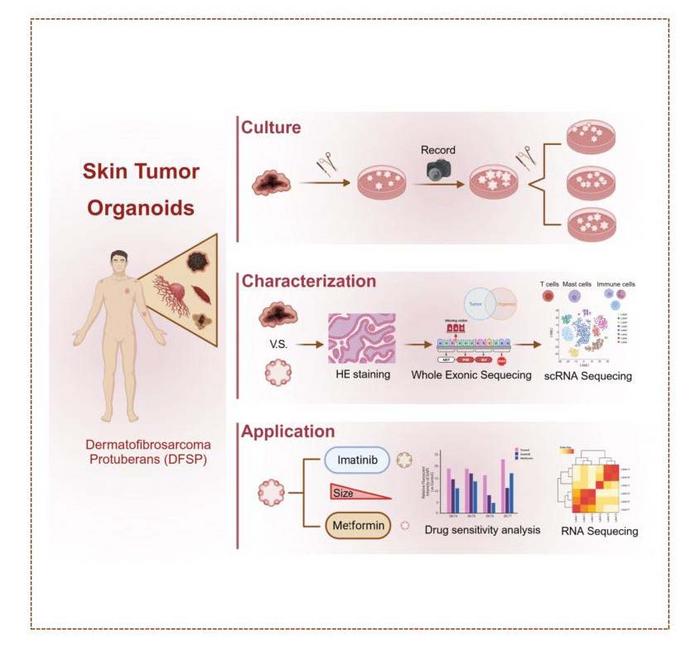
This schematic illustrates the process of developing patient-derived skin tumor organoids from Dermatofibrosarcoma Protuberans (DFSP). The workflow includes organoid culture, characterization through HE staining, whole exome sequencing, and single-cell RNA sequencing (scRNA-seq) to analyze cell types. Drug sensitivity analysis highlights the effects of imatinib and metformin, revealing metformin’s unique role in modulating immune pathways, which supports its potential as a therapeutic agent for DFSP.
The researchers developed DFSP organoids without the use of enzymes, maintaining the tumor’s natural immune environment. Single-cell RNA sequencing revealed these organoids contained 11 different cell types, including immune cells, offering a detailed model for drug testing. Both metformin and imatinib were shown to reduce tumor growth, but metformin stood out by significantly altering the expression of genes related to immune system activity and cancer cell signaling. This indicates that metformin doesn’t just target tumor cells but also influences the surrounding immune environment, providing a dual mechanism of action. This ability to modulate immune responses highlights metformin’s potential as a repurposed cancer treatment, particularly for rare skin tumors like DFSP. By preserving the tumor’s complexity, the organoids provide a valuable platform for screening drugs and exploring personalized therapies that go beyond standard treatments.
Dr. Jun Chen, a lead researcher, explained the significance of the findings: “By creating DFSP organoids, we’ve gained crucial insights into how drugs affect both tumor and immune cells. Metformin’s unique ability to modulate immune signaling opens up new treatment possibilities that could minimize the need for surgery. This approach not only helps us better understand the biology of these tumors but also suggests ways to improve outcomes for patients with difficult-to-treat cancers like DFSP.”
The success of metformin in modulating immune pathways within DFSP organoids suggests broader applications for cancer treatment. These organoids provide a highly accurate model for testing other drugs and personalized therapies, especially in cancers that are difficult to treat. By replicating the tumor microenvironment, this model opens new doors for developing targeted treatments. As researchers continue to explore metformin’s effects, its repurposing for cancer therapy could revolutionize treatment strategies for rare skin cancers and improve patient outcomes.
Source – Eurekalert


Dermatofibrosarcoma protuberans (DFSP) is a rare skin sarcoma known for its high recurrence rates, making treatment particularly challenging. While surgery remains the standard option, it often leads to scarring and other complications. Current in vitro models struggle to capture the complexity of the skin tumor environment, especially the role of immune cells. These limitations highlight the need for more accurate models to explore new treatment strategies. Due to these issues, advancing alternative therapies that can minimize surgical impact while effectively controlling tumor growth is crucial.
Cell Organoid published the findings of researchers from Shanghai Lisheng Biotech and Shanghai Ninth People’s Hospital. The research team successfully developed patient-derived organoids from DFSP tumors, closely replicating the histological and genetic characteristics of clinical samples. Using these organoids, they tested both metformin and imatinib, a drug already approved for DFSP treatment. Their study revealed that, beyond inhibiting tumor growth, metformin uniquely impacted immune pathways, suggesting a new therapeutic role for the drug in cancer treatment.
This schematic illustrates the process of developing patient-derived skin tumor organoids from Dermatofibrosarcoma Protuberans (DFSP). The workflow includes organoid culture, characterization through HE staining, whole exome sequencing, and single-cell RNA sequencing (scRNA-seq) to analyze cell types. Drug sensitivity analysis highlights the effects of imatinib and metformin, revealing metformin’s unique role in modulating immune pathways, which supports its potential as a therapeutic agent for DFSP.
The researchers developed DFSP organoids without the use of enzymes, maintaining the tumor’s natural immune environment. Single-cell RNA sequencing revealed these organoids contained 11 different cell types, including immune cells, offering a detailed model for drug testing. Both metformin and imatinib were shown to reduce tumor growth, but metformin stood out by significantly altering the expression of genes related to immune system activity and cancer cell signaling. This indicates that metformin doesn’t just target tumor cells but also influences the surrounding immune environment, providing a dual mechanism of action. This ability to modulate immune responses highlights metformin’s potential as a repurposed cancer treatment, particularly for rare skin tumors like DFSP. By preserving the tumor’s complexity, the organoids provide a valuable platform for screening drugs and exploring personalized therapies that go beyond standard treatments.
The success of metformin in modulating immune pathways within DFSP organoids suggests broader applications for cancer treatment. These organoids provide a highly accurate model for testing other drugs and personalized therapies, especially in cancers that are difficult to treat. By replicating the tumor microenvironment, this model opens new doors for developing targeted treatments. As researchers continue to explore metformin’s effects, its repurposing for cancer therapy could revolutionize treatment strategies for rare skin cancers and improve patient outcomes.
Source – Eurekalert
Shi Y, Liu J, Li L, Wang C, Zhang J, Rong M, Rao Y, Zhou X, Sun D, Chen J, Cai C, Xinxin Han X. (2024) Patient-derived skin tumor organoids with immune cells respond to metformin. Cell Organoids [Epub ahead of print]. [article]
Related Posts
Researchers create first whole-body single-cell atlas of an adult vertebrate
UAlbany Joins $10 Million Effort to Map RNA Modifications in the Human Body
SpliceCOV improves RNA sequencing analysis by filtering transcriptional noise
Overlooked ‘off switch’ in lung tumors may explain why immunotherapy doesn’t work for everyone
Squids Edit RNA for Novel Protein Functions
New marker panel and web tool help define early human cell fates
RNA sequencing reveals molecular changes driving right ventricular heart failure
Researchers Develop AI Tool to Map MicroRNA Binding Sites on Circular RNAs
Single-cell RNA sequencing reveals the diversity of human neutrophils across health and disease
Yale researchers improve RNA extraction from precision-cut lung slices
RNA sequencing reveals how genes combine to regulate inflammation and immune responses
RNAffinityDB – a curated database of experimental RNA–protein binding affinities
“Raman Genome” for SARS-CoV-2: new Raman technology distinguishes viral variants by their molecular RNA architecture
Advanced paternal age has sex-specific effects on fetal brain gene expression
Exercise is good for us—but why?
Ribosome profiling reveals shared patterns in ribosome diversity and collisions
RNAmel simplifies RNA sequencing data analysis with a reproducible, integrated platform
Heart failure reshapes bone marrow to create inflammation-related immune memory
Overlooked DNA regions surrounding ‘microexons’ hold missing pieces of autism’s genetic puzzle
RiboBA improves detection of hidden protein-coding regions using ribosome profiling
Stay Connected
Submit a Post to the Blog
Recent Posts
Subscribe to the RNA-Seq Blog
RNA-Seq Products & Services