


Single-cell RNA sequencing has become a powerful tool for studying how genes behave in individual cells. Most current approaches rely on comparing sequencing data to known reference genomes, which can limit discovery, especially when studying less characterized organisms or unexpected RNA features.
Researchers at Stanford University have developed a new method called sc-SPLASH that takes a different approach. Instead of depending on reference genomes, it uses a statistics-first framework to analyze RNA sequencing data directly.
This method allows researchers to identify patterns and features in RNA data that might otherwise be missed. For example, it can detect novel transcripts, unusual RNA molecules, or gene products that are not included in existing databases. This is particularly valuable for studying organisms with incomplete genome annotations or for uncovering unexpected biology.
Overview and evaluation of the sc-SPLASH pipeline and analysis of
human V(D)J rearrangement and spatial transcriptomics (Visium)
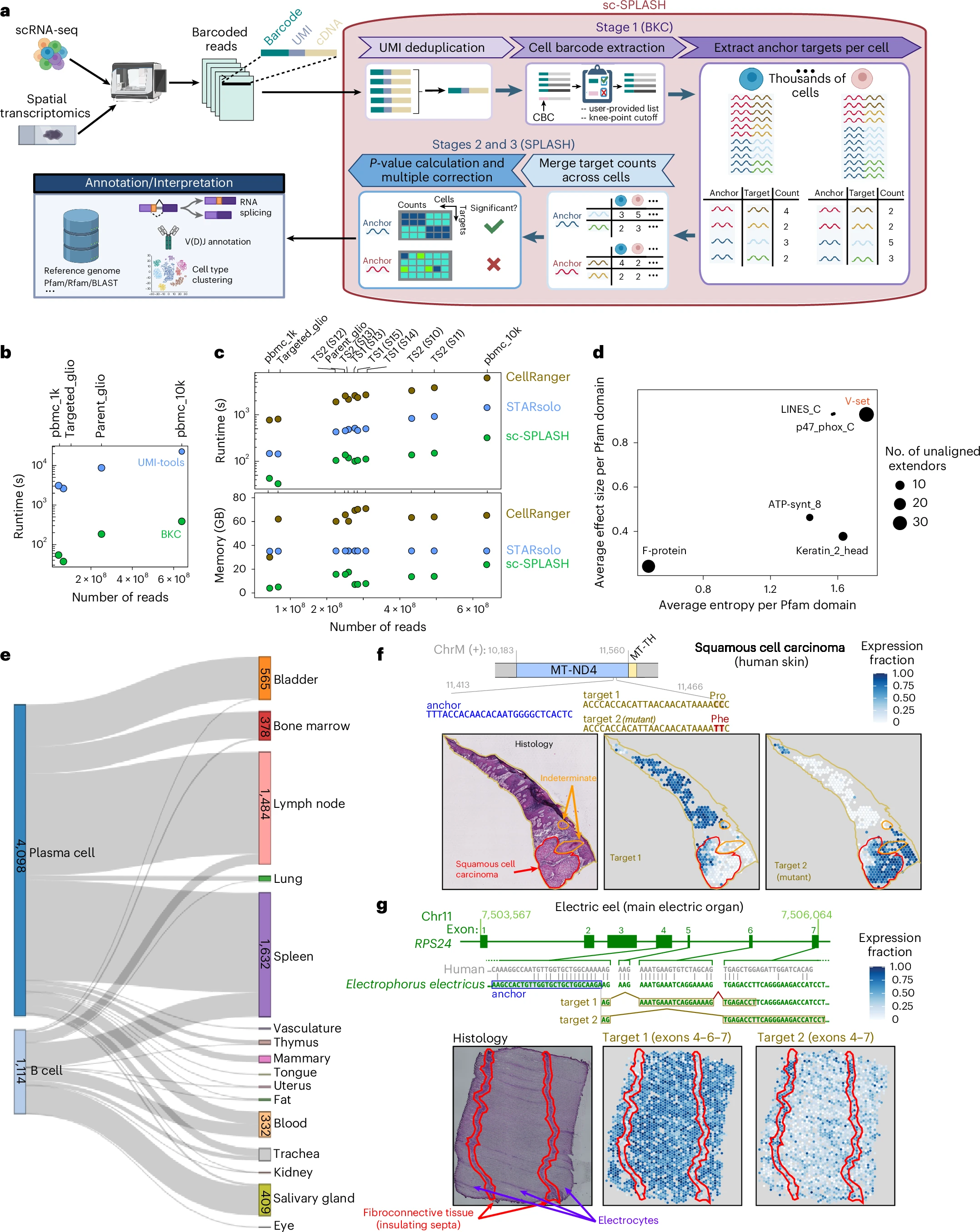
a, Overview of sc-SPLASH pipeline including preprocessing of 10x scRNA-seq data (cell barcode extraction and UMI deduplication), performing anchor–target counting with the BKC module and then performing statistical analysis to identify anchors (constant sequences) followed by targets (variable sequences) with single-cell-dependent distributions. b, Comparison of BKC and UMI-tools run times for 10x preprocessing using different datasets. c, Comparison of sc-SPLASH with Cell Ranger and STARsolo, on datasets with varying sequencing depths, indicates much higher efficiency for sc-SPLASH. d, Pfam analysis on unaligned extendors finds that the immunoglobulin variable domain (V-set) explains the most unaligned extendors and also has the highest average entropy compared to other Pfam domains. e, Number of in-frame V(D)J transcripts identified by integrating sc-SPLASH with IgBLAST for each cell type and tissue. f, Detection of a tumor-associated somatic double mutation in gene MT-ND4 in squamous cell carcinoma by sc-SPLASH where the target corresponding to the mutation has a higher fraction in carcinoma cells (red outline). g, Spatially regulated alternative splicing of RPS24 detected in electric eel where electrocytes (purple arrows) include exon 6 and stromal cells in the insulating septa (red arrows) exclude exon 6.
The sc-SPLASH framework also includes a preprocessing module that improves how sequencing data is handled. This component significantly speeds up analysis compared to commonly used tools, making it easier to work with large datasets generated by modern RNA sequencing experiments.
Using this approach, the team discovered previously unrecognized proteins in simple organisms such as sponges and tunicates. These findings highlight how much biological information may still be hidden in RNA sequencing data when traditional reference-based methods are used.
Overall, this work demonstrates how new analytical strategies can expand the capabilities of RNA sequencing. By moving beyond reliance on reference genomes, researchers can uncover new layers of gene expression and gain deeper insight into cellular function and evolution.
Availability – sc-SPLASH is integrated into SPLASH2 pipeline and can be accessed on GitHub (https://github.com/refresh-bio/splash).
Dehghannasiri R, Kokot M, Starr A L, Maziarz J, Gordon T, Tan S Y, Wang P L, Voskoboynik A, Musser J M, Deorowicz S, Salzman J. (2026) Reference-free discovery with barcoded single-cell sequencing. Nature Biotechnology [Epub ahead of print]. [article]
Related Posts






Single-cell RNA sequencing has become a powerful tool for studying how genes behave in individual cells. Most current approaches rely on comparing sequencing data to known reference genomes, which can limit discovery, especially when studying less characterized organisms or unexpected RNA features.
Researchers at Stanford University have developed a new method called sc-SPLASH that takes a different approach. Instead of depending on reference genomes, it uses a statistics-first framework to analyze RNA sequencing data directly.
This method allows researchers to identify patterns and features in RNA data that might otherwise be missed. For example, it can detect novel transcripts, unusual RNA molecules, or gene products that are not included in existing databases. This is particularly valuable for studying organisms with incomplete genome annotations or for uncovering unexpected biology.
Overview and evaluation of the sc-SPLASH pipeline and analysis of
human V(D)J rearrangement and spatial transcriptomics (Visium)
a, Overview of sc-SPLASH pipeline including preprocessing of 10x scRNA-seq data (cell barcode extraction and UMI deduplication), performing anchor–target counting with the BKC module and then performing statistical analysis to identify anchors (constant sequences) followed by targets (variable sequences) with single-cell-dependent distributions. b, Comparison of BKC and UMI-tools run times for 10x preprocessing using different datasets. c, Comparison of sc-SPLASH with Cell Ranger and STARsolo, on datasets with varying sequencing depths, indicates much higher efficiency for sc-SPLASH. d, Pfam analysis on unaligned extendors finds that the immunoglobulin variable domain (V-set) explains the most unaligned extendors and also has the highest average entropy compared to other Pfam domains. e, Number of in-frame V(D)J transcripts identified by integrating sc-SPLASH with IgBLAST for each cell type and tissue. f, Detection of a tumor-associated somatic double mutation in gene MT-ND4 in squamous cell carcinoma by sc-SPLASH where the target corresponding to the mutation has a higher fraction in carcinoma cells (red outline). g, Spatially regulated alternative splicing of RPS24 detected in electric eel where electrocytes (purple arrows) include exon 6 and stromal cells in the insulating septa (red arrows) exclude exon 6.
The sc-SPLASH framework also includes a preprocessing module that improves how sequencing data is handled. This component significantly speeds up analysis compared to commonly used tools, making it easier to work with large datasets generated by modern RNA sequencing experiments.
Using this approach, the team discovered previously unrecognized proteins in simple organisms such as sponges and tunicates. These findings highlight how much biological information may still be hidden in RNA sequencing data when traditional reference-based methods are used.
Overall, this work demonstrates how new analytical strategies can expand the capabilities of RNA sequencing. By moving beyond reliance on reference genomes, researchers can uncover new layers of gene expression and gain deeper insight into cellular function and evolution.
Availability – sc-SPLASH is integrated into SPLASH2 pipeline and can be accessed on GitHub (https://github.com/refresh-bio/splash).
Dehghannasiri R, Kokot M, Starr A L, Maziarz J, Gordon T, Tan S Y, Wang P L, Voskoboynik A, Musser J M, Deorowicz S, Salzman J. (2026) Reference-free discovery with barcoded single-cell sequencing. Nature Biotechnology [Epub ahead of print]. [article]
Related Posts
Recent Posts
 Scientists identify the neuroblastoma cells that signal poor outcomes
 GARAGE improves rare cell detection in single-cell RNA sequencing analysis using AI
 Machine learning reveals how RNA splicing is regulated in individual cell types
 Illumina releases SpliceAI2 to help advance rare disease research
 Postdoctoral Fellow – Long-Read RNA Methods Development for Neurodegeneration
 Novel biosensor uses DNA ‘barcodes’ to uncover disease signals in cells
RNA-Seq Products & Services


Stay Connected