

RNA molecules perform many important functions inside cells, from carrying genetic instructions to regulating gene activity. However, RNA rarely works alone. Proteins interact with RNA to control how it is processed, transported, translated into proteins and eventually broken down.
Understanding these interactions is essential for studying normal cellular functions and the molecular mechanisms underlying disease. One important factor is binding affinity, which describes how strongly a protein binds to a particular RNA molecule.
Researchers at the Institute of Pharmacy and Molecular Biotechnology, Heidelberg University have developed RNAffinityDB, a freely accessible database that organizes experimental measurements of RNA-protein binding strength. Their findings, published in Nucleic Acids Research, provide a resource for investigating how RNA sequences influence their interactions with proteins.
RNA-binding proteins help regulate nearly every stage of an RNA molecule’s life cycle. Some proteins control RNA splicing, which determines how RNA transcripts are processed, while others influence RNA stability, localization and protein production.
The strength of these interactions can determine how effectively a protein performs its function. Even small changes in an RNA sequence can alter how strongly a protein binds, potentially affecting gene regulation.
Although scientists have measured RNA-protein binding affinities for decades, much of this information has remained scattered across individual publications. Differences in experimental methods and reporting practices have also made it difficult to compare results.
RNAffinityDB addresses these challenges by bringing previously published measurements together in a standardized, searchable resource.
A comprehensive database of RNA-protein interactions
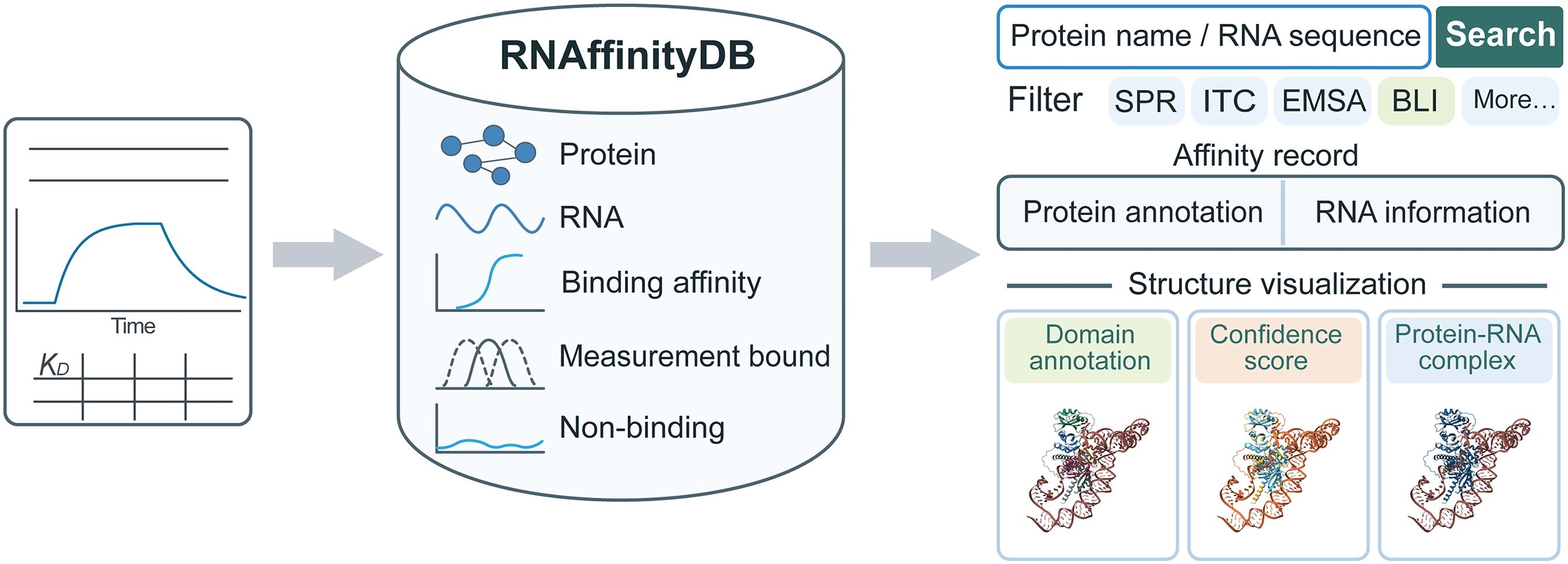
The researchers collected and organized 10,016 experimental binding records from 1,055 scientific publications. These records cover 3,057 distinct protein constructs and 4,638 RNA sequences.
Each database entry connects a specific RNA sequence with a defined protein construct and its experimentally measured binding affinity. The database also preserves information about experimental methods, measurement limitations and cases where no detectable binding occurred.
This level of detail is important because different versions of a protein, or small changes in an RNA sequence, can produce substantially different binding strengths.
By maintaining these distinctions, RNAffinityDB allows researchers to compare interactions more accurately and investigate the sequence features that influence RNA-protein recognition.
Combining experimental data with structural predictions
RNAffinityDB offers several features that make the information easier to explore.
Users can search by protein name, RNA sequence or biological function, making it possible to identify relevant interactions without examining hundreds of individual publications.
The database also connects records to UniProt, a resource containing information about protein sequences and functions.
An additional feature integrates AlphaFold 3, an artificial intelligence system that predicts molecular structures. Researchers can explore interactive three-dimensional models of RNA-protein complexes to better understand how the molecules may interact.
These structural predictions complement the experimental binding measurements, providing additional context for investigating the molecular basis of RNA-protein recognition.
Applications in RNA research and computational modeling
The researchers demonstrated how RNAffinityDB can help investigate differences in binding affinity using TDP-43, an RNA-binding protein associated with several neurodegenerative disorders.
By comparing previously published measurements, they examined how changes in RNA sequence length, protein mutations and protein domain composition affect binding strength.
Beyond individual proteins, the database could support the development of computational models that predict RNA-protein binding affinities. Such models may help scientists identify important RNA sequence features and better understand how mutations affect molecular interactions.
These capabilities could complement RNA sequencing research by helping scientists interpret the functional consequences of RNA sequences and their interactions with regulatory proteins.
Expanding our understanding of RNA regulation
RNAffinityDB provides a centralized resource for investigating the molecular interactions that regulate RNA behavior inside cells. By combining thousands of experimental measurements with protein annotations and predicted molecular structures, the database makes previously fragmented information easier to access and analyze.
The resource could support research into gene regulation, RNA biology and disease-associated molecular changes, while providing valuable training data for future computational models.
Availability – RNAffinityDB is freely available at https://www.ultrarnalab.com/RNAffinityDB.php.
Wang H, Huang H, Xiao H, Jäschke A, Ye Q, Zhang Y. (2026) RNAffinityDB: a curated database of experimental RNA–protein binding affinities. Nucleic Acids Research [Epub ahead of print]. [article]
Related Posts


RNA molecules perform many important functions inside cells, from carrying genetic instructions to regulating gene activity. However, RNA rarely works alone. Proteins interact with RNA to control how it is processed, transported, translated into proteins and eventually broken down.
Understanding these interactions is essential for studying normal cellular functions and the molecular mechanisms underlying disease. One important factor is binding affinity, which describes how strongly a protein binds to a particular RNA molecule.
Researchers at the Institute of Pharmacy and Molecular Biotechnology, Heidelberg University have developed RNAffinityDB, a freely accessible database that organizes experimental measurements of RNA-protein binding strength. Their findings, published in Nucleic Acids Research, provide a resource for investigating how RNA sequences influence their interactions with proteins.
RNA-binding proteins help regulate nearly every stage of an RNA molecule’s life cycle. Some proteins control RNA splicing, which determines how RNA transcripts are processed, while others influence RNA stability, localization and protein production.
The strength of these interactions can determine how effectively a protein performs its function. Even small changes in an RNA sequence can alter how strongly a protein binds, potentially affecting gene regulation.
Although scientists have measured RNA-protein binding affinities for decades, much of this information has remained scattered across individual publications. Differences in experimental methods and reporting practices have also made it difficult to compare results.
RNAffinityDB addresses these challenges by bringing previously published measurements together in a standardized, searchable resource.
A comprehensive database of RNA-protein interactions
The researchers collected and organized 10,016 experimental binding records from 1,055 scientific publications. These records cover 3,057 distinct protein constructs and 4,638 RNA sequences.
Each database entry connects a specific RNA sequence with a defined protein construct and its experimentally measured binding affinity. The database also preserves information about experimental methods, measurement limitations and cases where no detectable binding occurred.
This level of detail is important because different versions of a protein, or small changes in an RNA sequence, can produce substantially different binding strengths.
By maintaining these distinctions, RNAffinityDB allows researchers to compare interactions more accurately and investigate the sequence features that influence RNA-protein recognition.
Combining experimental data with structural predictions
RNAffinityDB offers several features that make the information easier to explore.
Users can search by protein name, RNA sequence or biological function, making it possible to identify relevant interactions without examining hundreds of individual publications.
The database also connects records to UniProt, a resource containing information about protein sequences and functions.
An additional feature integrates AlphaFold 3, an artificial intelligence system that predicts molecular structures. Researchers can explore interactive three-dimensional models of RNA-protein complexes to better understand how the molecules may interact.
These structural predictions complement the experimental binding measurements, providing additional context for investigating the molecular basis of RNA-protein recognition.
Applications in RNA research and computational modeling
The researchers demonstrated how RNAffinityDB can help investigate differences in binding affinity using TDP-43, an RNA-binding protein associated with several neurodegenerative disorders.
By comparing previously published measurements, they examined how changes in RNA sequence length, protein mutations and protein domain composition affect binding strength.
Beyond individual proteins, the database could support the development of computational models that predict RNA-protein binding affinities. Such models may help scientists identify important RNA sequence features and better understand how mutations affect molecular interactions.
These capabilities could complement RNA sequencing research by helping scientists interpret the functional consequences of RNA sequences and their interactions with regulatory proteins.
Expanding our understanding of RNA regulation
RNAffinityDB provides a centralized resource for investigating the molecular interactions that regulate RNA behavior inside cells. By combining thousands of experimental measurements with protein annotations and predicted molecular structures, the database makes previously fragmented information easier to access and analyze.
The resource could support research into gene regulation, RNA biology and disease-associated molecular changes, while providing valuable training data for future computational models.
Availability – RNAffinityDB is freely available at https://www.ultrarnalab.com/RNAffinityDB.php.
Wang H, Huang H, Xiao H, Jäschke A, Ye Q, Zhang Y. (2026) RNAffinityDB: a curated database of experimental RNA–protein binding affinities. Nucleic Acids Research [Epub ahead of print]. [article]
Related Posts
Recent Posts
 PANGEA – an integrated cell atlas across diverse biological contexts enables systematic profiling of multicellular responses in human diseases
 UMIche – a UMI-centric analysis platform for enhancing molecular quantification accuracy in bulk and single-cell sequencing
 New AI tool uses RNA sequencing to uncover gene interactions in Alzheimer’s disease
 New RNA sequencing tool reveals how stem cells develop into heart cells
 Estimating the completeness of large-scale single-cell sequencing projects
 New RNA sequencing tool improves transcriptome reconstruction using machine learning
RNA-Seq Products & Services


Stay Connected