

Single-cell RNA sequencing is a powerful tool that helps scientists see which genes are active inside individual cells, shedding light on everything from how tissues develop to what goes wrong in disease. But traditional approaches often miss important pieces of the puzzle because they don’t capture all the parts of the RNA message for every cell. Some genes, or even specific regions within a gene’s messages, can go undetected, and that missing information can be exactly what researchers need to understand complex biology.
Researchers from the University of Zurich have developed a clever solution to this problem by creating a workflow called RoCK and ROI, which stands for Robust Capture of Key transcripts and Regions Of Interest. This new approach builds on standard single-cell RNA sequencing methods by adding two enhancements that help researchers focus on the transcripts and regions they care about most.
RoCK and ROI concept and examples of RoCKseq bead modification
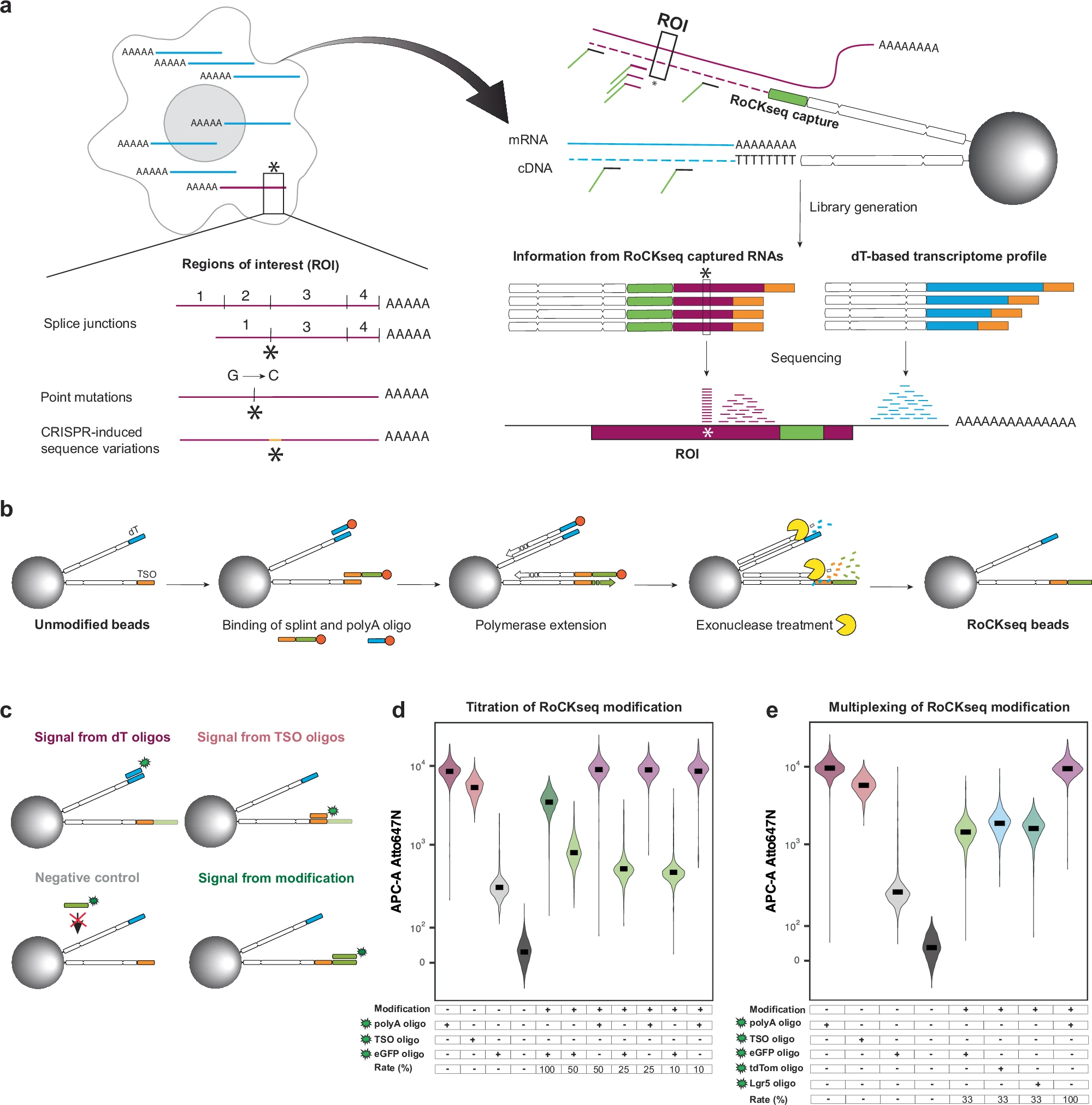
a Technique overview including BD Rhapsody beads modification (RoCKseq) and regions of interest enrichment (ROI) via primer addition. b RoCKseq bead modification. Red circles: 5’ phosphate groups on oligonucleotides. c Fluorescent assay to assess bead modification and quality of oligos on the beads. Signal from dT oligos: polyA probe binding to the dT stretch on the beads; Signal from TSO oligos: probe complementary to the TSO; Negative control: probe complementary to the capture on unmodified beads; Signal from modification: probe complementary to the capture on the modified beads. d, e FACS quantification of RoCKseq bead modification. Titration of modification on RoCKseq beads ranging from 100% to 10% (d). Target: eGFP CDS. Modification of RoCKseq beads with multiple capture sequences in the same ratio (33% each) (e). Targets: eGFP CDS, tdTomato CDS, Lgr5 CDS. To assess integrity of dT oligos on modified beads and to determine splint removal by lambda exonuclease, beads were tested using a polyA fluorescent oligo. For d, e, Y-axis: Atto647N fluorescent signal. The y axis has a biexponential transformation.
The first part, RoCKseq, enriches the sequencing data for specific transcripts that are especially important, so that even rare or low-abundance RNA molecules are more likely to be detected. The second part, ROIseq, directs sequencing efforts toward particular regions within those transcripts, allowing scientists to capture detailed sequence information that would otherwise be overlooked. Crucially, both enhancements work alongside the normal whole-transcriptome data, so researchers still get a broad picture of gene activity across all cells.
By testing these methods across different biological systems, the team showed that RoCK and ROI can reveal important transcriptomic features that standard methods often miss, all without sacrificing the overall quality of the single-cell data. That means researchers can get both the big picture and the critical fine details in one experiment.
Moro G, Mallona I, Barz MJ, Maillard J, Brügger MD, Fazilaty H, Szabo Q, Valenta T, Handler K, Kerlin F, Bastian L, Baldus CD, Moor AE, Zinzen R, Robinson MD, Brunner E, Basler K (2025) RoCK and ROI: single-cell transcriptomics with multiplexed enrichment of selected transcripts and region-specific sequencing. Nature Communications 16(1): 10991. [article]
Related Posts




Single-cell RNA sequencing is a powerful tool that helps scientists see which genes are active inside individual cells, shedding light on everything from how tissues develop to what goes wrong in disease. But traditional approaches often miss important pieces of the puzzle because they don’t capture all the parts of the RNA message for every cell. Some genes, or even specific regions within a gene’s messages, can go undetected, and that missing information can be exactly what researchers need to understand complex biology.
Researchers from the University of Zurich have developed a clever solution to this problem by creating a workflow called RoCK and ROI, which stands for Robust Capture of Key transcripts and Regions Of Interest. This new approach builds on standard single-cell RNA sequencing methods by adding two enhancements that help researchers focus on the transcripts and regions they care about most.
RoCK and ROI concept and examples of RoCKseq bead modification
a Technique overview including BD Rhapsody beads modification (RoCKseq) and regions of interest enrichment (ROI) via primer addition. b RoCKseq bead modification. Red circles: 5’ phosphate groups on oligonucleotides. c Fluorescent assay to assess bead modification and quality of oligos on the beads. Signal from dT oligos: polyA probe binding to the dT stretch on the beads; Signal from TSO oligos: probe complementary to the TSO; Negative control: probe complementary to the capture on unmodified beads; Signal from modification: probe complementary to the capture on the modified beads. d, e FACS quantification of RoCKseq bead modification. Titration of modification on RoCKseq beads ranging from 100% to 10% (d). Target: eGFP CDS. Modification of RoCKseq beads with multiple capture sequences in the same ratio (33% each) (e). Targets: eGFP CDS, tdTomato CDS, Lgr5 CDS. To assess integrity of dT oligos on modified beads and to determine splint removal by lambda exonuclease, beads were tested using a polyA fluorescent oligo. For d, e, Y-axis: Atto647N fluorescent signal. The y axis has a biexponential transformation.
The first part, RoCKseq, enriches the sequencing data for specific transcripts that are especially important, so that even rare or low-abundance RNA molecules are more likely to be detected. The second part, ROIseq, directs sequencing efforts toward particular regions within those transcripts, allowing scientists to capture detailed sequence information that would otherwise be overlooked. Crucially, both enhancements work alongside the normal whole-transcriptome data, so researchers still get a broad picture of gene activity across all cells.
By testing these methods across different biological systems, the team showed that RoCK and ROI can reveal important transcriptomic features that standard methods often miss, all without sacrificing the overall quality of the single-cell data. That means researchers can get both the big picture and the critical fine details in one experiment.
Moro G, Mallona I, Barz MJ, Maillard J, Brügger MD, Fazilaty H, Szabo Q, Valenta T, Handler K, Kerlin F, Bastian L, Baldus CD, Moor AE, Zinzen R, Robinson MD, Brunner E, Basler K (2025) RoCK and ROI: single-cell transcriptomics with multiplexed enrichment of selected transcripts and region-specific sequencing. Nature Communications 16(1): 10991. [article]
Related Posts
Recent Posts
 RNAmel simplifies RNA sequencing data analysis with a reproducible, integrated platform
 Heart failure reshapes bone marrow to create inflammation-related immune memory
 Overlooked DNA regions surrounding ‘microexons’ hold missing pieces of autism’s genetic puzzle
 RiboBA improves detection of hidden protein-coding regions using ribosome profiling
 An anti-senescence gene may fight spinal disc deterioration
 Bulk RNA-seq Analysis: A Complete Beginner’s Guide
RNA-Seq Products & Services


Stay Connected