- African American women have highest incidence of deadliest type of breast cancer
- Study included 462 African American women with TNBC across the US
- Findings appear today in Nature Genetics
Triple-negative breast cancer (TNBC), the deadliest breast cancer subtype, disproportionately affects African American women – but until now, they were underrepresented in genomic studies aimed at identifying the genetic mutations driving the disease. A landmark study led by researchers at Roswell Park Comprehensive Cancer Center and collaborating institutions fills that knowledge gap. Song Yao, MD, PhD, Professor of Oncology at Roswell Park, is lead author of the study, “Mutational Landscape of Triple-Negative Breast Cancer in African American Women,” which appears today in Nature Genetics.
Using whole-exome and RNA sequencing, investigators created the largest and most detailed mutational profile of 462 African American women with TNBC and found it was largely similar to that of Asian American and non-Hispanic white women, with no evidence of association with African ancestry. The team found that mutations in the TP53 gene were present in almost all African American TNBC patients – much more prevalent than previously realized.
“There is a long-standing question in the field of TNBC epidemiology of whether the disproportionately high incidence of TNBC in African American women is a result of different cancer biology or socio-environmental exposures,” says Dr. Yao. “Our data do not support major racial differences in TNBC biology at the level of somatic mutations, which are not inherited but acquired by cancer cells during disease development and progression.”
The researchers also identified two main pathways of disease development in this population. One, occurring more often in younger patients, is related to genetic predisposition and faulty DNA damage repair; the other, found more often in older patients, is related to aging and the effects of obesity. “This is quite fascinating!” says Dr. Yao.
Clinically actionable genomic changes in TNBC from AA women
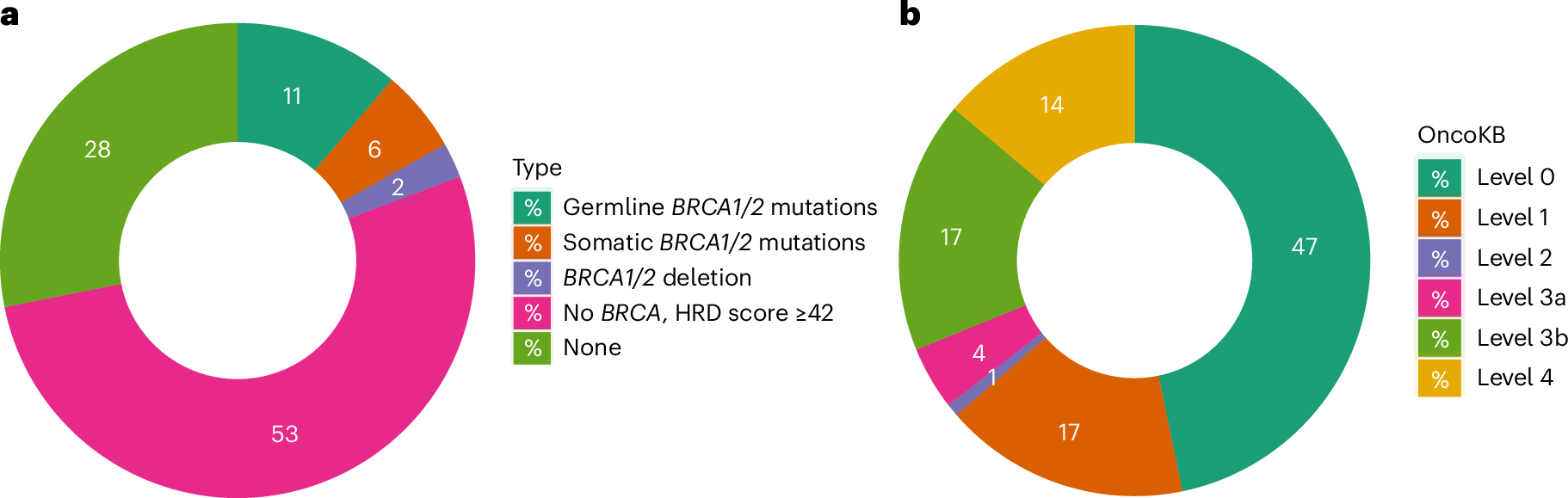
Donut plots of actionable alterations in TNBC from AA women. Numbers in the plots are percentage of cases classified to each category. a, HRD defined on the basis of germline and somatic mutations in BRCA1 and BRCA2, and an HRD score ≥42, which predicts response to neoadjuvant chemotherapy. b, Classification of actionable somatic mutations, CNAs or fusion events based on OncoKB database Level 1, Food and Drug Administration (FDA)-recognized biomarker predictive of response to an FDA-approved drug; level 2, standard care biomarkers predictive of response to an FDA-approved drug; level 3a, compelling clinical evidence for the biomarker predictive of response to a drug; level 3b, standard care of investigational biomarker predictive of response to an FDA-approved or investigational drug; level 4, compelling biological evidence for the biomarker predictive of response to a drug.
“We tend to link TNBC with deficiency in DNA damage repair and with younger women, but now we see evidence that aging and obesity may play a role in the development of TNBC as well.”
This study is a result of close collaboration among investigators at Roswell Park, including Christine Ambrosone, PhD, Senior Vice President of Population Sciences, and several other institutions, including John Carpten, PhD, at City of Hope Comprehensive Cancer Center; Wei Zheng, MD, PhD, MPH, at Vanderbilt-Ingram Cancer Center; and Julie Palmer, ScD, at Slone Epidemiology Center, Boston University. The Bioinformatics team at Roswell Park, headed by Song Liu, PhD, MBA, Vice Chair, Biostatistics and Bioinformatics, and colleagues Lei Wei, PhD, and Qiang Hu, MD, PhD, led the bioinformatics analysis of the massive dataset.
The study was made possible by pooling resources from the Women’s Circle of Health Study (WCHS), the Black Women’s Health Study (BWHS) and the Southern Community Cohort Study (SCCS), with patient volunteers from across the country who donated their time, efforts and samples.
Source – Newswise


Triple-negative breast cancer (TNBC), the deadliest breast cancer subtype, disproportionately affects African American women – but until now, they were underrepresented in genomic studies aimed at identifying the genetic mutations driving the disease. A landmark study led by researchers at Roswell Park Comprehensive Cancer Center and collaborating institutions fills that knowledge gap. Song Yao, MD, PhD, Professor of Oncology at Roswell Park, is lead author of the study, “Mutational Landscape of Triple-Negative Breast Cancer in African American Women,” which appears today in Nature Genetics.
Using whole-exome and RNA sequencing, investigators created the largest and most detailed mutational profile of 462 African American women with TNBC and found it was largely similar to that of Asian American and non-Hispanic white women, with no evidence of association with African ancestry. The team found that mutations in the TP53 gene were present in almost all African American TNBC patients – much more prevalent than previously realized.
The researchers also identified two main pathways of disease development in this population. One, occurring more often in younger patients, is related to genetic predisposition and faulty DNA damage repair; the other, found more often in older patients, is related to aging and the effects of obesity. “This is quite fascinating!” says Dr. Yao.
Clinically actionable genomic changes in TNBC from AA women
Donut plots of actionable alterations in TNBC from AA women. Numbers in the plots are percentage of cases classified to each category. a, HRD defined on the basis of germline and somatic mutations in BRCA1 and BRCA2, and an HRD score ≥42, which predicts response to neoadjuvant chemotherapy. b, Classification of actionable somatic mutations, CNAs or fusion events based on OncoKB database Level 1, Food and Drug Administration (FDA)-recognized biomarker predictive of response to an FDA-approved drug; level 2, standard care biomarkers predictive of response to an FDA-approved drug; level 3a, compelling clinical evidence for the biomarker predictive of response to a drug; level 3b, standard care of investigational biomarker predictive of response to an FDA-approved or investigational drug; level 4, compelling biological evidence for the biomarker predictive of response to a drug.
This study is a result of close collaboration among investigators at Roswell Park, including Christine Ambrosone, PhD, Senior Vice President of Population Sciences, and several other institutions, including John Carpten, PhD, at City of Hope Comprehensive Cancer Center; Wei Zheng, MD, PhD, MPH, at Vanderbilt-Ingram Cancer Center; and Julie Palmer, ScD, at Slone Epidemiology Center, Boston University. The Bioinformatics team at Roswell Park, headed by Song Liu, PhD, MBA, Vice Chair, Biostatistics and Bioinformatics, and colleagues Lei Wei, PhD, and Qiang Hu, MD, PhD, led the bioinformatics analysis of the massive dataset.
The study was made possible by pooling resources from the Women’s Circle of Health Study (WCHS), the Black Women’s Health Study (BWHS) and the Southern Community Cohort Study (SCCS), with patient volunteers from across the country who donated their time, efforts and samples.
Source – Newswise
Yao S, Wei L, Hu Q, Liu S, Manojlovic Z, Fiorica PN, Long M, Zirpoli GR, Cai Q, Long J, Ping J, Barnard ME, Jin Y, Murakami M, Wang J, Zhu Q, Davis W, Chen J, Ondracek RP, Khoury T, Gandhi S, Takabe K, Ko N, Sanderson M, Hong CC, Bandera EV, Craig DW, Ambrosone CB, Palmer JR, Zheng W, Carpten JD. (2025) Mutational landscape of triple-negative breast cancer in African American women. Nature Genetics [Epub ahead of print]. [article]
Related Posts
RNAmel simplifies RNA sequencing data analysis with a reproducible, integrated platform
Heart failure reshapes bone marrow to create inflammation-related immune memory
Overlooked DNA regions surrounding ‘microexons’ hold missing pieces of autism’s genetic puzzle
RiboBA improves detection of hidden protein-coding regions using ribosome profiling
An anti-senescence gene may fight spinal disc deterioration
Lexogen and Mithrl connect RNA-Seq library prep to AI-powered biological interpretation
Scientists identify the neuroblastoma cells that signal poor outcomes
Illumina releases SpliceAI2 to help advance rare disease research
Novel biosensor uses DNA ‘barcodes’ to uncover disease signals in cells
Boehringer taps Envisagenics’ AI to mine RNA splicing for cancer targets
CellART extracts single-cell information from high-resolution spatial transcriptomics
Cell2space restores spatial context to single-cell RNA sequencing data
Urine test may improve bladder cancer diagnosis and guide treatment decisions
DeCoRE – a computational method to resolve RNA structural heterogeneity from RNA structure probing data by direct RNA sequencing
Tracing 700 million years of cell evolution
How should biological replicates be handled in long-read RNA sequencing?
RNA-Seq reveals a new way the developing heart controls its growth
The Human RNome Project Consortium seeks to publish first-ever complete sequence of the body’s RNA
scFlowReport brings multiple single-cell RNA sequencing analyses into one workflow
Long-read RNA sequencing reveals how neurons choose alternative RNA endings
Stay Connected
Submit a Post to the Blog
Recent Posts
Subscribe to the RNA-Seq Blog
RNA-Seq Products & Services