

Single-cell RNA sequencing (scRNA-seq) is a powerful tool for studying gene expression at the cellular level. However, it can be tricky to analyze rare cell populations, especially when working with tiny, hard-to-find groups of cells. Researchers often face the challenge of collecting enough rare cells for reliable data. Traditionally, scientists enrich the target cells from multiple specimens, pooling them together to get a sample large enough to study. But this method can blur the origin of individual samples and make it harder to detect meaningful biological or technical differences—an issue that’s especially critical in complex studies, such as disease research or genetic screening.
What is Sample Multiplexing?
Sample multiplexing offers a clever solution to this problem. It involves tagging cells from different samples with unique barcodes, allowing researchers to track their origins even after they’re mixed together. These barcodes are then decoded during data analysis, making it easier to understand where each cell came from and how it behaves.
Researchers at Baylor College of Medicine applied sample multiplexing using cholesterol-modified oligonucleotides (special molecules attached to cell barcodes) to mouse retinal ganglion cells. These retinal cells are important for vision and are often studied to understand diseases such as glaucoma. Using this technique, the researchers were able to explore differences between retinal samples with much greater accuracy than would be possible through traditional pooling methods.

What Makes This Approach Useful?
This new pipeline offers several advantages:
- More Accurate Cell Tracking: It maintains the link between a cell’s origin and its behavior, even when samples are pooled. This is especially useful in studies with high variability, such as experiments involving genetic changes or disease models.
- Reduced Multiplet Errors: One common issue in scRNA-seq is the accidental grouping of multiple cells as one (“multiplets”). The study shows that the multiplexed data can help identify and filter out these errors, leading to cleaner, more reliable results.
- Investigating Variability: With this enhanced data precision, the team could dive deeper into the distribution and variation of retinal ganglion cell types, gaining new insights into their diversity and function.
Why Is This Important?
By improving the ability to study rare cells, this approach opens new doors for research in fields like neuroscience and disease biology. It could also make it easier to run large-scale genetic screens, where tracking individual samples is crucial. Ultimately, better methods for analyzing rare cells will lead to a deeper understanding of complex biological systems and help develop more targeted therapies for diseases.
This study demonstrates the potential of multiplexed scRNA-seq to enhance our ability to analyze complex data, ensuring that no valuable information is lost along the way.
Ma J, Chu TK, Polo Prieto M, Park Y, Li Y, Chen R, Mardon G, Frankfort BJ, Tran NM.(2024) Sample multiplexing for retinal single-cell RNA-sequencing. bioRxiv [Preprint]. [article]
Related Posts


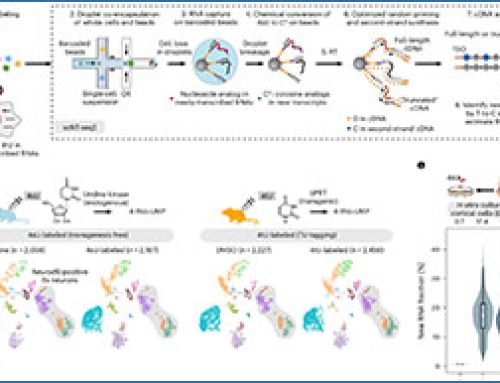


Single-cell RNA sequencing (scRNA-seq) is a powerful tool for studying gene expression at the cellular level. However, it can be tricky to analyze rare cell populations, especially when working with tiny, hard-to-find groups of cells. Researchers often face the challenge of collecting enough rare cells for reliable data. Traditionally, scientists enrich the target cells from multiple specimens, pooling them together to get a sample large enough to study. But this method can blur the origin of individual samples and make it harder to detect meaningful biological or technical differences—an issue that’s especially critical in complex studies, such as disease research or genetic screening.
What is Sample Multiplexing?
Sample multiplexing offers a clever solution to this problem. It involves tagging cells from different samples with unique barcodes, allowing researchers to track their origins even after they’re mixed together. These barcodes are then decoded during data analysis, making it easier to understand where each cell came from and how it behaves.
Researchers at Baylor College of Medicine applied sample multiplexing using cholesterol-modified oligonucleotides (special molecules attached to cell barcodes) to mouse retinal ganglion cells. These retinal cells are important for vision and are often studied to understand diseases such as glaucoma. Using this technique, the researchers were able to explore differences between retinal samples with much greater accuracy than would be possible through traditional pooling methods.
What Makes This Approach Useful?
This new pipeline offers several advantages:
- More Accurate Cell Tracking: It maintains the link between a cell’s origin and its behavior, even when samples are pooled. This is especially useful in studies with high variability, such as experiments involving genetic changes or disease models.
- Reduced Multiplet Errors: One common issue in scRNA-seq is the accidental grouping of multiple cells as one (“multiplets”). The study shows that the multiplexed data can help identify and filter out these errors, leading to cleaner, more reliable results.
- Investigating Variability: With this enhanced data precision, the team could dive deeper into the distribution and variation of retinal ganglion cell types, gaining new insights into their diversity and function.
Why Is This Important?
By improving the ability to study rare cells, this approach opens new doors for research in fields like neuroscience and disease biology. It could also make it easier to run large-scale genetic screens, where tracking individual samples is crucial. Ultimately, better methods for analyzing rare cells will lead to a deeper understanding of complex biological systems and help develop more targeted therapies for diseases.
This study demonstrates the potential of multiplexed scRNA-seq to enhance our ability to analyze complex data, ensuring that no valuable information is lost along the way.
Ma J, Chu TK, Polo Prieto M, Park Y, Li Y, Chen R, Mardon G, Frankfort BJ, Tran NM.(2024) Sample multiplexing for retinal single-cell RNA-sequencing. bioRxiv [Preprint]. [article]
Related Posts
Recent Posts
 New AI tool uses RNA sequencing to uncover gene interactions in Alzheimer’s disease
 New RNA sequencing tool reveals how stem cells develop into heart cells
 Estimating the completeness of large-scale single-cell sequencing projects
 New RNA sequencing tool improves transcriptome reconstruction using machine learning
 DeMixNB: deconvolution of sparse-count RNA sequencing data for tumor cells
 New RNA sequencing method improves tRNA analysis using deep learning
RNA-Seq Products & Services



Stay Connected