


Single-cell RNA sequencing allows scientists to study how individual cells behave, revealing important differences between cells in tissues, tumors, and developing organs. However, analyzing this data is not simple. The data can be noisy, incomplete, and influenced by technical differences between experiments, which makes it difficult to compare results across studies.
Researchers at RWTH Aachen University have developed a new computational method called scDecorr to address these challenges. The goal of this approach is to better capture the true biological signals in single-cell data while reducing unwanted technical variation.
Overview of the scDecorr workflow
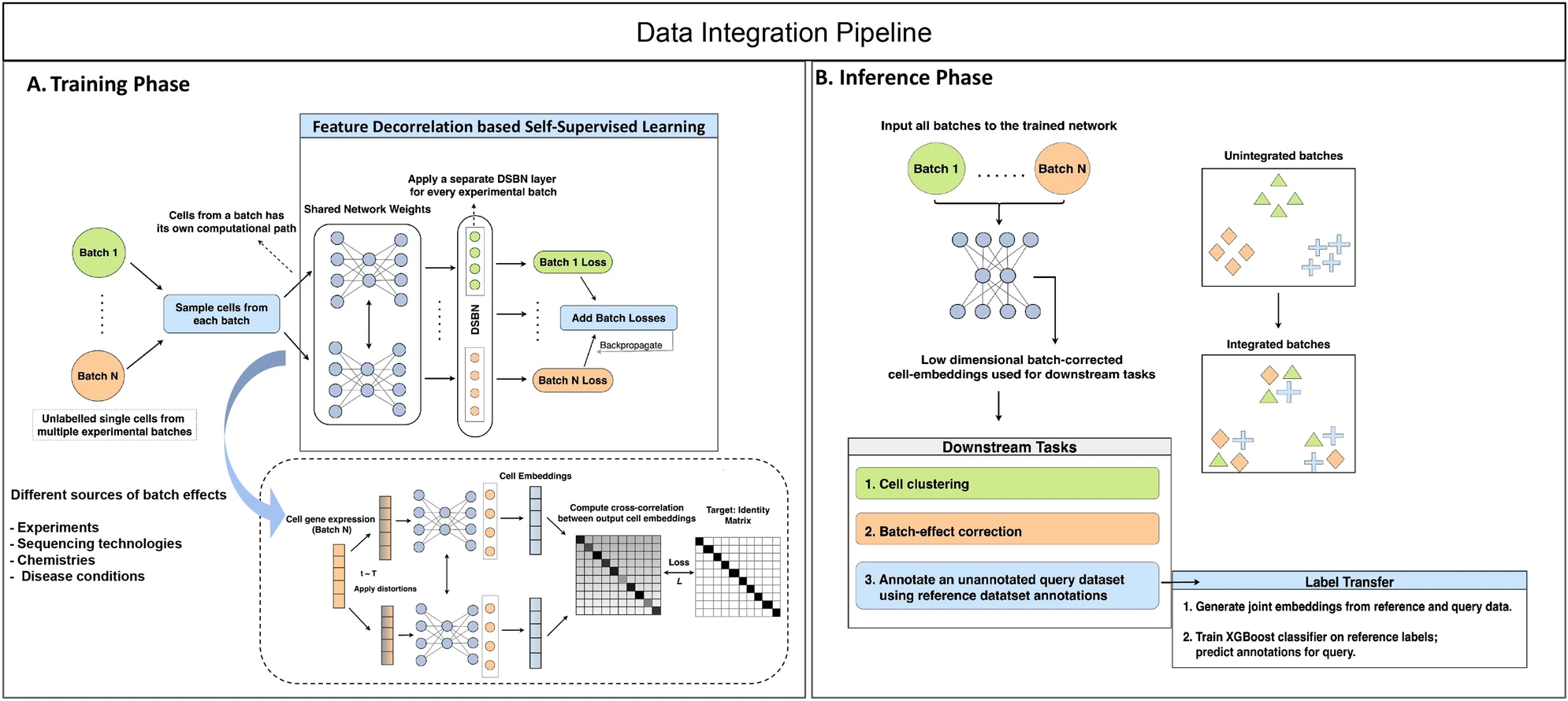
scDecorr takes as input single-cell gene-expression matrix coming from different studies (Domains) and uses a self-supervised feature decorrelation approach using a siamese twin model to obtain an optimal data representation. This representation is then used to perform typical single-cell downstream tasks such as clustering, batch-effect correction and cell-type annotation. We show the utility of scDecorr on 4 datasets from different tissues and technologies and compare it to other computational tools on similar tasks.
The method uses a concept called self-supervised learning, which means it can learn patterns in the data without needing predefined labels for cell types. Instead of relying on prior knowledge, scDecorr identifies similarities between cells and builds a simplified representation of the data. This helps researchers understand how cells are related to one another.
A key feature of scDecorr is its ability to reduce noise while preserving meaningful biological differences. It does this by separating important signals from technical artifacts, allowing for more accurate interpretation of gene expression patterns. This is especially useful when combining datasets from different experiments, which often have inconsistencies due to batch effects.
The framework also supports integration across multiple datasets. By aligning data collected under different conditions, scDecorr enables researchers to compare results more effectively and identify consistent biological trends. This improves tasks like clustering cells into groups and transferring cell-type labels between datasets.
Overall, scDecorr provides a more reliable way to analyze large and complex single-cell RNA sequencing datasets. As these technologies continue to grow, tools that improve data integration and interpretation will be essential for advancing research in biology and disease.
Availability – The code is available here https://github.com/hayatlab/scdecorr.
Sanyal R, Xu Y, Kim H, Kramann R, Hayat S. (2026) scDecorr: feature decorrelation based representation learning enables self-supervised alignment of multiple single-cell experiments. Scientific Reports 16(1): 13782. [article]
Related Posts






Single-cell RNA sequencing allows scientists to study how individual cells behave, revealing important differences between cells in tissues, tumors, and developing organs. However, analyzing this data is not simple. The data can be noisy, incomplete, and influenced by technical differences between experiments, which makes it difficult to compare results across studies.
Researchers at RWTH Aachen University have developed a new computational method called scDecorr to address these challenges. The goal of this approach is to better capture the true biological signals in single-cell data while reducing unwanted technical variation.
Overview of the scDecorr workflow
scDecorr takes as input single-cell gene-expression matrix coming from different studies (Domains) and uses a self-supervised feature decorrelation approach using a siamese twin model to obtain an optimal data representation. This representation is then used to perform typical single-cell downstream tasks such as clustering, batch-effect correction and cell-type annotation. We show the utility of scDecorr on 4 datasets from different tissues and technologies and compare it to other computational tools on similar tasks.
The method uses a concept called self-supervised learning, which means it can learn patterns in the data without needing predefined labels for cell types. Instead of relying on prior knowledge, scDecorr identifies similarities between cells and builds a simplified representation of the data. This helps researchers understand how cells are related to one another.
A key feature of scDecorr is its ability to reduce noise while preserving meaningful biological differences. It does this by separating important signals from technical artifacts, allowing for more accurate interpretation of gene expression patterns. This is especially useful when combining datasets from different experiments, which often have inconsistencies due to batch effects.
The framework also supports integration across multiple datasets. By aligning data collected under different conditions, scDecorr enables researchers to compare results more effectively and identify consistent biological trends. This improves tasks like clustering cells into groups and transferring cell-type labels between datasets.
Overall, scDecorr provides a more reliable way to analyze large and complex single-cell RNA sequencing datasets. As these technologies continue to grow, tools that improve data integration and interpretation will be essential for advancing research in biology and disease.
Availability – The code is available here https://github.com/hayatlab/scdecorr.
Sanyal R, Xu Y, Kim H, Kramann R, Hayat S. (2026) scDecorr: feature decorrelation based representation learning enables self-supervised alignment of multiple single-cell experiments. Scientific Reports 16(1): 13782. [article]
Related Posts
Recent Posts
 Scientists identify the neuroblastoma cells that signal poor outcomes
 GARAGE improves rare cell detection in single-cell RNA sequencing analysis using AI
 Machine learning reveals how RNA splicing is regulated in individual cell types
 Illumina releases SpliceAI2 to help advance rare disease research
 Postdoctoral Fellow – Long-Read RNA Methods Development for Neurodegeneration
 Novel biosensor uses DNA ‘barcodes’ to uncover disease signals in cells
RNA-Seq Products & Services


Stay Connected