

A research team led by researchers at Boston Children’s Hospital has developed a powerful new tool for analyzing single-cell RNA sequencing data. The tool, called scDown, is designed to help scientists better understand how cells behave, communicate, and change over time, especially in the context of rare diseases.
Single-cell RNA sequencing (scRNA-seq) allows researchers to study the gene activity of individual cells, offering detailed insights into complex biological processes. While tools like Seurat and Scanpy are widely used to label and group cells based on their gene expression, analyzing what happens after that step often requires multiple additional programs.
scDown simplifies this process by integrating several important types of downstream analyses into one R package. These include:
- Cell proportion difference analysis (comparing how many cells of each type are found in different conditions),
- Pseudotime analysis and RNA velocity (which trace how cells change or “differentiate” over time),
- Cell-cell communication analysis (which reveals how cells interact with one another).
Flowchart of scDown
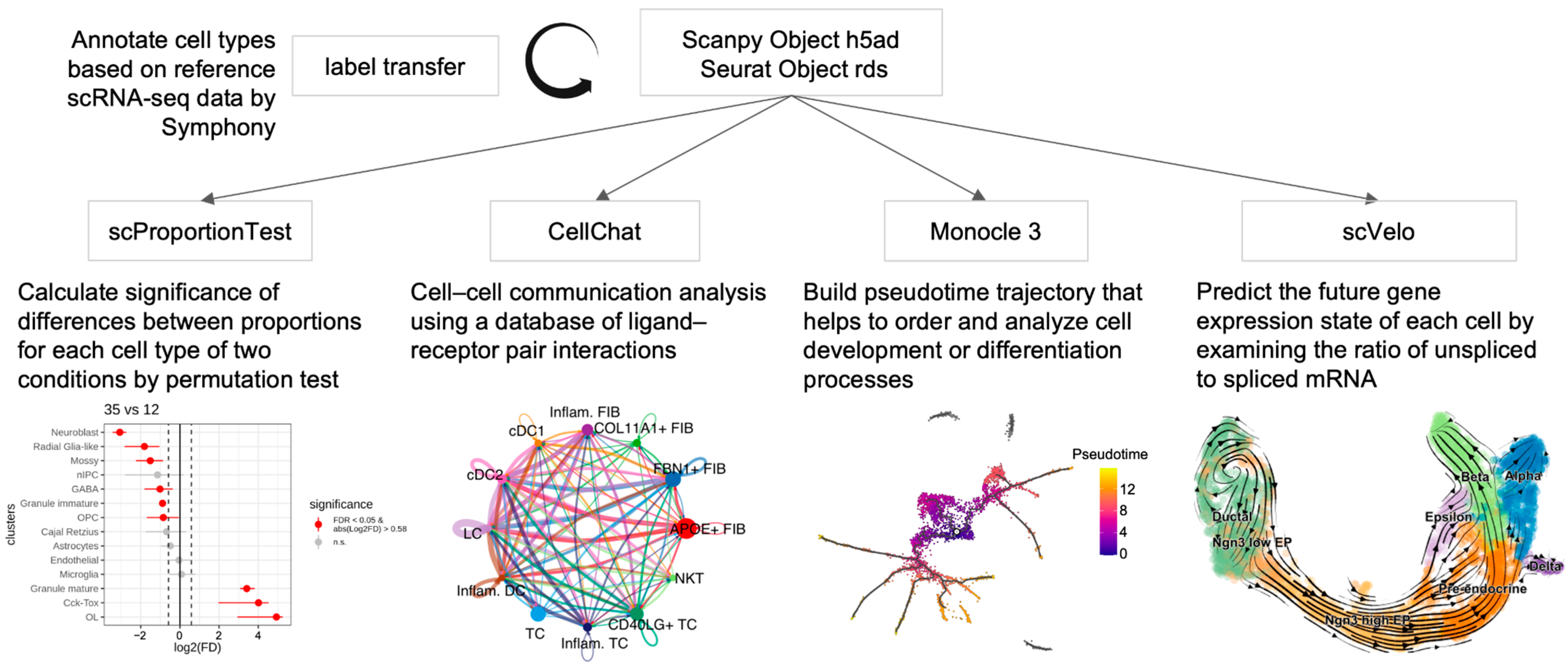
The scDown pipeline integrates multiple downstream analyses for scRNA-seq data. It includes automated cell type annotation using Symphony, cell proportion comparison with scProportionTest, cell–cell communication analysis via CellChat, trajectory inference with Monocle3, and RNA velocity analysis with scVelo.
To demonstrate its power, the team applied scDown to a previously published dataset. They discovered a unique pattern of inflammatory signaling in neurons related to a rare genetic neurodevelopmental disorder. This signal had not been detected using traditional analysis methods, showing how scDown can uncover hidden patterns that are important for understanding disease.
Because it works with data from both Seurat and Scanpy, scDown is accessible to a wide range of researchers. It could prove especially useful in studying rare diseases, where subtle changes in a small number of cells may hold important clues.
Availability – https://github.com/BCH-RC/scDown
Sun L, Ma Q, Cai C, Labaf M, Jain A, Dias C, Rockowitz S, Sliz P. (2025) scDown: A Pipeline for Single-Cell RNA-Seq Downstream Analysis. Int J Mol Sci 26(11):5297. [article]
Related Posts






A research team led by researchers at Boston Children’s Hospital has developed a powerful new tool for analyzing single-cell RNA sequencing data. The tool, called scDown, is designed to help scientists better understand how cells behave, communicate, and change over time, especially in the context of rare diseases.
Single-cell RNA sequencing (scRNA-seq) allows researchers to study the gene activity of individual cells, offering detailed insights into complex biological processes. While tools like Seurat and Scanpy are widely used to label and group cells based on their gene expression, analyzing what happens after that step often requires multiple additional programs.
scDown simplifies this process by integrating several important types of downstream analyses into one R package. These include:
- Cell proportion difference analysis (comparing how many cells of each type are found in different conditions),
- Pseudotime analysis and RNA velocity (which trace how cells change or “differentiate” over time),
- Cell-cell communication analysis (which reveals how cells interact with one another).
Flowchart of scDown
The scDown pipeline integrates multiple downstream analyses for scRNA-seq data. It includes automated cell type annotation using Symphony, cell proportion comparison with scProportionTest, cell–cell communication analysis via CellChat, trajectory inference with Monocle3, and RNA velocity analysis with scVelo.
To demonstrate its power, the team applied scDown to a previously published dataset. They discovered a unique pattern of inflammatory signaling in neurons related to a rare genetic neurodevelopmental disorder. This signal had not been detected using traditional analysis methods, showing how scDown can uncover hidden patterns that are important for understanding disease.
Because it works with data from both Seurat and Scanpy, scDown is accessible to a wide range of researchers. It could prove especially useful in studying rare diseases, where subtle changes in a small number of cells may hold important clues.
Availability – https://github.com/BCH-RC/scDown
Sun L, Ma Q, Cai C, Labaf M, Jain A, Dias C, Rockowitz S, Sliz P. (2025) scDown: A Pipeline for Single-Cell RNA-Seq Downstream Analysis. Int J Mol Sci 26(11):5297. [article]
Related Posts
Recent Posts
 RNAmel simplifies RNA sequencing data analysis with a reproducible, integrated platform
 Heart failure reshapes bone marrow to create inflammation-related immune memory
 Overlooked DNA regions surrounding ‘microexons’ hold missing pieces of autism’s genetic puzzle
 RiboBA improves detection of hidden protein-coding regions using ribosome profiling
 An anti-senescence gene may fight spinal disc deterioration
 Bulk RNA-seq Analysis: A Complete Beginner’s Guide
RNA-Seq Products & Services


Stay Connected