

Single-cell RNA sequencing (scRNA-seq) is a powerful tool for understanding the diversity of cells in the body. However, analyzing the vast amount of data generated from these experiments can be difficult, especially when dealing with datasets that lack clear labeling. Researchers at Peking University have developed scExtract, an innovative tool that uses artificial intelligence to make this process much easier.
The researchers developed scExtract to automate the entire analysis pipeline for single-cell RNA sequencing. The tool uses large language models to extract helpful information from scientific articles and apply it to the data processing steps. This includes everything from cleaning up the raw data to labeling the types of cells and combining datasets from different studies.
Workflow of scExtract
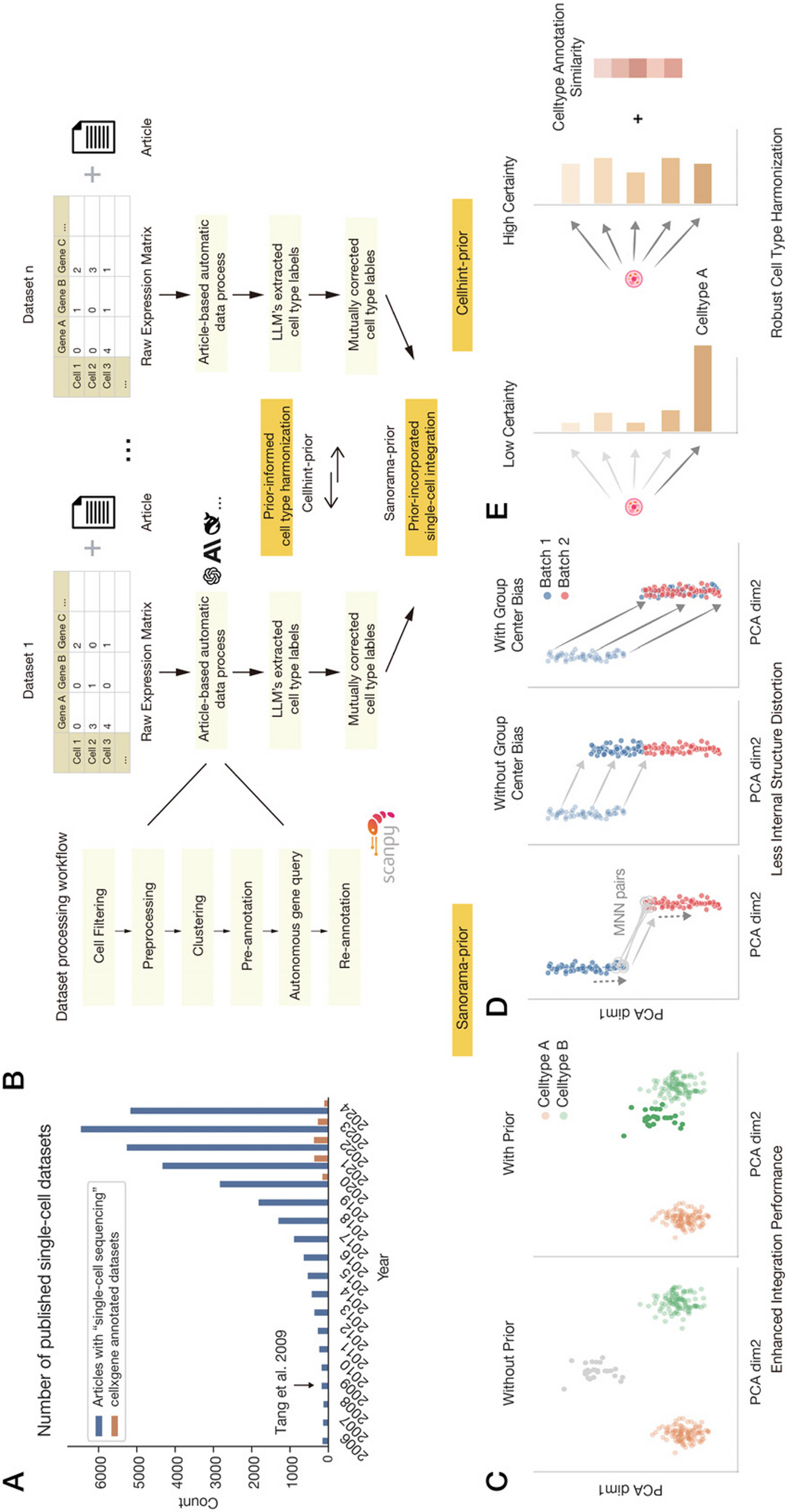 A Bar chart comparing the annual number of newly published single-cell sequencing articles versus datasets available on crowdsourcing platforms. B Schematic workflow illustrating the integration and annotation steps of scExtract. Individual datasets are first processed separately by the LLM agent, including preprocessing and annotation, before being merged together using annotation-based prior information for integration. C Scatter plot showing that Scanorama-prior utilizes label prior information to facilitate integration. D Scatter plot showing that Scanorama-prior better preserves the internal structure of cell clusters during integration. Left panel: During integration, Scanorama calculates mutual nearest pairs between two batches and determines the integration displacement vector (light gray arrows) through mutual nearest neighbor pairs. Scanorama-prior builds upon this by additionally considering the relative positions of cells within the clusters (gray dotted arrows). Middle panel: In Scanorama integration, cells move according to the original light gray displacement vectors, causing all Batch 1 cells to shift to the upper portion of Batch 2. Right panel: Scanorama-prior considers relative positions, using gray arrows for displacement, resulting in better preservation of internal structure. E Cellhint-prior dynamically adjusts the weights of prior knowledge based on the uncertainty of cell population assignments. When uncertainty is higher during the integration process, cellhint-prior incorporates a greater proportion of prior knowledge, ensuring the cautious introduction of prior information
To improve integration across multiple experiments, the authors also introduced two new tools, scanorama-prior and cellhint-prior, which use existing knowledge to correct for batch effects while still preserving important biological differences. Using these methods, the team successfully combined data from 14 different studies to create a detailed map of human skin containing 440,000 individual cells.
By using AI to automate and enhance data processing, scExtract makes it easier for researchers to unlock valuable insights from the growing number of publicly available single-cell datasets.
Availability – All original code of scExtract has been deposited on GitHub and is publicly available under https://github.com/yxwucq/scExtract
Wu Y, Tang F. (2025) scExtract: leveraging large language models for fully automated single-cell RNA-seq data annotation and prior-informed multi-dataset integration. Genome Biol 26(1): 174. [article]
Related Posts






Single-cell RNA sequencing (scRNA-seq) is a powerful tool for understanding the diversity of cells in the body. However, analyzing the vast amount of data generated from these experiments can be difficult, especially when dealing with datasets that lack clear labeling. Researchers at Peking University have developed scExtract, an innovative tool that uses artificial intelligence to make this process much easier.
The researchers developed scExtract to automate the entire analysis pipeline for single-cell RNA sequencing. The tool uses large language models to extract helpful information from scientific articles and apply it to the data processing steps. This includes everything from cleaning up the raw data to labeling the types of cells and combining datasets from different studies.
Workflow of scExtract
A Bar chart comparing the annual number of newly published single-cell sequencing articles versus datasets available on crowdsourcing platforms. B Schematic workflow illustrating the integration and annotation steps of scExtract. Individual datasets are first processed separately by the LLM agent, including preprocessing and annotation, before being merged together using annotation-based prior information for integration. C Scatter plot showing that Scanorama-prior utilizes label prior information to facilitate integration. D Scatter plot showing that Scanorama-prior better preserves the internal structure of cell clusters during integration. Left panel: During integration, Scanorama calculates mutual nearest pairs between two batches and determines the integration displacement vector (light gray arrows) through mutual nearest neighbor pairs. Scanorama-prior builds upon this by additionally considering the relative positions of cells within the clusters (gray dotted arrows). Middle panel: In Scanorama integration, cells move according to the original light gray displacement vectors, causing all Batch 1 cells to shift to the upper portion of Batch 2. Right panel: Scanorama-prior considers relative positions, using gray arrows for displacement, resulting in better preservation of internal structure. E Cellhint-prior dynamically adjusts the weights of prior knowledge based on the uncertainty of cell population assignments. When uncertainty is higher during the integration process, cellhint-prior incorporates a greater proportion of prior knowledge, ensuring the cautious introduction of prior information
To improve integration across multiple experiments, the authors also introduced two new tools, scanorama-prior and cellhint-prior, which use existing knowledge to correct for batch effects while still preserving important biological differences. Using these methods, the team successfully combined data from 14 different studies to create a detailed map of human skin containing 440,000 individual cells.
By using AI to automate and enhance data processing, scExtract makes it easier for researchers to unlock valuable insights from the growing number of publicly available single-cell datasets.
Availability – All original code of scExtract has been deposited on GitHub and is publicly available under https://github.com/yxwucq/scExtract
Wu Y, Tang F. (2025) scExtract: leveraging large language models for fully automated single-cell RNA-seq data annotation and prior-informed multi-dataset integration. Genome Biol 26(1): 174. [article]
Related Posts
Recent Posts
 Machine learning reveals how RNA splicing is regulated in individual cell types
 Illumina releases SpliceAI2 to help advance rare disease research
 Postdoctoral Fellow – Long-Read RNA Methods Development for Neurodegeneration
 Novel biosensor uses DNA ‘barcodes’ to uncover disease signals in cells
 GP-DHT uses single-cell RNA sequencing to map gene regulatory networks
 Boehringer taps Envisagenics’ AI to mine RNA splicing for cancer targets
RNA-Seq Products & Services



Stay Connected