

Single-cell RNA sequencing (scRNA-seq) offers an unprecedented opportunity to understand the cellular complexity and heterogeneity that defines both healthy and diseased states. By measuring the gene expression profiles of individual cells, researchers can uncover the complex workings of different cell types and their roles in broader biological systems. However, the full potential of scRNA-seq is often hampered by the limited number of cells that can be profiled, especially in studies focusing on rare diseases, specialized tissues, and uncommon cell types.
Challenges of Data Scarcity
One of the primary challenges associated with scRNA-seq is data scarcity. The limited number of cells sampled in many studies can restrict the statistical reliability of conclusions drawn from the data. While deep learning-based generative models (GMs) have been developed to address this issue by generating synthetic data, these models often rely on pre-training or fine-tuning. Unfortunately, this approach can perpetuate the cycle of data inadequacy, as the models are still constrained by the original limited datasets.
Introducing scGFT: An Improvement in Single-Cell Analysis
To overcome these limitations, researchers at Sanofi have introduced scGFT (single-cell Generative Fourier Transformer), a novel, train-free, cell-centric generative model designed to synthesize single cells with natural gene expression profiles. Unlike traditional GMs, scGFT does not rely on pre-training or fine-tuning, making it more versatile and less dependent on large datasets. This innovative approach allows scGFT to generate synthetic cells that accurately reflect the gene expression patterns found in authentic scRNA-seq data.
Overview of GAN, VAE, and GFT generative models
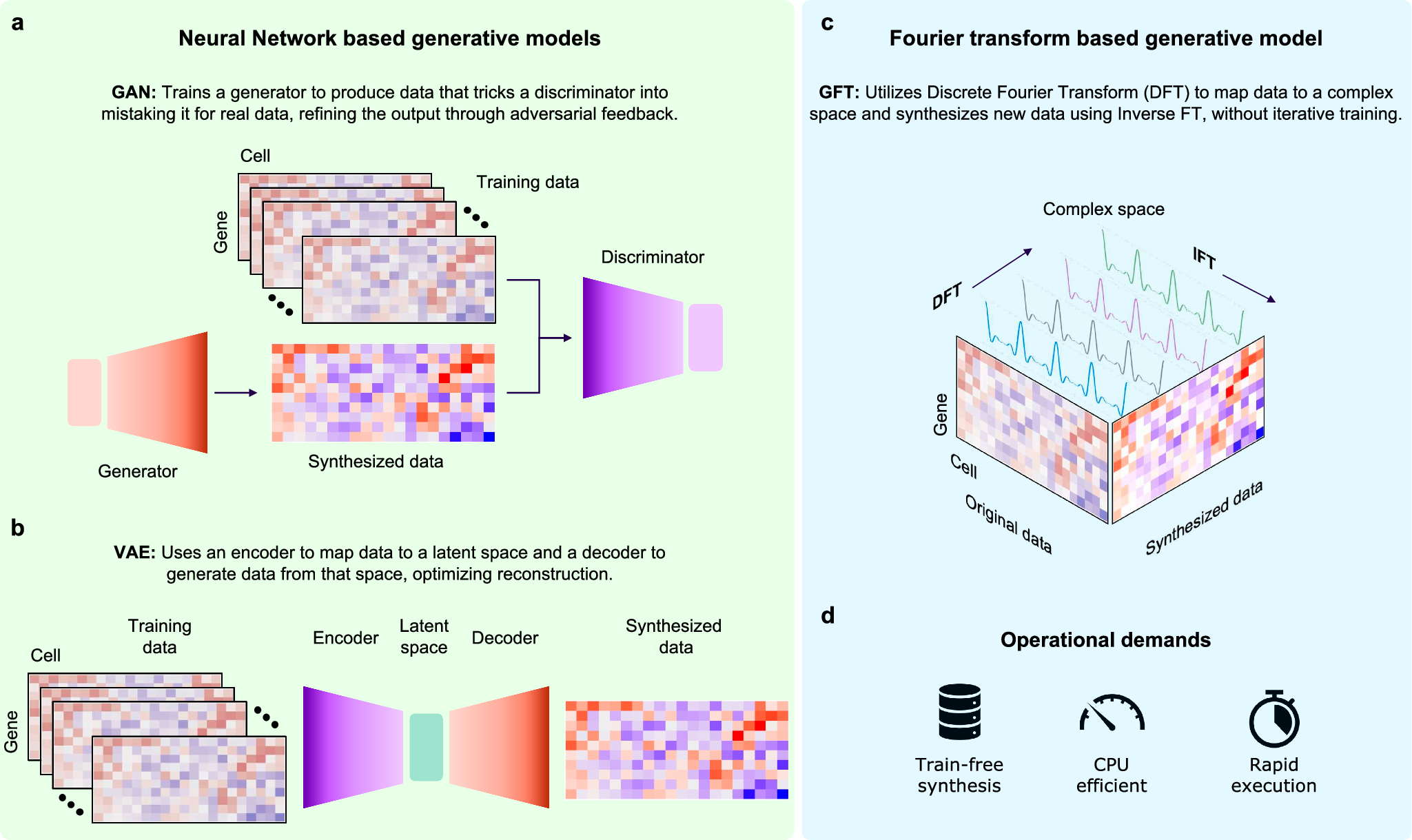
a Illustrates the operational frameworks of a generative adversarial network (GAN), focusing on the interactions between the generator and discriminator components for generating synthetic data. b Illustrates the operational frameworks of a variational autoencoder (VAE), highlighting the interactions among the encoder, latent space, and decoder for generating synthetic data. c Illustrates the operational framework of a generative fourier transformer (GFT) devised in this study, outlining the transformation of original cell gene expression profiles into a complex space using the discrete fourier transform (DFT) and reconstruction of synthetic profiles using the inverse fourier transform (IFT). d Illustrates the operational resources required by the Fourier transform-based generative model.
Key Features and Benefits of scGFT
- Mathematical Rigor: scGFT employs a mathematically rigorous approach to synthesize cells, ensuring that the generated data maintains the intrinsic characteristics of the original scRNA-seq profiles.
- Performance: Comparisons between scGFT and leading neural network-based GMs demonstrate its superior performance. This can be attributed to scGFT’s analytical mechanism, which enhances its ability to generate realistic and biologically relevant synthetic cells.
- Scalability: By streamlining the process of single-cell data augmentation, scGFT offers a scalable solution to mitigate data scarcity. This makes it an invaluable tool for researchers working on cell-targeted studies, particularly those involving rare cell types or limited sample sizes.
Implications for Future Research
The introduction of scGFT holds significant promise for the field of single-cell analysis. By providing a reliable means of augmenting scRNA-seq data, scGFT enables researchers to achieve statistically robust conclusions, even in studies with limited cell numbers. This advancement has the potential to accelerate discoveries in rare diseases, specialized tissues, and uncommon cell types, thereby paving the way for more comprehensive and insightful biological research.
Conclusion
In summary, scGFT represents a major breakthrough in overcoming the data scarcity challenges associated with single-cell RNA sequencing. Its ability to generate synthetic cells that accurately mirror natural gene expression profiles offers a powerful tool for researchers aiming to delve deeper into cellular complexity and heterogeneity. As the scientific community continues to harness the capabilities of scGFT, we can expect to see significant advancements in our understanding of cellular biology and the development of targeted therapies for various diseases.
Availability – The scGFT source code (R package) is available on GitHub
Nouri N. (2025) Single-cell RNA-seq data augmentation using generative Fourier transformer. Commun Biol 8(1):113. [article]
Related Posts






Single-cell RNA sequencing (scRNA-seq) offers an unprecedented opportunity to understand the cellular complexity and heterogeneity that defines both healthy and diseased states. By measuring the gene expression profiles of individual cells, researchers can uncover the complex workings of different cell types and their roles in broader biological systems. However, the full potential of scRNA-seq is often hampered by the limited number of cells that can be profiled, especially in studies focusing on rare diseases, specialized tissues, and uncommon cell types.
Challenges of Data Scarcity
One of the primary challenges associated with scRNA-seq is data scarcity. The limited number of cells sampled in many studies can restrict the statistical reliability of conclusions drawn from the data. While deep learning-based generative models (GMs) have been developed to address this issue by generating synthetic data, these models often rely on pre-training or fine-tuning. Unfortunately, this approach can perpetuate the cycle of data inadequacy, as the models are still constrained by the original limited datasets.
Introducing scGFT: An Improvement in Single-Cell Analysis
To overcome these limitations, researchers at Sanofi have introduced scGFT (single-cell Generative Fourier Transformer), a novel, train-free, cell-centric generative model designed to synthesize single cells with natural gene expression profiles. Unlike traditional GMs, scGFT does not rely on pre-training or fine-tuning, making it more versatile and less dependent on large datasets. This innovative approach allows scGFT to generate synthetic cells that accurately reflect the gene expression patterns found in authentic scRNA-seq data.
Overview of GAN, VAE, and GFT generative models
a Illustrates the operational frameworks of a generative adversarial network (GAN), focusing on the interactions between the generator and discriminator components for generating synthetic data. b Illustrates the operational frameworks of a variational autoencoder (VAE), highlighting the interactions among the encoder, latent space, and decoder for generating synthetic data. c Illustrates the operational framework of a generative fourier transformer (GFT) devised in this study, outlining the transformation of original cell gene expression profiles into a complex space using the discrete fourier transform (DFT) and reconstruction of synthetic profiles using the inverse fourier transform (IFT). d Illustrates the operational resources required by the Fourier transform-based generative model.
Key Features and Benefits of scGFT
- Mathematical Rigor: scGFT employs a mathematically rigorous approach to synthesize cells, ensuring that the generated data maintains the intrinsic characteristics of the original scRNA-seq profiles.
- Performance: Comparisons between scGFT and leading neural network-based GMs demonstrate its superior performance. This can be attributed to scGFT’s analytical mechanism, which enhances its ability to generate realistic and biologically relevant synthetic cells.
- Scalability: By streamlining the process of single-cell data augmentation, scGFT offers a scalable solution to mitigate data scarcity. This makes it an invaluable tool for researchers working on cell-targeted studies, particularly those involving rare cell types or limited sample sizes.
Implications for Future Research
The introduction of scGFT holds significant promise for the field of single-cell analysis. By providing a reliable means of augmenting scRNA-seq data, scGFT enables researchers to achieve statistically robust conclusions, even in studies with limited cell numbers. This advancement has the potential to accelerate discoveries in rare diseases, specialized tissues, and uncommon cell types, thereby paving the way for more comprehensive and insightful biological research.
Conclusion
In summary, scGFT represents a major breakthrough in overcoming the data scarcity challenges associated with single-cell RNA sequencing. Its ability to generate synthetic cells that accurately mirror natural gene expression profiles offers a powerful tool for researchers aiming to delve deeper into cellular complexity and heterogeneity. As the scientific community continues to harness the capabilities of scGFT, we can expect to see significant advancements in our understanding of cellular biology and the development of targeted therapies for various diseases.
Availability – The scGFT source code (R package) is available on GitHub
Nouri N. (2025) Single-cell RNA-seq data augmentation using generative Fourier transformer. Commun Biol 8(1):113. [article]
Related Posts
Recent Posts
 Scientists identify the neuroblastoma cells that signal poor outcomes
 GARAGE improves rare cell detection in single-cell RNA sequencing analysis using AI
 Machine learning reveals how RNA splicing is regulated in individual cell types
 Illumina releases SpliceAI2 to help advance rare disease research
 Postdoctoral Fellow – Long-Read RNA Methods Development for Neurodegeneration
 Novel biosensor uses DNA ‘barcodes’ to uncover disease signals in cells
RNA-Seq Products & Services


Stay Connected