

Single-cell RNA sequencing (scRNA-seq) has become a cornerstone tool in modern biology, allowing researchers to examine gene expression at the individual cell level. This powerful technique uncovers the vast diversity of cell types and states that exist within tissues, helping scientists understand biological processes in much greater detail. However, accurately classifying these cells and understanding their interactions remains a challenge.
scGraphformer, developed at the Chinese University of Hong Kong, is a new method designed to improve cell type classification from scRNA-seq data. This technique promises to take single-cell analysis to the next level by overcoming limitations of traditional methods. To understand why this is so exciting, let’s break down the problem and see how scGraphformer works.
The Challenge: Understanding Cellular Heterogeneity
In biological research, one of the key goals is to understand the diversity of cells within an organism, known as cellular heterogeneity. Even within a single tissue, cells can have vastly different functions, behaviors, and gene expression patterns. This diversity can be crucial for processes like development, immune responses, and disease progression.
Traditionally, methods for classifying cell types from scRNA-seq data use graph neural networks (GNNs). These models rely on predefined graphs, which essentially map out the relationships between cells based on known data or assumptions. However, this approach can be limiting because it restricts how researchers explore the complex and dynamic relationships between different cell types.
The Innovation: scGraphformer
scGraphformer is a new method that addresses these limitations. Unlike traditional GNN models, which rely on predefined graphs, scGraphformer is a transformer-based model that can learn an all-encompassing cell-to-cell relational network directly from scRNA-seq data. This means it can build a dynamic and detailed map of how cells are related to each other without relying on prior assumptions.
Here’s how it works:
- Learning from Data: scGraphformer starts by analyzing the gene expression data from each individual cell. It doesn’t rely on predefined relationships but instead learns how each cell interacts with others based on patterns in the data.
- Iterative Refinement: The model then refines this information over multiple steps, gradually building a more accurate and complex network of cell-cell interactions. This helps capture subtle relationships and interactions that may have been overlooked in previous models.
- Identifying Cell Types: By constructing this detailed network, scGraphformer is able to classify cells more accurately, even identifying rare or previously hidden cell types. This is a significant step forward in single-cell research, as it allows researchers to uncover new cellular patterns that were previously difficult to detect.
Workflow of the scGraphformer approach for single-cell transcriptomic data analysis
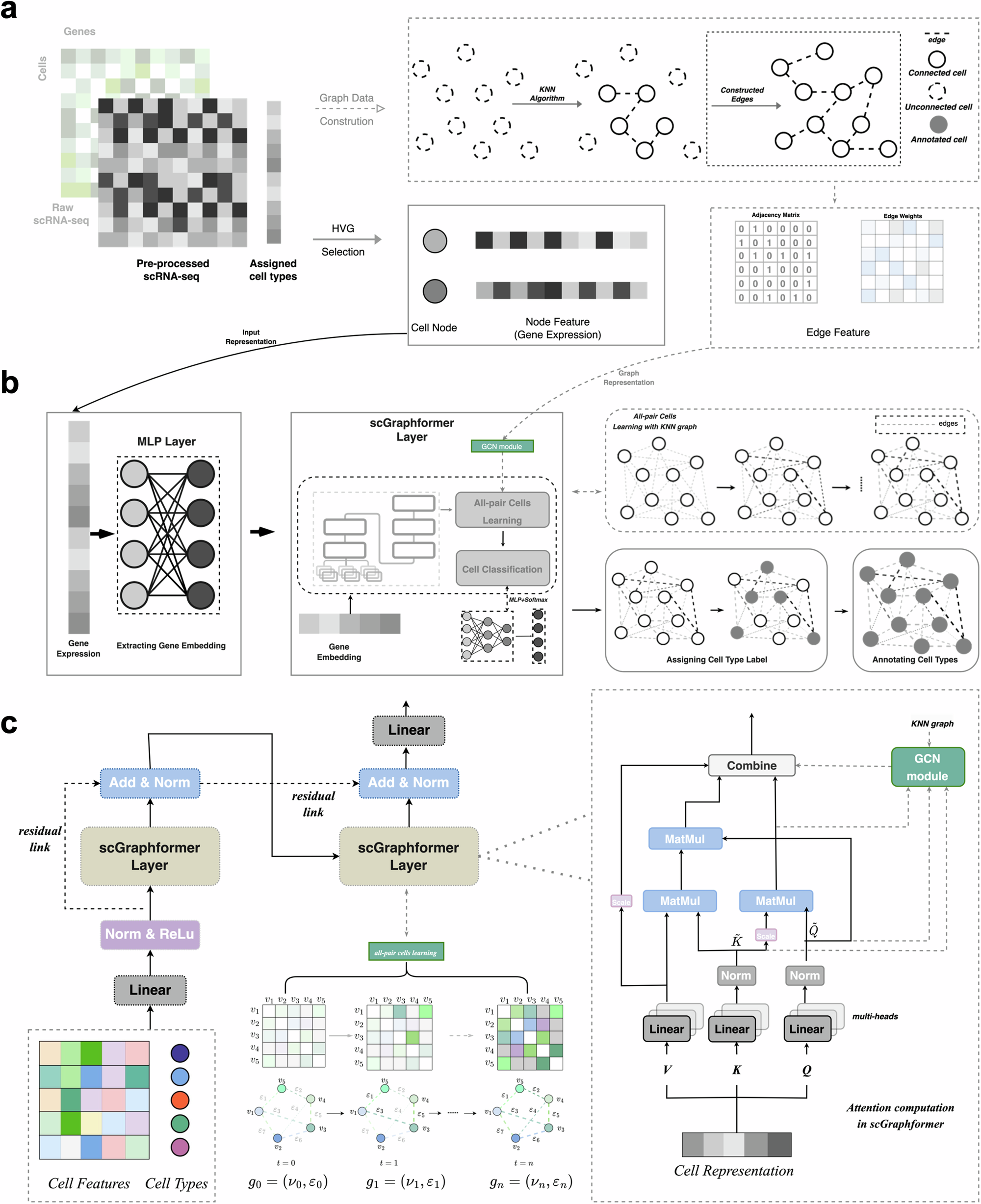
a Data preparation: Starting from raw single-cell RNA sequencing (scRNA-seq) data, scGraphformer employs standard normalization to preprocess the expression matrix. Cell nodes are defined by selecting highly variable gene (HVG) features. The pre-processed cell nodes with their HVG features will be input to the model. The pre-constructed graph structure G by kNN algorithm serves as a relational bias and is not compulsory. b scGraphformer pipeline: The normalized gene expression data undergo an initial transformation through a multilayer perceptron (MLP) layer to obtain gene embeddings. These embeddings are then processed by scGraphformer layers, which learn the all-pair connected network and update the cell graph topology. While kNN graph is used, the model will assign adjacent nodes within the G with proper weights in the all-pair network. c scGraphformer architecture: Detailed schematic of the scGraphformer framework illustrating the sequence of operations within the scGraphformer layers. The left shows the model’s architecture. The right shows the attention computation in scGraphformer layer, and the dashed lines show the computation process when adding a predefined graph structure.
Why Does This Matter?
The ability to more accurately classify cell types and understand their interactions opens up exciting possibilities for biological research. scGraphformer not only enhances the precision of cell type identification but also provides deeper insights into how cells function together. This can help scientists understand cellular behavior in various contexts, from development to disease.
For example, in cancer research, understanding the subtle interactions between different types of tumor cells and the surrounding environment could lead to better targeted therapies. In immunology, uncovering the complex relationships between immune cells could help design more effective vaccines or treatments for autoimmune diseases.
Real-World Impact
When tested on multiple datasets, scGraphformer outperformed existing methods, demonstrating its superior ability to classify cell types and reveal complex cellular interactions. This performance is especially notable when working with large-scale datasets, which are becoming increasingly common as single-cell technologies advance.
With its enhanced capabilities, scGraphformer has the potential to transform how we study cellular behavior at a single-cell level. By offering a more detailed, nuanced understanding of how cells interact, scGraphformer could be a game-changer in fields like genomics, immunology, and developmental biology.
Conclusion
The development of scGraphformer marks an important leap forward in the field of single-cell analysis. By leveraging transformer-based models to build more accurate cell-cell relational networks, it provides a more powerful tool for cell type classification and opens up new avenues for exploring cellular behavior. As we continue to explore the complexities of biology at the single-cell level, tools like scGraphformer will be crucial in helping us unlock new insights and advance our understanding of health and disease.
Availability – https://github.com/xyfan22/scGraphformer
Fan X, Liu J, Yang Y et al. (2024) scGraphformer: unveiling cellular heterogeneity and interactions in scRNA-seq data using a scalable graph transformer network. Commun Biol [Epub ahead of print]. [article]
Related Posts




Single-cell RNA sequencing (scRNA-seq) has become a cornerstone tool in modern biology, allowing researchers to examine gene expression at the individual cell level. This powerful technique uncovers the vast diversity of cell types and states that exist within tissues, helping scientists understand biological processes in much greater detail. However, accurately classifying these cells and understanding their interactions remains a challenge.
scGraphformer, developed at the Chinese University of Hong Kong, is a new method designed to improve cell type classification from scRNA-seq data. This technique promises to take single-cell analysis to the next level by overcoming limitations of traditional methods. To understand why this is so exciting, let’s break down the problem and see how scGraphformer works.
The Challenge: Understanding Cellular Heterogeneity
In biological research, one of the key goals is to understand the diversity of cells within an organism, known as cellular heterogeneity. Even within a single tissue, cells can have vastly different functions, behaviors, and gene expression patterns. This diversity can be crucial for processes like development, immune responses, and disease progression.
Traditionally, methods for classifying cell types from scRNA-seq data use graph neural networks (GNNs). These models rely on predefined graphs, which essentially map out the relationships between cells based on known data or assumptions. However, this approach can be limiting because it restricts how researchers explore the complex and dynamic relationships between different cell types.
The Innovation: scGraphformer
scGraphformer is a new method that addresses these limitations. Unlike traditional GNN models, which rely on predefined graphs, scGraphformer is a transformer-based model that can learn an all-encompassing cell-to-cell relational network directly from scRNA-seq data. This means it can build a dynamic and detailed map of how cells are related to each other without relying on prior assumptions.
Here’s how it works:
- Learning from Data: scGraphformer starts by analyzing the gene expression data from each individual cell. It doesn’t rely on predefined relationships but instead learns how each cell interacts with others based on patterns in the data.
- Iterative Refinement: The model then refines this information over multiple steps, gradually building a more accurate and complex network of cell-cell interactions. This helps capture subtle relationships and interactions that may have been overlooked in previous models.
- Identifying Cell Types: By constructing this detailed network, scGraphformer is able to classify cells more accurately, even identifying rare or previously hidden cell types. This is a significant step forward in single-cell research, as it allows researchers to uncover new cellular patterns that were previously difficult to detect.
Workflow of the scGraphformer approach for single-cell transcriptomic data analysis
a Data preparation: Starting from raw single-cell RNA sequencing (scRNA-seq) data, scGraphformer employs standard normalization to preprocess the expression matrix. Cell nodes are defined by selecting highly variable gene (HVG) features. The pre-processed cell nodes with their HVG features will be input to the model. The pre-constructed graph structure G by kNN algorithm serves as a relational bias and is not compulsory. b scGraphformer pipeline: The normalized gene expression data undergo an initial transformation through a multilayer perceptron (MLP) layer to obtain gene embeddings. These embeddings are then processed by scGraphformer layers, which learn the all-pair connected network and update the cell graph topology. While kNN graph is used, the model will assign adjacent nodes within the G with proper weights in the all-pair network. c scGraphformer architecture: Detailed schematic of the scGraphformer framework illustrating the sequence of operations within the scGraphformer layers. The left shows the model’s architecture. The right shows the attention computation in scGraphformer layer, and the dashed lines show the computation process when adding a predefined graph structure.
Why Does This Matter?
The ability to more accurately classify cell types and understand their interactions opens up exciting possibilities for biological research. scGraphformer not only enhances the precision of cell type identification but also provides deeper insights into how cells function together. This can help scientists understand cellular behavior in various contexts, from development to disease.
For example, in cancer research, understanding the subtle interactions between different types of tumor cells and the surrounding environment could lead to better targeted therapies. In immunology, uncovering the complex relationships between immune cells could help design more effective vaccines or treatments for autoimmune diseases.
Real-World Impact
When tested on multiple datasets, scGraphformer outperformed existing methods, demonstrating its superior ability to classify cell types and reveal complex cellular interactions. This performance is especially notable when working with large-scale datasets, which are becoming increasingly common as single-cell technologies advance.
With its enhanced capabilities, scGraphformer has the potential to transform how we study cellular behavior at a single-cell level. By offering a more detailed, nuanced understanding of how cells interact, scGraphformer could be a game-changer in fields like genomics, immunology, and developmental biology.
Conclusion
The development of scGraphformer marks an important leap forward in the field of single-cell analysis. By leveraging transformer-based models to build more accurate cell-cell relational networks, it provides a more powerful tool for cell type classification and opens up new avenues for exploring cellular behavior. As we continue to explore the complexities of biology at the single-cell level, tools like scGraphformer will be crucial in helping us unlock new insights and advance our understanding of health and disease.
Availability – https://github.com/xyfan22/scGraphformer
Fan X, Liu J, Yang Y et al. (2024) scGraphformer: unveiling cellular heterogeneity and interactions in scRNA-seq data using a scalable graph transformer network. Commun Biol [Epub ahead of print]. [article]
Related Posts
Recent Posts
 Dynamo – predictive modeling of single-cell transcriptomic dynamics
 scClustBench – label-free multi-metric pipeline for reproducible clustering of single-cell RNA-seq cell types
 Can genome editing be safer and more effective?
 New AI-powered RNA sequencing tool improves LINE-1 transcript quantification
 PANGEA – an integrated cell atlas across diverse biological contexts enables systematic profiling of multicellular responses in human diseases
 UMIche – a UMI-centric analysis platform for enhancing molecular quantification accuracy in bulk and single-cell sequencing
RNA-Seq Products & Services


Stay Connected