Increasing paternal age has been linked to elevated health risks for the next generation, including higher risks of obesity and stillbirth. But what drives this increased risk remains unknown.
Most research into this link focuses on how the DNA inside sperm changes with age. But sperm carries other molecules as well, including a diverse array of molecules called RNAs. Now, new research from University of Utah Health has shown that the RNA contents of sperm go through similar shifts over time in both mice and humans, which may lead to a rapid, dramatic shift at mid-life. What’s more, “old RNA” seems to change cells’ metabolism, potentially contributing to the health risks of having kids later in life.
“It’s like finding a molecular clock that ticks with age in both mice and humans, suggesting a fundamental, conserved molecular signature of sperm aging. Maybe this progressive length shift accumulates quietly, until it triggers the ‘cliff’ change at mid-life.” Qi Chen, MD, PhD associate professor of urology and human genetics at U of U Health and co-senior author of the study
The Importance of RNA
Previous work in Chen’s lab had established that RNA in sperm could be changed by a father’s environment, including diet, and that those changes could impact the next generation. But the kinds of RNA molecules that seemed to be most important were difficult to detect with standard techniques. Chen’s team developed an advanced RNA sequencing method, called PANDORA-seq, to “see” this previously undetectable world of sperm RNAs.
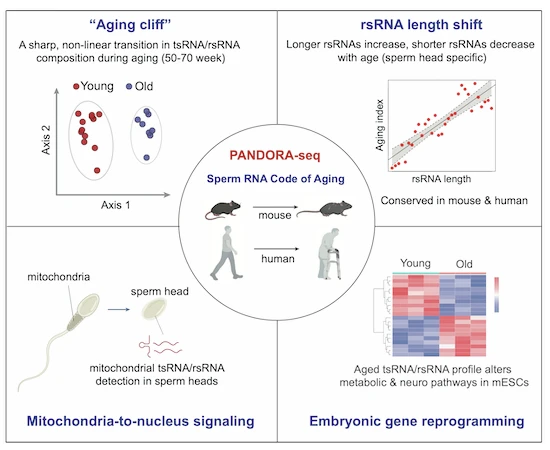
When they used this new tool to analyze sperm in mice, the researchers spotted a pattern that traditional techniques couldn’t detect—a sharp, dramatic transition in sperm RNA contents in mice between 50 and 70 weeks of age. In addition to this “aging cliff,” they found what appeared to be a molecular clock. As males age, the proportions of certain sperm RNAs change progressively—longer fragments become more common, while shorter fragments become less common. And when they looked at RNA in human sperm, they found the same progressive shift.
“At first glance, this finding seems counterintuitive,” Chen says. “For decades, we have known that as sperm age, their DNA becomes more fragmented and broken. One might expect RNA to follow this pattern. Instead, we found the opposite: specific sperm RNAs actually become longer with age.”
These changes in RNA may affect offspring health in important ways, the results suggest. When the team introduced a cocktail of “old RNA” into mouse embryonic stem cells, which are biologically similar to early embryos, the cells displayed changes in gene expression associated with metabolism and neurodegeneration, potentially suggesting a mechanism by which RNA could impact the health of the next generation.
Finding Unseen Patterns
The researchers were only able to detect some of these changes when they looked at RNA from the sperm head alone, the part of the sperm that delivers its contents to the egg. The long tail of the sperm contains other RNA that obscured the pattern until now.
“This rsRNA length shift was a unique signal, specific to the sperm heads. It was obscured by the ‘noisier’ profile of the whole sperm,” explains co-corresponding author Tong Zhou, PhD, associate professor of physiology and cell biology in the University of Nevada, Reno School of Medicine and co-senior author on the paper. “Sequencing the sperm head sample is what made this discovery possible.”
From Mice to Humans to Health
Researchers were able to confirm these RNA changes in humans thanks to U of U Health’s unique clinical and research infrastructure, which connects basic science labs directly with andrology and patient resources, says Kenneth Aston, PhD, director of the Andrology & IVF Lab at the University of Utah and co-senior author on the paper.
“Validating this finding from mice to humans was really exciting,” Aston says. “Our sperm bank resources at the University of Utah made this cross-species validation possible.”
“This could be an important step for translational andrology,” adds James M. Hotaling, MD, Chief Innovation Officer at University of Utah Health and an author on the study. “This discovery, made possible by PANDORA-seq, could lay the groundwork for future diagnostics to help guide informed reproductive decisions and improve fertility outcomes.”
The team’s next steps will focus on identifying the specific enzymes responsible for these changes in RNA.
“If we can understand the enzymes driving this shift, they could become actionable targets for interventions to potentially improve sperm quality in aging males,” Chen says. “Stay tuned.”
Source – University of Utah Health


Increasing paternal age has been linked to elevated health risks for the next generation, including higher risks of obesity and stillbirth. But what drives this increased risk remains unknown.
Most research into this link focuses on how the DNA inside sperm changes with age. But sperm carries other molecules as well, including a diverse array of molecules called RNAs. Now, new research from University of Utah Health has shown that the RNA contents of sperm go through similar shifts over time in both mice and humans, which may lead to a rapid, dramatic shift at mid-life. What’s more, “old RNA” seems to change cells’ metabolism, potentially contributing to the health risks of having kids later in life.
The Importance of RNA
Previous work in Chen’s lab had established that RNA in sperm could be changed by a father’s environment, including diet, and that those changes could impact the next generation. But the kinds of RNA molecules that seemed to be most important were difficult to detect with standard techniques. Chen’s team developed an advanced RNA sequencing method, called PANDORA-seq, to “see” this previously undetectable world of sperm RNAs.
When they used this new tool to analyze sperm in mice, the researchers spotted a pattern that traditional techniques couldn’t detect—a sharp, dramatic transition in sperm RNA contents in mice between 50 and 70 weeks of age. In addition to this “aging cliff,” they found what appeared to be a molecular clock. As males age, the proportions of certain sperm RNAs change progressively—longer fragments become more common, while shorter fragments become less common. And when they looked at RNA in human sperm, they found the same progressive shift.
These changes in RNA may affect offspring health in important ways, the results suggest. When the team introduced a cocktail of “old RNA” into mouse embryonic stem cells, which are biologically similar to early embryos, the cells displayed changes in gene expression associated with metabolism and neurodegeneration, potentially suggesting a mechanism by which RNA could impact the health of the next generation.
Finding Unseen Patterns
The researchers were only able to detect some of these changes when they looked at RNA from the sperm head alone, the part of the sperm that delivers its contents to the egg. The long tail of the sperm contains other RNA that obscured the pattern until now.
From Mice to Humans to Health
Researchers were able to confirm these RNA changes in humans thanks to U of U Health’s unique clinical and research infrastructure, which connects basic science labs directly with andrology and patient resources, says Kenneth Aston, PhD, director of the Andrology & IVF Lab at the University of Utah and co-senior author on the paper.
The team’s next steps will focus on identifying the specific enzymes responsible for these changes in RNA.
Source – University of Utah Health
Shi J, Zhang X, Cai C, Liu S, Yu J, James ER, Liu L, Emery BR, McMurray Bires MR, Torres-Arce E, Rawal HC, Ramsay J, Kunisaki J, Zhou C, Milstone DS, Patti ME, Yang X, Jenkins TG, Quinlan A, Cairns BR, Schimmel P, Hotaling JM, Aston KI, Zhou T, Chen Q. (2026) Conserved shifts in sperm small non-coding RNA profiles during mouse and human aging. The EMBO Journal [Epub ahead of print]. [article]
Related Posts
RNAmel simplifies RNA sequencing data analysis with a reproducible, integrated platform
Heart failure reshapes bone marrow to create inflammation-related immune memory
Overlooked DNA regions surrounding ‘microexons’ hold missing pieces of autism’s genetic puzzle
RiboBA improves detection of hidden protein-coding regions using ribosome profiling
An anti-senescence gene may fight spinal disc deterioration
Scientists identify the neuroblastoma cells that signal poor outcomes
Novel biosensor uses DNA ‘barcodes’ to uncover disease signals in cells
CellART extracts single-cell information from high-resolution spatial transcriptomics
Cell2space restores spatial context to single-cell RNA sequencing data
Urine test may improve bladder cancer diagnosis and guide treatment decisions
DeCoRE – a computational method to resolve RNA structural heterogeneity from RNA structure probing data by direct RNA sequencing
Tracing 700 million years of cell evolution
How should biological replicates be handled in long-read RNA sequencing?
RNA-Seq reveals a new way the developing heart controls its growth
The Human RNome Project Consortium seeks to publish first-ever complete sequence of the body’s RNA
scFlowReport brings multiple single-cell RNA sequencing analyses into one workflow
Long-read RNA sequencing reveals how neurons choose alternative RNA endings
DeOPUS improves cell-type estimates from bulk RNA sequencing
ResolVI improves accuracy in spatial transcriptomics analysis
RNA sequencing reveals transcriptional allele differences in prostate cancer stem cells
Stay Connected
Submit a Post to the Blog
Recent Posts
Subscribe to the RNA-Seq Blog
RNA-Seq Products & Services