

Understanding how our genes behave in the brain is a huge step toward uncovering the mysteries of neurological diseases like Alzheimer’s. Scientists from Weill Cornell Medicine have taken that step by developing a powerful method that allows them to look at both RNA splicing and chromatin accessibility in the same single cell, even in frozen brain tissues.
RNA splicing is the process by which cells edit RNA before it’s turned into proteins, while chromatin accessibility refers to how “open” or “closed” regions of DNA are, which controls which genes can be turned on. Usually, these two processes are studied separately. But the new technique, called ScISOr–ATAC, merges single-cell RNA sequencing with ATAC-seq to study both aspects at the same time. That’s like listening to both sides of a conversation instead of just one.
ScISOr-ATAC pipeline and data overview
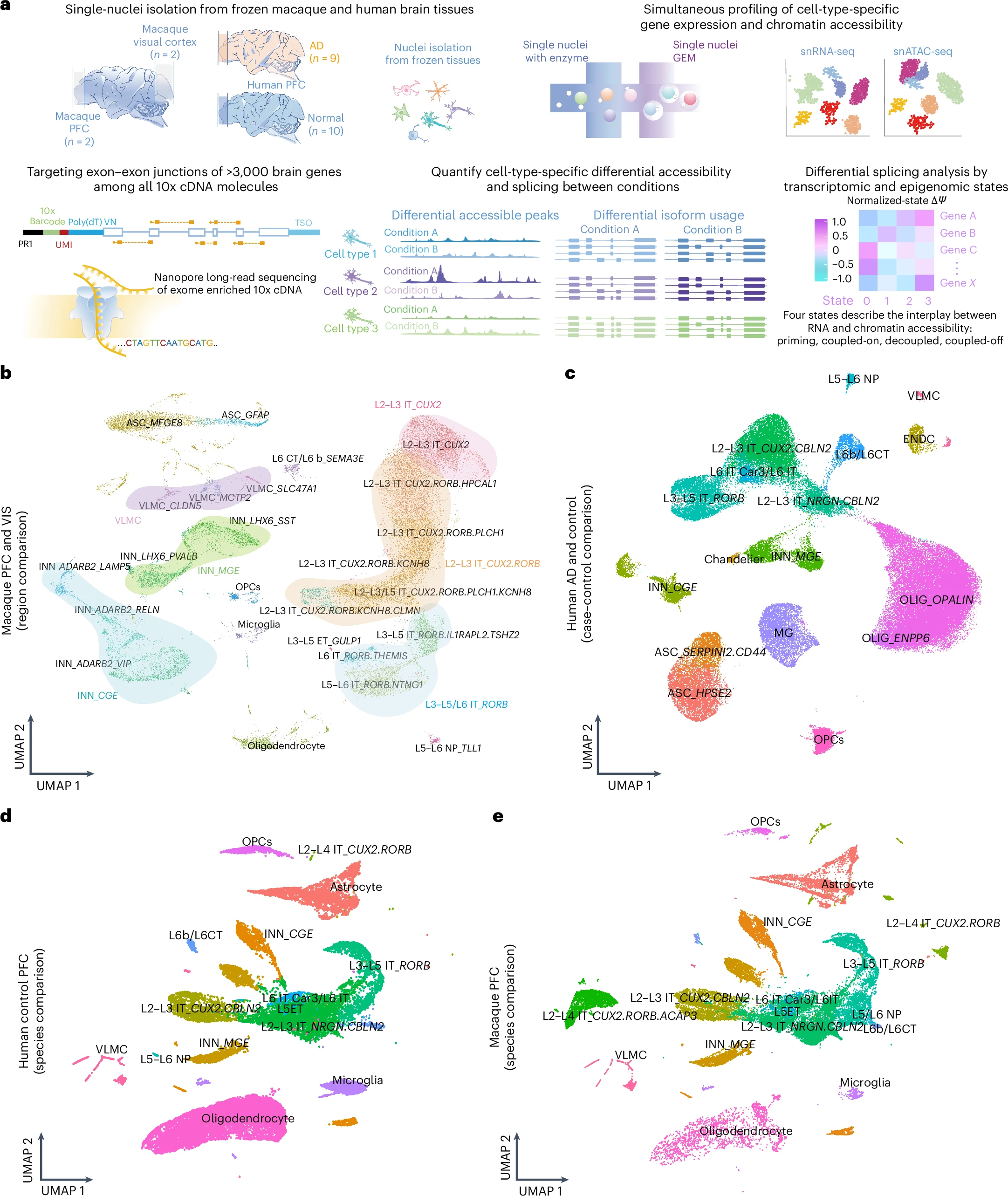
a, Outline of ScISOr–ATAC experimental and analysis pipeline; GEM, Gel Bead-In Emulsion; snRNA-seq, single-nucleus RNA sequencing; snATAC-seq, single-nucleus ATAC with sequencing; TSO, template switch oligo; poly(dT)VN, poly-dT primer sequence. b, Uniform manifold approximation and projection (UMAP) of macaque PFC and visual cortex (VIS) samples; ASC, astrocytes; INN, inhibitory neurons; VLMC, vascular and leptomeningeal cells; MG, microglia; OLIG, oligodendrocytes; OPCs, oligodendrocyte precursor cells; ENDC, endothelial cell. Excitatory neurons are indicated by L, IT or ET and gene markers. c, UMAP of human AD and control PFC samples. d, UMAP of human nuclei from integrated control human PFC and macaque samples. e, UMAP of macaque nuclei from integrated control human PFC and macaque samples.
Using this tool, the team examined brain samples from both humans and rhesus macaques, comparing healthy brains with those affected by Alzheimer’s disease. They found that even within the same brain cell type, the way genes are spliced can vary depending on the cell’s state. Some changes are unique to certain brain regions, and the relationship between splicing and chromatin accessibility doesn’t always follow the same rules across species. In other words, evolution has allowed some flexibility in how these two processes work together.
In Alzheimer’s patients, the researchers found that a type of brain cell called oligodendrocytes showed big changes in both splicing and chromatin accessibility, hinting that these cells might play a more significant role in the disease than previously thought.
This research could open new doors for understanding brain development, aging, and diseases by giving scientists a clearer, more complete picture of how gene regulation works at the single-cell level. And since the technique works on frozen tissue, it can be used with existing brain banks, making it even more valuable for future discoveries.
Availability – The package scisorATAC is available at https://github.com/careenfoord/scisorATAC
Wen H, Foord C, Hsu J, Fan L, Corley MJ, Lanjewar SN, Xu S, Belchikov N, He Y, Pang APS, Bhatia TN, Jarroux J, Joglekar A, Milner TA, Ndhlovu LC, Zhang J, Butelman E, Sloan SA, Lee VMY, Gan L, Tilgner HU. (2025) Combined single-cell profiling of chromatin–transcriptome and splicing across brain cell types, regions and disease state. Nature Biotechnology (2025) [article]
Related Posts






Understanding how our genes behave in the brain is a huge step toward uncovering the mysteries of neurological diseases like Alzheimer’s. Scientists from Weill Cornell Medicine have taken that step by developing a powerful method that allows them to look at both RNA splicing and chromatin accessibility in the same single cell, even in frozen brain tissues.
RNA splicing is the process by which cells edit RNA before it’s turned into proteins, while chromatin accessibility refers to how “open” or “closed” regions of DNA are, which controls which genes can be turned on. Usually, these two processes are studied separately. But the new technique, called ScISOr–ATAC, merges single-cell RNA sequencing with ATAC-seq to study both aspects at the same time. That’s like listening to both sides of a conversation instead of just one.
ScISOr-ATAC pipeline and data overview
a, Outline of ScISOr–ATAC experimental and analysis pipeline; GEM, Gel Bead-In Emulsion; snRNA-seq, single-nucleus RNA sequencing; snATAC-seq, single-nucleus ATAC with sequencing; TSO, template switch oligo; poly(dT)VN, poly-dT primer sequence. b, Uniform manifold approximation and projection (UMAP) of macaque PFC and visual cortex (VIS) samples; ASC, astrocytes; INN, inhibitory neurons; VLMC, vascular and leptomeningeal cells; MG, microglia; OLIG, oligodendrocytes; OPCs, oligodendrocyte precursor cells; ENDC, endothelial cell. Excitatory neurons are indicated by L, IT or ET and gene markers. c, UMAP of human AD and control PFC samples. d, UMAP of human nuclei from integrated control human PFC and macaque samples. e, UMAP of macaque nuclei from integrated control human PFC and macaque samples.
Using this tool, the team examined brain samples from both humans and rhesus macaques, comparing healthy brains with those affected by Alzheimer’s disease. They found that even within the same brain cell type, the way genes are spliced can vary depending on the cell’s state. Some changes are unique to certain brain regions, and the relationship between splicing and chromatin accessibility doesn’t always follow the same rules across species. In other words, evolution has allowed some flexibility in how these two processes work together.
In Alzheimer’s patients, the researchers found that a type of brain cell called oligodendrocytes showed big changes in both splicing and chromatin accessibility, hinting that these cells might play a more significant role in the disease than previously thought.
This research could open new doors for understanding brain development, aging, and diseases by giving scientists a clearer, more complete picture of how gene regulation works at the single-cell level. And since the technique works on frozen tissue, it can be used with existing brain banks, making it even more valuable for future discoveries.
Availability – The package scisorATAC is available at https://github.com/careenfoord/scisorATAC
Wen H, Foord C, Hsu J, Fan L, Corley MJ, Lanjewar SN, Xu S, Belchikov N, He Y, Pang APS, Bhatia TN, Jarroux J, Joglekar A, Milner TA, Ndhlovu LC, Zhang J, Butelman E, Sloan SA, Lee VMY, Gan L, Tilgner HU. (2025) Combined single-cell profiling of chromatin–transcriptome and splicing across brain cell types, regions and disease state. Nature Biotechnology (2025) [article]
Related Posts
Recent Posts
 Machine learning reveals how RNA splicing is regulated in individual cell types
 Illumina releases SpliceAI2 to help advance rare disease research
 Postdoctoral Fellow – Long-Read RNA Methods Development for Neurodegeneration
 Novel biosensor uses DNA ‘barcodes’ to uncover disease signals in cells
 GP-DHT uses single-cell RNA sequencing to map gene regulatory networks
 Boehringer taps Envisagenics’ AI to mine RNA splicing for cancer targets
RNA-Seq Products & Services


Stay Connected