

Single-cell RNA sequencing (scRNA-seq) has revolutionized the study of gene expression by allowing researchers to explore the diversity of cells in tissues. However, the data it provides often doesn’t capture the full picture, particularly when it comes to cellular pathways and protein complexes, which are more easily understood at the protein level. This limitation becomes even more pronounced because scRNA-seq data can be noisy and have gaps, making it difficult to interpret meaningful biological information.
Researchers at Tel Aviv University have proposed a novel approach to improve the utility of scRNA-seq. This new method, called scNET, integrates scRNA-seq data with protein–protein interaction networks to provide a more complete understanding of gene functions and cellular relationships.
The key innovation of scNET lies in its use of a dual-view architecture based on graph neural networks. This allows the system to combine gene expression data with protein interactions, creating a richer model of gene-to-gene relationships in specific biological contexts. An attention mechanism helps refine the connections between cells, improving the clarity of cell clustering and pathway analysis across different biological conditions.
Autoencoder model architecture
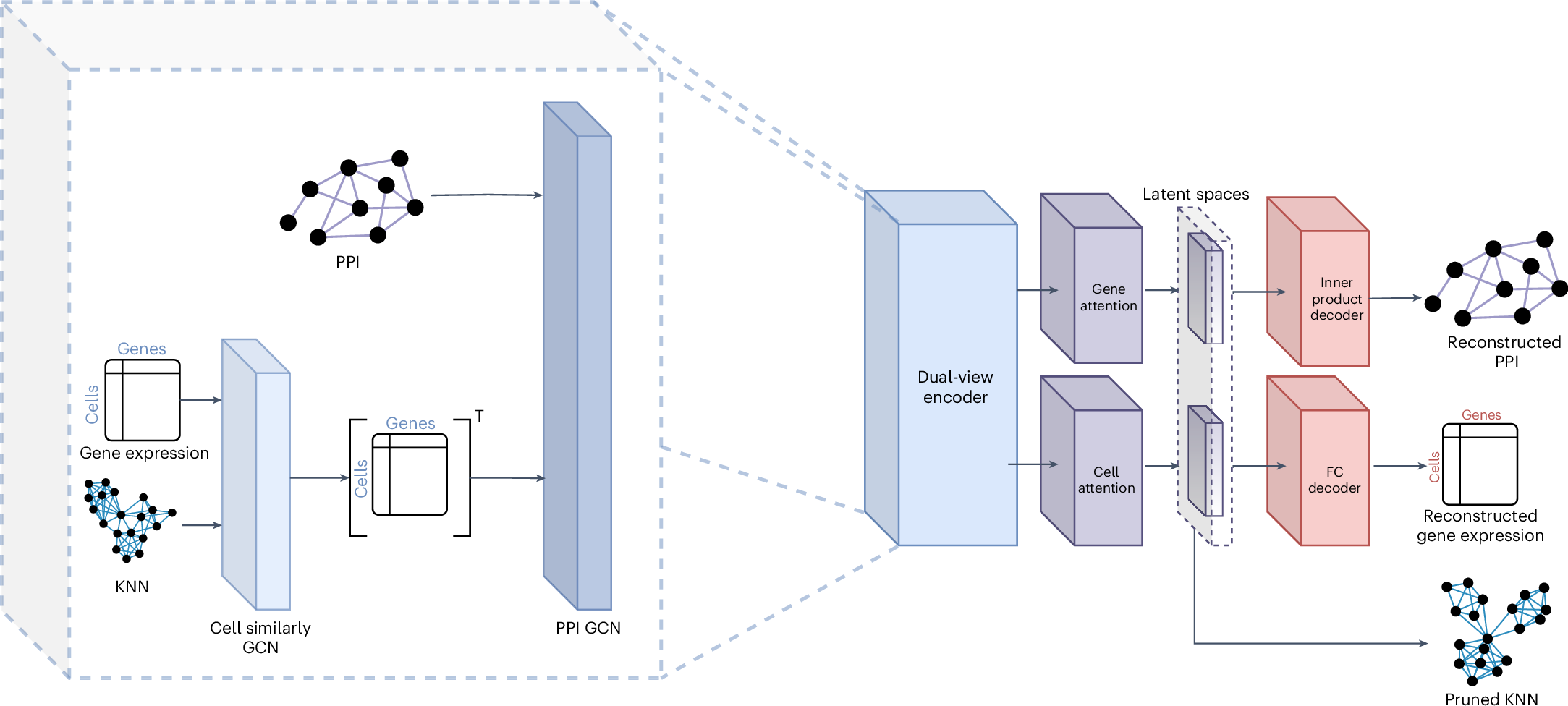
Initially, the PPI network, the KNN graph and gene expression data are input into the dual-view encoder (dashed line). Subsequently, graph attention layers are employed to extract the latent representations of both cells and genes. The inner product decoder is then used to reconstruct the network connections, whereas a fully connected layer is responsible for reconstructing the gene expression. The KNN graph then undergoes pruning using attention coefficients to optimize model performance.
Through rigorous evaluations, the study demonstrated that scNET outperformed traditional methods, excelling in gene annotation, pathway characterization, and the identification of gene–gene relationships. By combining gene expression with protein networks, scNET offers a more accurate and context-aware way of analyzing scRNA-seq data, opening the door to deeper insights into complex biological systems.
This breakthrough demonstrates how integrating multi-level biological data, such as scRNA-seq and protein interactions, can provide a more holistic view of cellular functions, potentially transforming how we study health and disease.
Sheinin R., Sharan R., Madi A. (2025) scNET: learning context-specific gene and cell embeddings by integrating single-cell gene expression data with protein–protein interactions. Nat Methods [Epub ahead of print]. [article]
Related Posts




Single-cell RNA sequencing (scRNA-seq) has revolutionized the study of gene expression by allowing researchers to explore the diversity of cells in tissues. However, the data it provides often doesn’t capture the full picture, particularly when it comes to cellular pathways and protein complexes, which are more easily understood at the protein level. This limitation becomes even more pronounced because scRNA-seq data can be noisy and have gaps, making it difficult to interpret meaningful biological information.
Researchers at Tel Aviv University have proposed a novel approach to improve the utility of scRNA-seq. This new method, called scNET, integrates scRNA-seq data with protein–protein interaction networks to provide a more complete understanding of gene functions and cellular relationships.
The key innovation of scNET lies in its use of a dual-view architecture based on graph neural networks. This allows the system to combine gene expression data with protein interactions, creating a richer model of gene-to-gene relationships in specific biological contexts. An attention mechanism helps refine the connections between cells, improving the clarity of cell clustering and pathway analysis across different biological conditions.
Autoencoder model architecture
Initially, the PPI network, the KNN graph and gene expression data are input into the dual-view encoder (dashed line). Subsequently, graph attention layers are employed to extract the latent representations of both cells and genes. The inner product decoder is then used to reconstruct the network connections, whereas a fully connected layer is responsible for reconstructing the gene expression. The KNN graph then undergoes pruning using attention coefficients to optimize model performance.
Through rigorous evaluations, the study demonstrated that scNET outperformed traditional methods, excelling in gene annotation, pathway characterization, and the identification of gene–gene relationships. By combining gene expression with protein networks, scNET offers a more accurate and context-aware way of analyzing scRNA-seq data, opening the door to deeper insights into complex biological systems.
This breakthrough demonstrates how integrating multi-level biological data, such as scRNA-seq and protein interactions, can provide a more holistic view of cellular functions, potentially transforming how we study health and disease.
Sheinin R., Sharan R., Madi A. (2025) scNET: learning context-specific gene and cell embeddings by integrating single-cell gene expression data with protein–protein interactions. Nat Methods [Epub ahead of print]. [article]
Related Posts
Recent Posts
 Scientists identify the neuroblastoma cells that signal poor outcomes
 GARAGE improves rare cell detection in single-cell RNA sequencing analysis using AI
 Machine learning reveals how RNA splicing is regulated in individual cell types
 Illumina releases SpliceAI2 to help advance rare disease research
 Postdoctoral Fellow – Long-Read RNA Methods Development for Neurodegeneration
 Novel biosensor uses DNA ‘barcodes’ to uncover disease signals in cells
RNA-Seq Products & Services



Stay Connected