

Comparing human and animal cells can reveal powerful insights about health and disease, but the data from each species often look very different. Researchers at the University of Freiburg have developed a deep learning method designed to bridge this gap and make cross species comparisons more reliable.
The researchers developed a computational tool called scSpecies that learns patterns from animal single cell data and then transfers that knowledge to human data. The method uses a conditional variational autoencoder, a type of neural network that learns compressed representations of complex datasets. By pre training the model on animal cells and then transferring key encoder layers into a human version of the network, the system can recognize shared biological features even when there are differences in gene sets or sample sizes.
Graphical representation of the scSpecies workflow
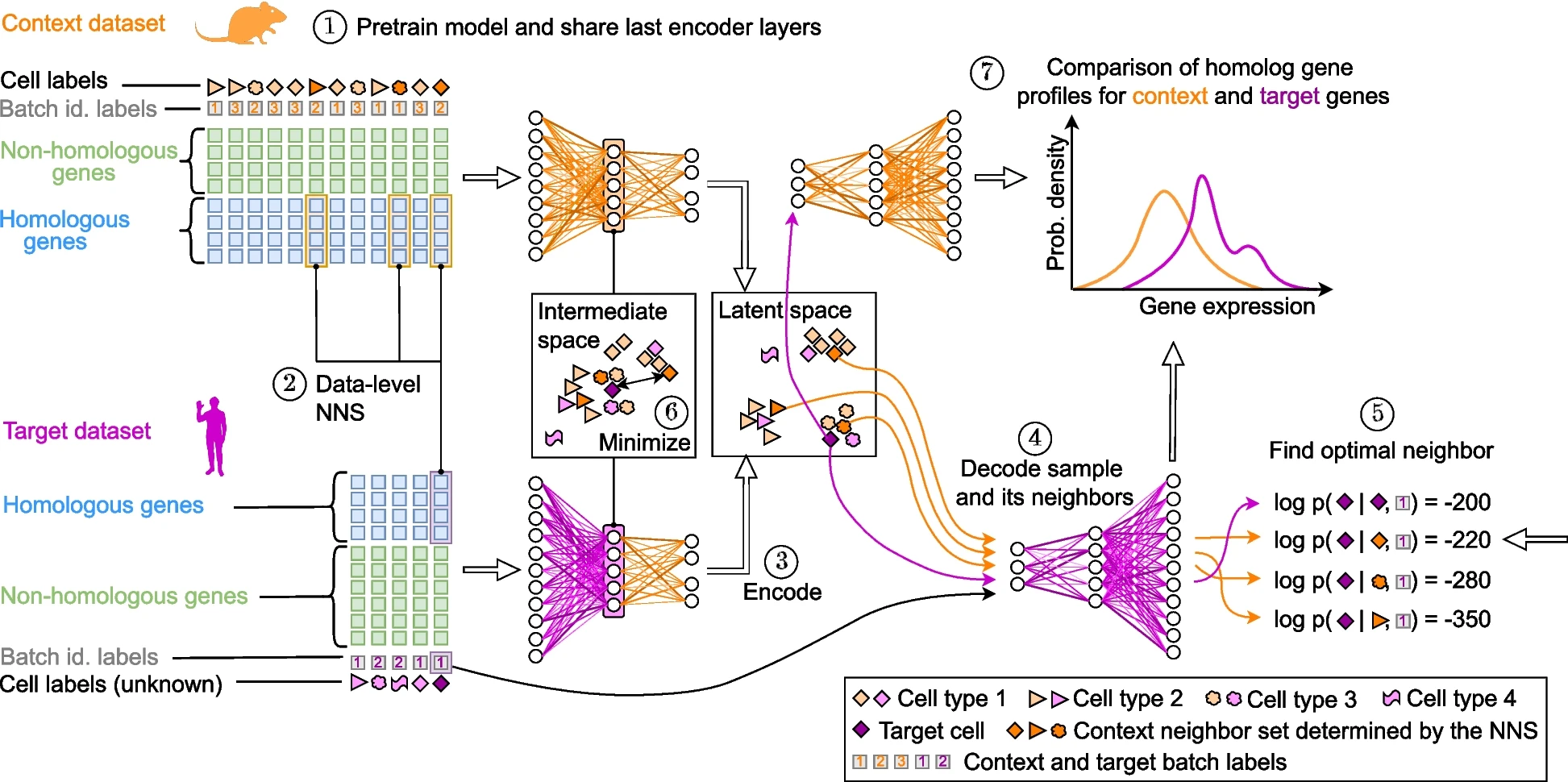
The model is trained in a pre-training and fine-tuning phase. First, a pre-training phase trains the context encoder and decoder neural networks (Step 1). Afterwards, a k-nearest-neighbor search is performed on shared genes of the context and target dataset. This identifies a fixed set of k context neighbors for every target cell (Step 2). During fine-tuning, the weights of the last encoder layers are incorporated into the encoder model for the target species. Then, target cells are encoded into the latent space (Step 3). Without adjustment, the model might learn a misaligned representation of context and target datasets. Therefore, the model is incentivized to align target cells with a similar cell of its neighbor set. For cells with high agreement among cell labels of their neighbors, we decode each neighbor’s latent variable with the target decoder, conditioning on the human batch label, to define the corresponding target-decoder distribution (Step 4). The optimal candidate for alignment is chosen as the neighbor whose latent representation resulted in the highest log-likelihood when sampling the target cell from the respective target decoder distribution. This identifies the most similar context cell given the learned latent manifold (Step 5). The distance between the optimal candidate and the intermediate representation of its target cell is minimized (Step 6). After training, the model returns an aligned latent representation through which labels and information can be transferred. Additionally, normalized gene expression profiles can be compared by decoding latent variables with both decoder networks (Step 7)
The tool also aligns the hidden, or latent, spaces of the two species by combining similarities found directly in the data with similarities learned by the model itself. This alignment allows the system to accurately match cell types across species, which is valuable for label transfer and for identifying differences in gene expression. The researchers tested scSpecies on cross species datasets from liver, adipose tissue, and glioblastoma samples. The method performed well even with limited data, suggesting it can be used in many experimental settings.
By making it easier to compare human cell data with well studied animal models, scSpecies provides researchers with a new way to place human biology in a broader evolutionary context. This can help scientists better interpret human single cell datasets, understand disease mechanisms, and identify meaningful biological patterns that are conserved across species.
Availability – https://github.com/cschaech/scspecies_package
Schächter C, Hackenberg M, Treppner M, Raum H, Bödecker J, Binder H, (2025) scSpecies: enhancement of network architecture alignment in comparative single cell studies. Genome Biol 26(1):397. [article]
Related Posts






Comparing human and animal cells can reveal powerful insights about health and disease, but the data from each species often look very different. Researchers at the University of Freiburg have developed a deep learning method designed to bridge this gap and make cross species comparisons more reliable.
The researchers developed a computational tool called scSpecies that learns patterns from animal single cell data and then transfers that knowledge to human data. The method uses a conditional variational autoencoder, a type of neural network that learns compressed representations of complex datasets. By pre training the model on animal cells and then transferring key encoder layers into a human version of the network, the system can recognize shared biological features even when there are differences in gene sets or sample sizes.
Graphical representation of the scSpecies workflow
The model is trained in a pre-training and fine-tuning phase. First, a pre-training phase trains the context encoder and decoder neural networks (Step 1). Afterwards, a k-nearest-neighbor search is performed on shared genes of the context and target dataset. This identifies a fixed set of k context neighbors for every target cell (Step 2). During fine-tuning, the weights of the last encoder layers are incorporated into the encoder model for the target species. Then, target cells are encoded into the latent space (Step 3). Without adjustment, the model might learn a misaligned representation of context and target datasets. Therefore, the model is incentivized to align target cells with a similar cell of its neighbor set. For cells with high agreement among cell labels of their neighbors, we decode each neighbor’s latent variable with the target decoder, conditioning on the human batch label, to define the corresponding target-decoder distribution (Step 4). The optimal candidate for alignment is chosen as the neighbor whose latent representation resulted in the highest log-likelihood when sampling the target cell from the respective target decoder distribution. This identifies the most similar context cell given the learned latent manifold (Step 5). The distance between the optimal candidate and the intermediate representation of its target cell is minimized (Step 6). After training, the model returns an aligned latent representation through which labels and information can be transferred. Additionally, normalized gene expression profiles can be compared by decoding latent variables with both decoder networks (Step 7)
The tool also aligns the hidden, or latent, spaces of the two species by combining similarities found directly in the data with similarities learned by the model itself. This alignment allows the system to accurately match cell types across species, which is valuable for label transfer and for identifying differences in gene expression. The researchers tested scSpecies on cross species datasets from liver, adipose tissue, and glioblastoma samples. The method performed well even with limited data, suggesting it can be used in many experimental settings.
By making it easier to compare human cell data with well studied animal models, scSpecies provides researchers with a new way to place human biology in a broader evolutionary context. This can help scientists better interpret human single cell datasets, understand disease mechanisms, and identify meaningful biological patterns that are conserved across species.
Availability – https://github.com/cschaech/scspecies_package
Schächter C, Hackenberg M, Treppner M, Raum H, Bödecker J, Binder H, (2025) scSpecies: enhancement of network architecture alignment in comparative single cell studies. Genome Biol 26(1):397. [article]
Related Posts
Recent Posts
 Scientists identify the neuroblastoma cells that signal poor outcomes
 GARAGE improves rare cell detection in single-cell RNA sequencing analysis using AI
 Machine learning reveals how RNA splicing is regulated in individual cell types
 Illumina releases SpliceAI2 to help advance rare disease research
 Postdoctoral Fellow – Long-Read RNA Methods Development for Neurodegeneration
 Novel biosensor uses DNA ‘barcodes’ to uncover disease signals in cells
RNA-Seq Products & Services


Stay Connected