

Recent advances in RNA sequencing, particularly in single-cell RNA sequencing (scRNA-seq), have introduced a new approach to understanding how cells change and differentiate over time. One of these advances is the concept of RNA velocity, which helps predict the direction of cellular changes by measuring the dynamics of RNA molecules in individual cells. This process allows researchers to trace the trajectory of a cell’s development, providing valuable insights into cell differentiation and the transitions between different cell states.
However, while RNA velocity has shown great promise, most existing methods for analyzing these dynamic processes have limitations. Traditional models rely on ordinary differential equations (ODE) to describe the behavior of individual genes, but these methods fail to account for the inherent randomness in how genes are expressed across different cells. This randomness, known as stochasticity, plays a significant role in transcriptional dynamics—the process by which genes are activated and produce RNA. As a result, current models might not fully capture the complexity of gene expression patterns and could lead to inaccurate conclusions.
To address these challenges, researchers at the Chinese University of Hong Kong-Shenzhen have developed a new approach called SDEvelo. Unlike traditional methods, SDEvelo uses stochastic differential equations (SDEs) to model the RNA velocity across multiple genes simultaneously. This approach not only accounts for the inherent randomness in gene expression but also estimates a cell-specific latent time, which represents the unique timepoint in the gene expression process for each cell. By considering the variability between cells, SDEvelo can more accurately model the transitions between gene states and predict cell differentiation processes.
Overview of SDEvelo
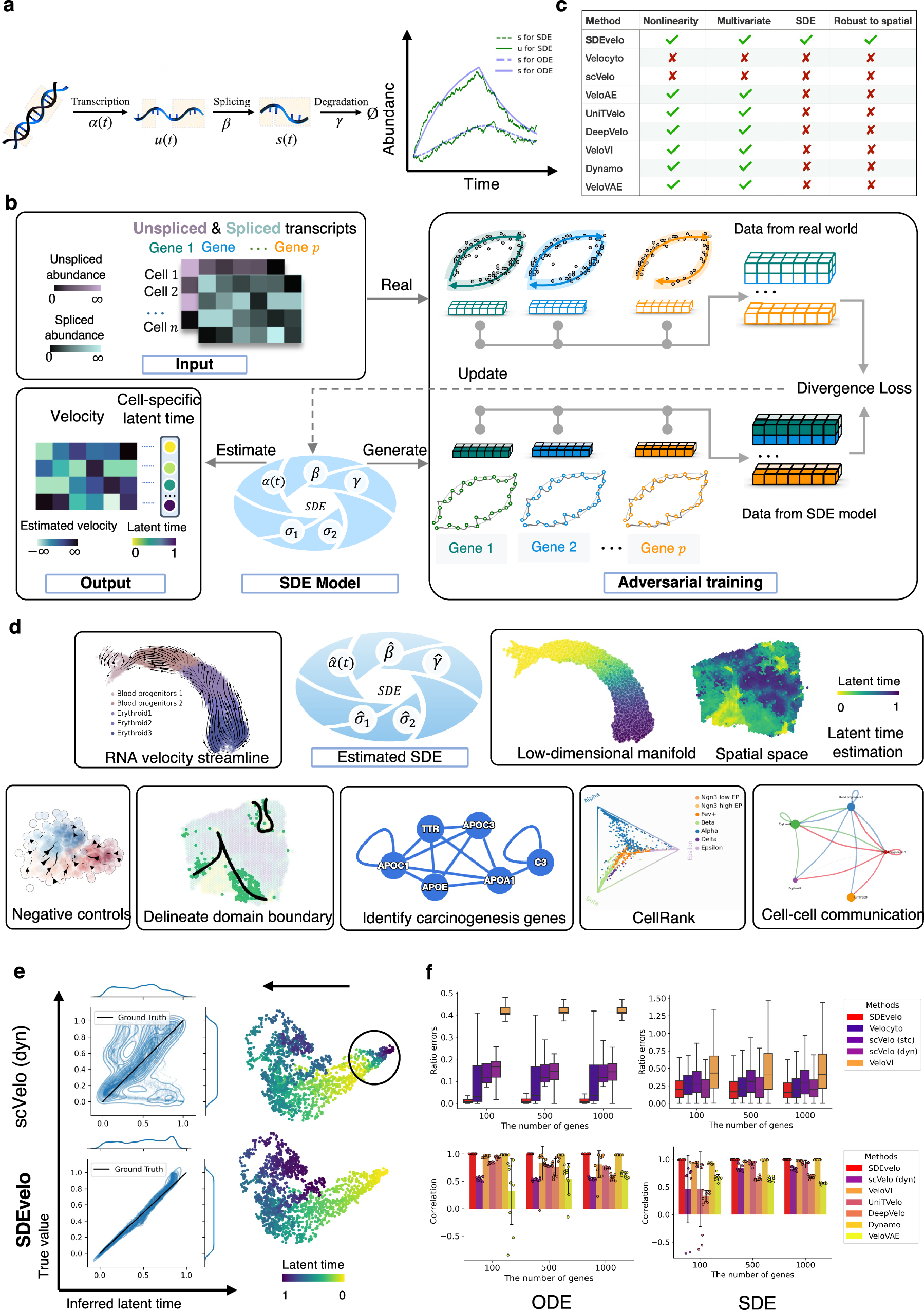
a Left panel: the continuous RNA transcription-splicing-degradation process, illustrating the conversion of DNA transcripts to pre-mature mRNA u(t) (with transcription rate α(t)), pre-mature mRNA u(t) to mature mRNA s(t) (splicing rate β), and the eventual degradation (degradation rate γ). Right panel: a comparison of abundance over time between the deterministic ODE model and the stochastic SDE model, demonstrating the SDE model’s capability to capture stochasticity. b Input (upper left): unspliced and spliced matrices are provided as real data. Generation (lower middle): a nonlinear multivariate SDE model generates simulated data. Training process (right): the SDE model parameters are updated by minimizing the distributional divergence between real and generated data. Output (lower left): the trained SDE model produces estimated velocity and cell-specific latent time. c Chart comparing SDEvelo with other methods, focusing on aspects that include the nonlinearity of transcriptional dynamic model, the use of a multivariate model to collaboratively consider multiple genes, modeling with SDE, and robustness to spatial transcriptomics data. d SDEvelo is capable of visualizing streamline plots with estimated velocity and latent time heatmap plots. Additionally, SDEvelo can guarantee negative controls in mature-state populations, delineate stromal and tumor/normal epithelium (TNE) boundaries, identify carcinogenesis-related candidate genes, integrate with CellRank and analyze cell-cell communication. e Comparison between SDEvelo and scVelo (dyn) in terms of estimated latent time, including KDE scatter plots with the ground truth line between the estimated and true latent time (left panel) and a latent time heatmap on the projected PCA space. The arrow indicates the correct direction along the true latent time, and the circle highlights the inconsistent part estimated by scVelo (dyn). f For each setting with gene numbers from 100 to 1000, performance was evaluated using absolute relative ratio errors and Pearson correlation coefficients with ten-fold cross-validation (n = 10 cross-validation replicates per group). Bar plots show mean ± standard deviation (SD) with individual points. Box plots show median, quartiles, and 1.5 times interquartile range. Source data are provided as a Source Data file.
One of the key advantages of SDEvelo is its ability to model these complex transcriptional dynamics with a high degree of precision. The method was tested on both simulated datasets and real-world data from scRNA-seq and spatial transcriptomics. The results showed that SDEvelo could effectively track the random patterns of gene expression in mature cells and accurately detect processes like carcinogenesis, which is the formation of cancer cells. In addition, the model’s ability to estimate latent time across genes can aid in various downstream analyses, such as identifying specific biomarkers or understanding cellular behavior in more depth.
SDEvelo is also highly scalable, meaning it can handle large datasets, which is essential for modern biological research. Its application extends not only to traditional scRNA-seq data but also to sequencing-based spatial transcriptomics, which examines how gene expression varies in different tissue locations. This versatility makes SDEvelo a powerful tool for researchers exploring complex biological systems, such as the development of diseases or the mechanisms of cellular behavior.
In conclusion, SDEvelo represents a significant advancement in the modeling of RNA velocity. By using multivariate stochastic differential equations, it overcomes the limitations of previous methods and provides more accurate, scalable, and biologically meaningful insights into how cells evolve and differentiate over time. As RNA velocity continues to play a central role in understanding cellular processes, tools like SDEvelo will be essential for uncovering the complexities of gene expression and the dynamic behaviors of cells in health and disease.
Availability – SDEvelo is freely available as a Python package accessible at https://github.com/Liao-Xu/SDEvelo
Liao X, Kang L, Peng Y et al. (2024) Multivariate stochastic modeling for transcriptional dynamics with cell-specific latent time using SDEvelo. Nat Commun [Epub ahead of print]. [article]
Related Posts






Recent advances in RNA sequencing, particularly in single-cell RNA sequencing (scRNA-seq), have introduced a new approach to understanding how cells change and differentiate over time. One of these advances is the concept of RNA velocity, which helps predict the direction of cellular changes by measuring the dynamics of RNA molecules in individual cells. This process allows researchers to trace the trajectory of a cell’s development, providing valuable insights into cell differentiation and the transitions between different cell states.
However, while RNA velocity has shown great promise, most existing methods for analyzing these dynamic processes have limitations. Traditional models rely on ordinary differential equations (ODE) to describe the behavior of individual genes, but these methods fail to account for the inherent randomness in how genes are expressed across different cells. This randomness, known as stochasticity, plays a significant role in transcriptional dynamics—the process by which genes are activated and produce RNA. As a result, current models might not fully capture the complexity of gene expression patterns and could lead to inaccurate conclusions.
To address these challenges, researchers at the Chinese University of Hong Kong-Shenzhen have developed a new approach called SDEvelo. Unlike traditional methods, SDEvelo uses stochastic differential equations (SDEs) to model the RNA velocity across multiple genes simultaneously. This approach not only accounts for the inherent randomness in gene expression but also estimates a cell-specific latent time, which represents the unique timepoint in the gene expression process for each cell. By considering the variability between cells, SDEvelo can more accurately model the transitions between gene states and predict cell differentiation processes.
Overview of SDEvelo
a Left panel: the continuous RNA transcription-splicing-degradation process, illustrating the conversion of DNA transcripts to pre-mature mRNA u(t) (with transcription rate α(t)), pre-mature mRNA u(t) to mature mRNA s(t) (splicing rate β), and the eventual degradation (degradation rate γ). Right panel: a comparison of abundance over time between the deterministic ODE model and the stochastic SDE model, demonstrating the SDE model’s capability to capture stochasticity. b Input (upper left): unspliced and spliced matrices are provided as real data. Generation (lower middle): a nonlinear multivariate SDE model generates simulated data. Training process (right): the SDE model parameters are updated by minimizing the distributional divergence between real and generated data. Output (lower left): the trained SDE model produces estimated velocity and cell-specific latent time. c Chart comparing SDEvelo with other methods, focusing on aspects that include the nonlinearity of transcriptional dynamic model, the use of a multivariate model to collaboratively consider multiple genes, modeling with SDE, and robustness to spatial transcriptomics data. d SDEvelo is capable of visualizing streamline plots with estimated velocity and latent time heatmap plots. Additionally, SDEvelo can guarantee negative controls in mature-state populations, delineate stromal and tumor/normal epithelium (TNE) boundaries, identify carcinogenesis-related candidate genes, integrate with CellRank and analyze cell-cell communication. e Comparison between SDEvelo and scVelo (dyn) in terms of estimated latent time, including KDE scatter plots with the ground truth line between the estimated and true latent time (left panel) and a latent time heatmap on the projected PCA space. The arrow indicates the correct direction along the true latent time, and the circle highlights the inconsistent part estimated by scVelo (dyn). f For each setting with gene numbers from 100 to 1000, performance was evaluated using absolute relative ratio errors and Pearson correlation coefficients with ten-fold cross-validation (n = 10 cross-validation replicates per group). Bar plots show mean ± standard deviation (SD) with individual points. Box plots show median, quartiles, and 1.5 times interquartile range. Source data are provided as a Source Data file.
One of the key advantages of SDEvelo is its ability to model these complex transcriptional dynamics with a high degree of precision. The method was tested on both simulated datasets and real-world data from scRNA-seq and spatial transcriptomics. The results showed that SDEvelo could effectively track the random patterns of gene expression in mature cells and accurately detect processes like carcinogenesis, which is the formation of cancer cells. In addition, the model’s ability to estimate latent time across genes can aid in various downstream analyses, such as identifying specific biomarkers or understanding cellular behavior in more depth.
SDEvelo is also highly scalable, meaning it can handle large datasets, which is essential for modern biological research. Its application extends not only to traditional scRNA-seq data but also to sequencing-based spatial transcriptomics, which examines how gene expression varies in different tissue locations. This versatility makes SDEvelo a powerful tool for researchers exploring complex biological systems, such as the development of diseases or the mechanisms of cellular behavior.
In conclusion, SDEvelo represents a significant advancement in the modeling of RNA velocity. By using multivariate stochastic differential equations, it overcomes the limitations of previous methods and provides more accurate, scalable, and biologically meaningful insights into how cells evolve and differentiate over time. As RNA velocity continues to play a central role in understanding cellular processes, tools like SDEvelo will be essential for uncovering the complexities of gene expression and the dynamic behaviors of cells in health and disease.
Availability – SDEvelo is freely available as a Python package accessible at https://github.com/Liao-Xu/SDEvelo
Liao X, Kang L, Peng Y et al. (2024) Multivariate stochastic modeling for transcriptional dynamics with cell-specific latent time using SDEvelo. Nat Commun [Epub ahead of print]. [article]
Related Posts
Recent Posts
 RNAmel simplifies RNA sequencing data analysis with a reproducible, integrated platform
 Heart failure reshapes bone marrow to create inflammation-related immune memory
 Overlooked DNA regions surrounding ‘microexons’ hold missing pieces of autism’s genetic puzzle
 RiboBA improves detection of hidden protein-coding regions using ribosome profiling
 An anti-senescence gene may fight spinal disc deterioration
 Bulk RNA-seq Analysis: A Complete Beginner’s Guide
RNA-Seq Products & Services



Stay Connected