From The Transmitter by Katie Moisse
The findings, shared in a preprint, help to illuminate how a large and heterogeneous group of genes could be involved in autism.
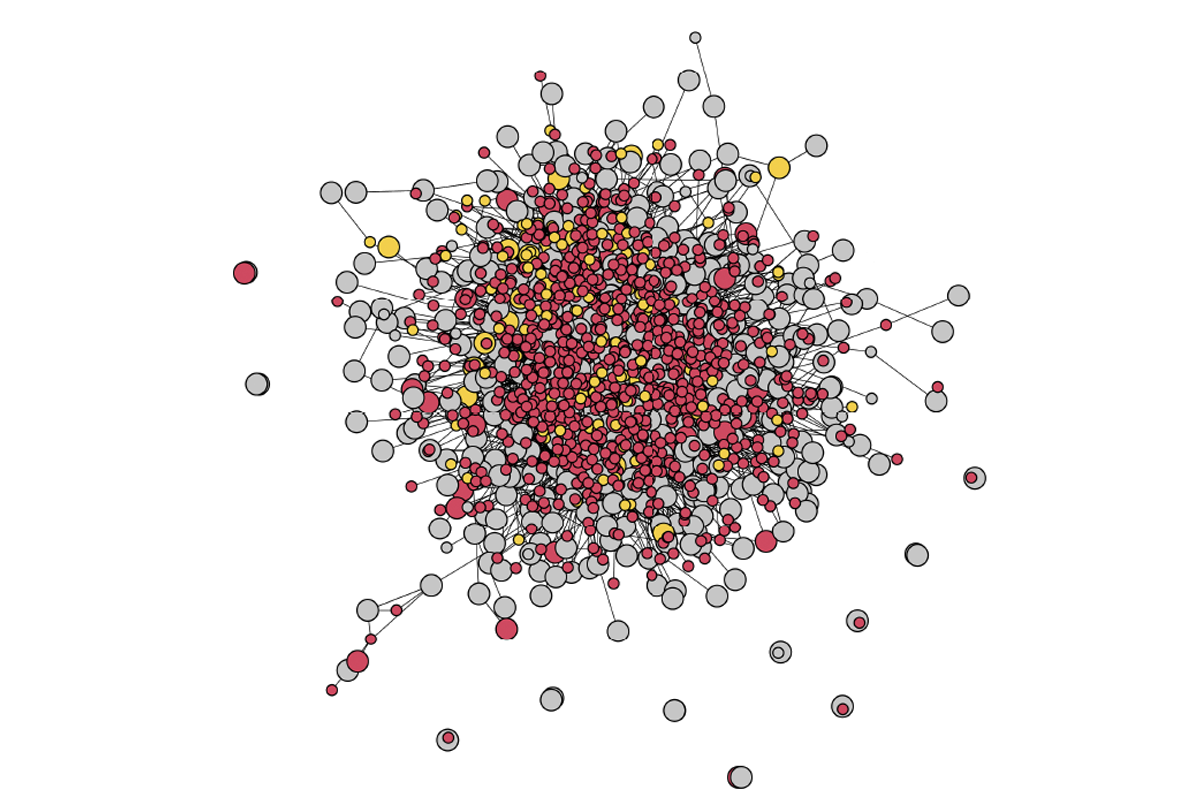
Who’s the boss: Some 78 “central regulators” (large circles) control the expression of other genes (small circles), some of which have a link to autism (red and yellow), a preprint finds.
Knocking down 19 genes linked to autism, one at a time, shakes up a network of other genes, many of which regulate the early proliferation and differentiation of brain cells, according to a new preprint. Some people with autism carry rare variants of certain genes in the network, previous research has found. Others have been implicated in genome-wide association studies of autism, which reveal common genetic variants that may work in combination to increase autism likelihood.
“We’re finding this really interesting signal of autism-associated genes that are changing when we perturb just a single autism-associated gene,” says study investigator Rebecca Andersen, a postdoctoral researcher in Christopher Walsh’s lab at Boston Children’s Hospital. “That could explain how [disruptions to] these different autism-associated genes could all lead to similar neurodevelopmental phenotypes and, eventually, a diagnosis of autism.”


From The Transmitter by Katie Moisse
The findings, shared in a preprint, help to illuminate how a large and heterogeneous group of genes could be involved in autism.
Who’s the boss: Some 78 “central regulators” (large circles) control the expression of other genes (small circles), some of which have a link to autism (red and yellow), a preprint finds.
Knocking down 19 genes linked to autism, one at a time, shakes up a network of other genes, many of which regulate the early proliferation and differentiation of brain cells, according to a new preprint. Some people with autism carry rare variants of certain genes in the network, previous research has found. Others have been implicated in genome-wide association studies of autism, which reveal common genetic variants that may work in combination to increase autism likelihood.
Related Posts
Heart failure reshapes bone marrow to create inflammation-related immune memory
Overlooked DNA regions surrounding ‘microexons’ hold missing pieces of autism’s genetic puzzle
An anti-senescence gene may fight spinal disc deterioration
Scientists identify the neuroblastoma cells that signal poor outcomes
Urine test may improve bladder cancer diagnosis and guide treatment decisions
Tracing 700 million years of cell evolution
RNA-Seq reveals a new way the developing heart controls its growth
The Human RNome Project Consortium seeks to publish first-ever complete sequence of the body’s RNA
Unmasking “zombie cells” in aging tissue with an AI-powered barcode
RNA variant imaging for cancer diagnosis
Autism-risk mutations reveal two opposing patterns of brain gene activity
Avoiding a sticky situation: how cells stop messenger RNAs from clumping together
RNA Sequencing identifies new tick-borne virus that causes flu-like illness
Worm’s radical transformation shows metamorphosis can change the functions of cells
RNA sequencing reveals functional chimeric mRNAs in mammalian immunity
Atlas of the brain’s striatum could guide researchers to new drug treatments
Immune cells offer insights on billion-dollar virus
A functionally integrated cross-tissue alternative splicing program during short-term calorie restriction
Dietary oxidized plant sterol shifts macrophage state to fuel aortic inflammation
Unlocking the past – new method helps gain insights into old tissue
Stay Connected
Submit a Post to the Blog
Recent Posts
Subscribe to the RNA-Seq Blog
RNA-Seq Products & Services