Leaf vasculature plays a pivotal role in nutrient transport and leaf morphology. A new study in Brassica rapa reveals the developmental trajectories of vascular tissues in Chinese cabbage using single-cell RNA sequencing (scRNA-seq). This comprehensive transcriptome map identifies seven distinct vascular cell types and traces the differentiation processes of xylem and phloem tissues. The study uncovers how auxin and ethylene regulate vascular differentiation and highlights the asymmetric gene expression patterns across subgenomes, providing crucial insights into the complex regulatory mechanisms driving leaf morphogenesis in this important vegetable crop.
Leaf vascular development is essential for plant adaptation to terrestrial environments, supporting nutrient and water transport, as well as structural integrity. Brassica rapa, with its diverse leaf forms, has long been studied for its unique leaf vascular architecture. However, understanding the precise molecular mechanisms behind vascular differentiation, especially at single-cell resolution, has been lacking. Previous studies in other species, such as Arabidopsis, have provided insight into vascular differentiation, but high-resolution studies in B. rapa remain scarce. Based on these challenges, further in-depth research into the regulatory roles of vascular cell differentiation in B. rapa is critical for improving crop traits.
Researchers from the Institute of Vegetables and Flowers, Chinese Academy of Agricultural Sciences, together with collaborators from Henan Institute of Science and Technology, a study on 26 February 2025 in Horticulture Research provides a detailed single-cell transcriptome analysis of leaf vascular tissues in Chinese cabbage (Brassica rapa). This work sheds light on the molecular and developmental features of vascular differentiation, exploring the roles of key genes in xylem and phloem development. The research not only advances our understanding of leaf morphogenesis in B. rapa but also lays the groundwork for similar studies in other Brassica crops.
Using single-cell RNA sequencing, the researchers identified 12 distinct cell clusters within the leaf vasculature of B. rapa, which were classified into seven major cell types: xylem parenchyma (XP), tracheary elements (TE), phloem parenchyma (PP), sieve elements (SE), companion cells (CC), procambium cells (PC), and PCXP (procamium cells with xylem differentiation traits). The study’s pseudo-time analysis revealed the developmental pathways of these cells, emphasizing the regulatory roles of auxin and ethylene in xylem differentiation. Key transcription factors (TFs) like MYBs and VNDs were identified as critical for tracheary element formation, while NAC TFs played a crucial role in sieve element differentiation. Notably, asymmetric gene expression patterns were observed across subgenomes, suggesting that the genome triplication in B. rapa has led to divergent roles for its homoeologous genes in different vascular cell types. This research provides a high-resolution molecular framework for understanding vascular development and leaf morphogenesis in Brassica vegetables, opening avenues for crop improvement.
“This comprehensive single-cell analysis is a significant advancement in our understanding of vascular differentiation in Brassica rapa,” said Dr. Xiaowu Wang, co-author of the study. “By tracing the developmental trajectories of leaf vascular cells and identifying key regulatory genes, we gain invaluable insights into the genetic basis of leaf morphogenesis. This work not only enhances our knowledge of B. rapa but also offers a robust model for similar studies in other crop species, paving the way for more precise breeding strategies.”
Hypothetical regulatory model for vascular tissue differentiation in Chinese cabbage leaves
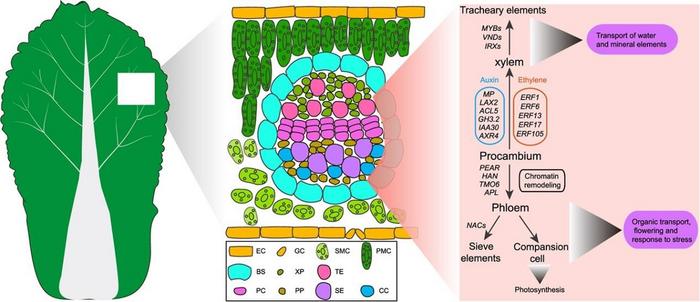
Auxin and ethylene were involved in the differentiation process from procambium to xylem. Xylem is involved in water and mineral element transport. The TFs MYBs and VNDs, as well as IRXs genes regulate and participate in TE formation. Phloem (including SE and CC) is mainly involved in flowering, organic transport, and stress response. TF encoding genes PEAR, HAN, TMO6, and APL are involved in the differentiation process from the procambium to the phloem, whereas many NAC TFs regulate SE formation. EC, epidermis; GC, guard cell; PMC, palisade mesophyll cell; SMC, spongy mesophyll cell; BS, bundle sheath; XP, xylem parenchyma; TE, tracheary elements; PC, procambium cell; PP, phloem parenchyma; SE, sieve elements; CC, companion cells.
The findings from this study could have far-reaching implications for improving leaf architecture in Brassica crops, which are essential for global food security. Understanding the genetic regulation of vascular development could lead to the creation of more robust crops with optimized leaf morphology and enhanced stress tolerance. Additionally, the identification of key transcription factors and their regulatory networks may serve as targets for future genetic engineering, enabling the development of crops that can better withstand environmental stressors such as drought and high temperatures. This research lays the foundation for future studies in crop enhancement and sustainable agriculture.
Source – Nanjing Agricultural University The Academy of Science


Leaf vasculature plays a pivotal role in nutrient transport and leaf morphology. A new study in Brassica rapa reveals the developmental trajectories of vascular tissues in Chinese cabbage using single-cell RNA sequencing (scRNA-seq). This comprehensive transcriptome map identifies seven distinct vascular cell types and traces the differentiation processes of xylem and phloem tissues. The study uncovers how auxin and ethylene regulate vascular differentiation and highlights the asymmetric gene expression patterns across subgenomes, providing crucial insights into the complex regulatory mechanisms driving leaf morphogenesis in this important vegetable crop.
Leaf vascular development is essential for plant adaptation to terrestrial environments, supporting nutrient and water transport, as well as structural integrity. Brassica rapa, with its diverse leaf forms, has long been studied for its unique leaf vascular architecture. However, understanding the precise molecular mechanisms behind vascular differentiation, especially at single-cell resolution, has been lacking. Previous studies in other species, such as Arabidopsis, have provided insight into vascular differentiation, but high-resolution studies in B. rapa remain scarce. Based on these challenges, further in-depth research into the regulatory roles of vascular cell differentiation in B. rapa is critical for improving crop traits.
Researchers from the Institute of Vegetables and Flowers, Chinese Academy of Agricultural Sciences, together with collaborators from Henan Institute of Science and Technology, a study on 26 February 2025 in Horticulture Research provides a detailed single-cell transcriptome analysis of leaf vascular tissues in Chinese cabbage (Brassica rapa). This work sheds light on the molecular and developmental features of vascular differentiation, exploring the roles of key genes in xylem and phloem development. The research not only advances our understanding of leaf morphogenesis in B. rapa but also lays the groundwork for similar studies in other Brassica crops.
Using single-cell RNA sequencing, the researchers identified 12 distinct cell clusters within the leaf vasculature of B. rapa, which were classified into seven major cell types: xylem parenchyma (XP), tracheary elements (TE), phloem parenchyma (PP), sieve elements (SE), companion cells (CC), procambium cells (PC), and PCXP (procamium cells with xylem differentiation traits). The study’s pseudo-time analysis revealed the developmental pathways of these cells, emphasizing the regulatory roles of auxin and ethylene in xylem differentiation. Key transcription factors (TFs) like MYBs and VNDs were identified as critical for tracheary element formation, while NAC TFs played a crucial role in sieve element differentiation. Notably, asymmetric gene expression patterns were observed across subgenomes, suggesting that the genome triplication in B. rapa has led to divergent roles for its homoeologous genes in different vascular cell types. This research provides a high-resolution molecular framework for understanding vascular development and leaf morphogenesis in Brassica vegetables, opening avenues for crop improvement.
Hypothetical regulatory model for vascular tissue differentiation in Chinese cabbage leaves
Auxin and ethylene were involved in the differentiation process from procambium to xylem. Xylem is involved in water and mineral element transport. The TFs MYBs and VNDs, as well as IRXs genes regulate and participate in TE formation. Phloem (including SE and CC) is mainly involved in flowering, organic transport, and stress response. TF encoding genes PEAR, HAN, TMO6, and APL are involved in the differentiation process from the procambium to the phloem, whereas many NAC TFs regulate SE formation. EC, epidermis; GC, guard cell; PMC, palisade mesophyll cell; SMC, spongy mesophyll cell; BS, bundle sheath; XP, xylem parenchyma; TE, tracheary elements; PC, procambium cell; PP, phloem parenchyma; SE, sieve elements; CC, companion cells.
The findings from this study could have far-reaching implications for improving leaf architecture in Brassica crops, which are essential for global food security. Understanding the genetic regulation of vascular development could lead to the creation of more robust crops with optimized leaf morphology and enhanced stress tolerance. Additionally, the identification of key transcription factors and their regulatory networks may serve as targets for future genetic engineering, enabling the development of crops that can better withstand environmental stressors such as drought and high temperatures. This research lays the foundation for future studies in crop enhancement and sustainable agriculture.
Source – Nanjing Agricultural University The Academy of Science
Guo X, Yuan J, Zhang Y, Wu J, Wang X. (2025) Developmental landscape and asymmetric gene expression in the leaf vasculature of Brassica rapa revealed by single cell transcriptome. Horticulture Research 12(6): uhaf060. [article]
Related Posts
Novel biosensor uses DNA ‘barcodes’ to uncover disease signals in cells
CellART extracts single-cell information from high-resolution spatial transcriptomics
Cell2space restores spatial context to single-cell RNA sequencing data
Urine test may improve bladder cancer diagnosis and guide treatment decisions
DeCoRE – a computational method to resolve RNA structural heterogeneity from RNA structure probing data by direct RNA sequencing
Tracing 700 million years of cell evolution
How should biological replicates be handled in long-read RNA sequencing?
RNA-Seq reveals a new way the developing heart controls its growth
The Human RNome Project Consortium seeks to publish first-ever complete sequence of the body’s RNA
scFlowReport brings multiple single-cell RNA sequencing analyses into one workflow
Long-read RNA sequencing reveals how neurons choose alternative RNA endings
DeOPUS improves cell-type estimates from bulk RNA sequencing
ResolVI improves accuracy in spatial transcriptomics analysis
RNA sequencing reveals transcriptional allele differences in prostate cancer stem cells
Unmasking “zombie cells” in aging tissue with an AI-powered barcode
RNA variant imaging for cancer diagnosis
Autism-risk mutations reveal two opposing patterns of brain gene activity
A real-data approach to evaluating RNA transcript analysis methods
Detection and sequencing of Ap2N-capped RNAs in human cells
Single-cell RNA sequencing provides a closer look at the Aedes aegypti midgut
Stay Connected
Submit a Post to the Blog
Recent Posts
Subscribe to the RNA-Seq Blog
RNA-Seq Products & Services