

As we age, our immune system changes. These changes are crucial for understanding how our body responds to infections, diseases, and even how we age itself. However, we didn’t fully understand how our immune system evolves over a lifetime—until now.
Researchers at the Shanghai Cancer Institute set out to fill in this gap. The researchers looked at immune cells from 220 healthy people, ranging in age from newborns to those over 90 years old. They used advanced techniques like single-cell RNA sequencing, which helps scientists look at the activity of individual cells, and mass cytometry, which identifies specific proteins on cells. These tools helped the team study the immune cells in great detail.
Overview of single-cell transcriptomes of peripheral immune cells across each stage of the human lifespan
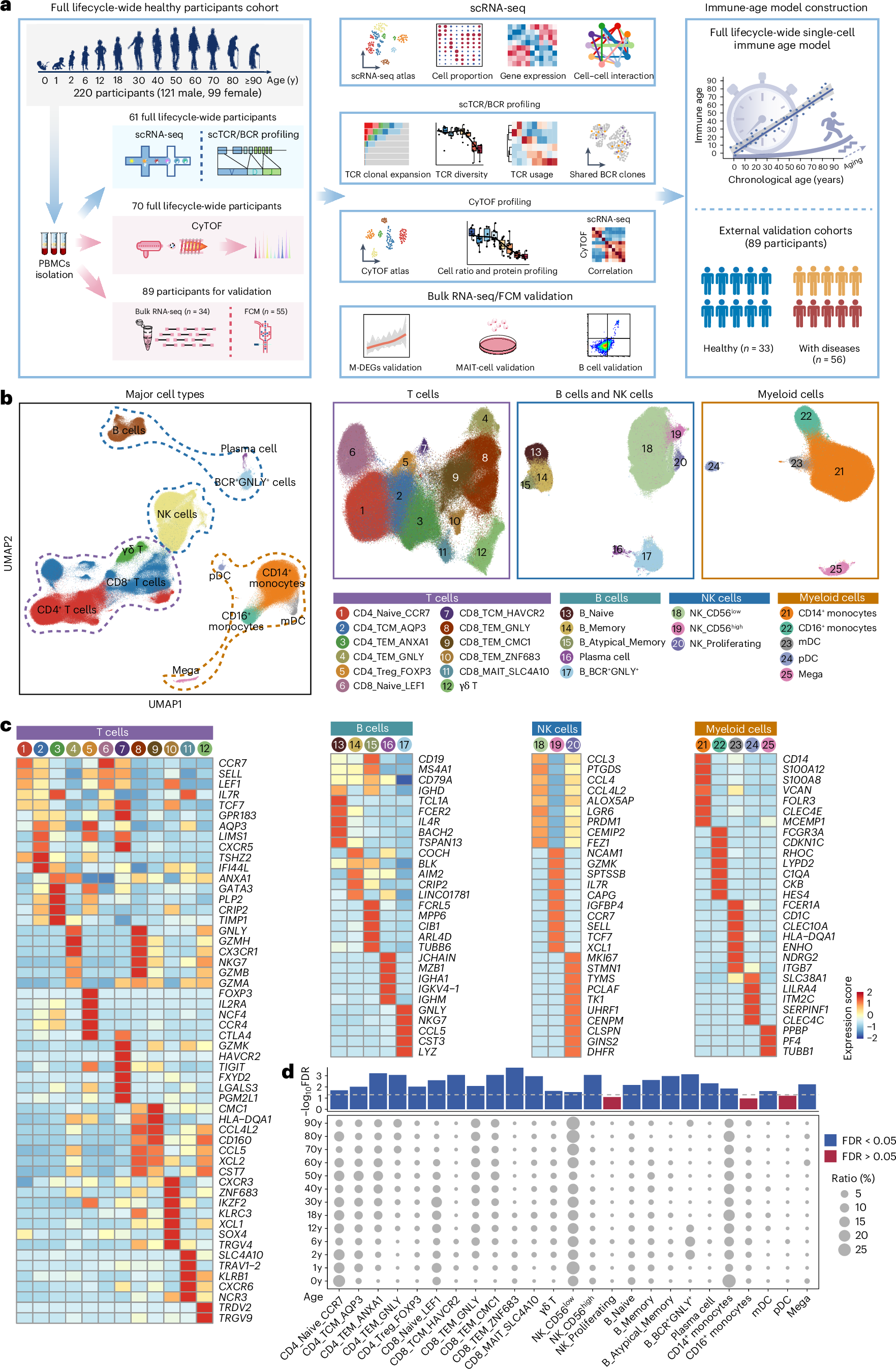
a, Workflow of the overall experimental design of this study. b, UMAP plot illustrating the peripheral immune cell subsets identified within PBMCs from 61 samples. c, Heatmaps showing the expression of signature genes in each cell subset. d, Dot plot showing the age-related variations in proportion of the 25 immune cell subsets across 13 age groups. Kruskal–Wallis one-way analysis was used to identify cell subsets with significant differences across age groups. FDR correction was applied to account for multiple testing and the values are shown above the dot plot. Horizontal dashed line marks the threshold for FDR significance (FDR < 0.05). mDCs, myeloid dendritic cells; pDCs, plasmacytoid dendritic cells; UMAP, uniform manifold approximation and projection; y, years.
The researchers found that the immune system’s T cells, which are a key part of our defense against infections, changed the most with age. T cells are like soldiers in our body that fight off infections and diseases. The researchers saw that the way these T cells interact with each other shifts as we get older. For example, some T cells, like GNLY+CD8+ effector memory T cells, grew in number and became more active during childhood and old age. These T cells were very good at fighting infections, but their function looked different depending on the person’s age. In contrast, another type of T cell called CD8+ MAIT cells was at its peak in adolescence—both in terms of how many of them were in the body and how effective they were at fighting infections. However, these cells started to decline as people aged.
What’s also interesting is that the researchers discovered a new type of cytotoxic B cell—a type of immune cell that targets harmful cells in the body. This B cell was most common in children, adding to our understanding of how our immune system behaves at different stages of life.
Lastly, the researchers developed a model that can predict a person’s “immune age.” This model uses data from across the lifespan to help doctors understand if someone’s immune system is aging in a healthy way or if something is disrupting its function. This model could be very helpful for early detection of immune system issues, giving us better tools for staying healthy as we age.
Wang Y, Li R, Tong R et al. (2025) Integrating single-cell RNA and T cell/B cell receptor sequencing with mass cytometry reveals dynamic trajectories of human peripheral immune cells from birth to old age. Nat Immunol [Epub ahead of print]. [article]
Related Posts




As we age, our immune system changes. These changes are crucial for understanding how our body responds to infections, diseases, and even how we age itself. However, we didn’t fully understand how our immune system evolves over a lifetime—until now.
Researchers at the Shanghai Cancer Institute set out to fill in this gap. The researchers looked at immune cells from 220 healthy people, ranging in age from newborns to those over 90 years old. They used advanced techniques like single-cell RNA sequencing, which helps scientists look at the activity of individual cells, and mass cytometry, which identifies specific proteins on cells. These tools helped the team study the immune cells in great detail.
Overview of single-cell transcriptomes of peripheral immune cells across each stage of the human lifespan
a, Workflow of the overall experimental design of this study. b, UMAP plot illustrating the peripheral immune cell subsets identified within PBMCs from 61 samples. c, Heatmaps showing the expression of signature genes in each cell subset. d, Dot plot showing the age-related variations in proportion of the 25 immune cell subsets across 13 age groups. Kruskal–Wallis one-way analysis was used to identify cell subsets with significant differences across age groups. FDR correction was applied to account for multiple testing and the values are shown above the dot plot. Horizontal dashed line marks the threshold for FDR significance (FDR < 0.05). mDCs, myeloid dendritic cells; pDCs, plasmacytoid dendritic cells; UMAP, uniform manifold approximation and projection; y, years.
The researchers found that the immune system’s T cells, which are a key part of our defense against infections, changed the most with age. T cells are like soldiers in our body that fight off infections and diseases. The researchers saw that the way these T cells interact with each other shifts as we get older. For example, some T cells, like GNLY+CD8+ effector memory T cells, grew in number and became more active during childhood and old age. These T cells were very good at fighting infections, but their function looked different depending on the person’s age. In contrast, another type of T cell called CD8+ MAIT cells was at its peak in adolescence—both in terms of how many of them were in the body and how effective they were at fighting infections. However, these cells started to decline as people aged.
What’s also interesting is that the researchers discovered a new type of cytotoxic B cell—a type of immune cell that targets harmful cells in the body. This B cell was most common in children, adding to our understanding of how our immune system behaves at different stages of life.
Lastly, the researchers developed a model that can predict a person’s “immune age.” This model uses data from across the lifespan to help doctors understand if someone’s immune system is aging in a healthy way or if something is disrupting its function. This model could be very helpful for early detection of immune system issues, giving us better tools for staying healthy as we age.
Wang Y, Li R, Tong R et al. (2025) Integrating single-cell RNA and T cell/B cell receptor sequencing with mass cytometry reveals dynamic trajectories of human peripheral immune cells from birth to old age. Nat Immunol [Epub ahead of print]. [article]
Related Posts
Recent Posts
 Machine learning reveals how RNA splicing is regulated in individual cell types
 Illumina releases SpliceAI2 to help advance rare disease research
 Postdoctoral Fellow – Long-Read RNA Methods Development for Neurodegeneration
 Novel biosensor uses DNA ‘barcodes’ to uncover disease signals in cells
 GP-DHT uses single-cell RNA sequencing to map gene regulatory networks
 Boehringer taps Envisagenics’ AI to mine RNA splicing for cancer targets
RNA-Seq Products & Services


Stay Connected