

Breast cancer is made up of many different types of cells, and these differences can strongly influence how a tumor grows and responds to treatment. A research team from the Henan University of Chinese Medicine used single cell RNA sequencing to look at thousands of individual cells from breast tumors. This approach allowed them to map out the tumor microenvironment in great detail and reveal how each cell type contributes to tumor behavior.
By examining 68 breast cancer samples, the team identified all major cell types in and around the tumor, including cancerous epithelial cells, immune cells, fibroblasts and endothelial cells. The proportions of these cells varied widely depending on the breast cancer subtype. For example, one triple negative breast cancer sample showed a high number of immune cells, while an estrogen receptor positive tumor had many more epithelial cells. These patterns match what clinicians already know about how different breast cancer subtypes behave.
Malignant cell identification by infercnvpy
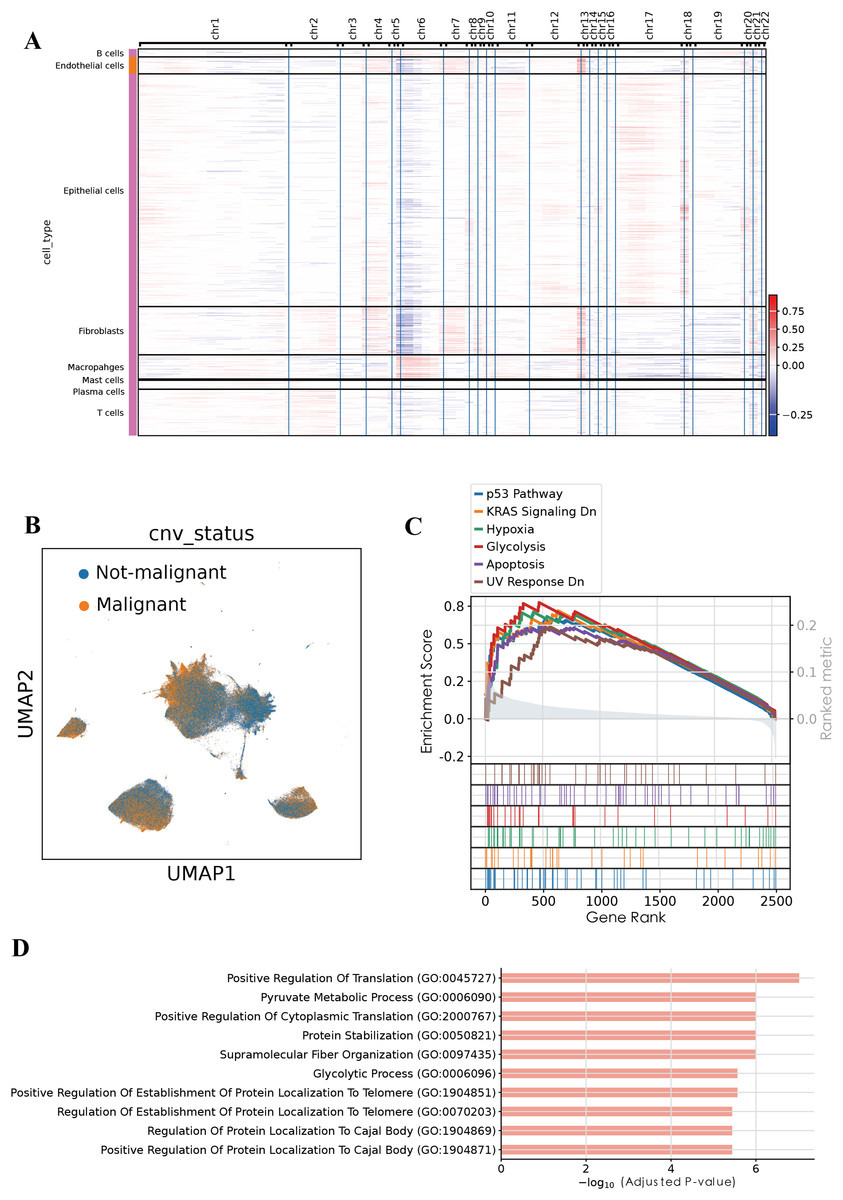
(A) Heatmap of inferred copy number variations across cell types. (B) UMAP highlighting malignant versus non-malignant epithelial cells. (C) GSEA results showing pathways enriched in malignant epithelial cells. (D) GO enrichment (Biological Process) for the top 200 signature genes in malignant epithelial cells.
The researchers next focused on the cancer cells themselves. By identifying which cells had abnormal chromosome patterns, they picked out about ninety thousand malignant cells and grouped them into five distinct subpopulations. One group stood out because it expressed the gene KRT17 and showed strong stem like characteristics. Genes active in this KRT17 positive group, including NFKBIA, PDLIM4 and TCP1, were linked to patient survival in a large public cancer dataset.
Using these genes, the team created an eight gene signature that could sort patients into high risk and low risk groups. Tumors in the high risk group had more suppressive immune cells, whereas low risk tumors were more often surrounded by active lymphocytes. One gene, TCP1, became a key focus. When TCP1 was reduced in breast cancer cell lines, the cancer cells became much less able to move and invade, suggesting that blocking TCP1 might slow the spread of aggressive breast cancers.
Together, these findings show how single cell analysis can uncover hidden tumor cell states and point to new therapeutic targets like TCP1 that may help guide more personalized breast cancer treatments.
Wu H, Du H, Si G, Song X, Si F, (2025) Single cell RNA seq reveals breast cancer heterogeneity and identifies TCP1 as a therapeutic target in breast cancer. PeerJ 13:e20451 [article]
Related Posts






Breast cancer is made up of many different types of cells, and these differences can strongly influence how a tumor grows and responds to treatment. A research team from the Henan University of Chinese Medicine used single cell RNA sequencing to look at thousands of individual cells from breast tumors. This approach allowed them to map out the tumor microenvironment in great detail and reveal how each cell type contributes to tumor behavior.
By examining 68 breast cancer samples, the team identified all major cell types in and around the tumor, including cancerous epithelial cells, immune cells, fibroblasts and endothelial cells. The proportions of these cells varied widely depending on the breast cancer subtype. For example, one triple negative breast cancer sample showed a high number of immune cells, while an estrogen receptor positive tumor had many more epithelial cells. These patterns match what clinicians already know about how different breast cancer subtypes behave.
Malignant cell identification by infercnvpy
(A) Heatmap of inferred copy number variations across cell types. (B) UMAP highlighting malignant versus non-malignant epithelial cells. (C) GSEA results showing pathways enriched in malignant epithelial cells. (D) GO enrichment (Biological Process) for the top 200 signature genes in malignant epithelial cells.
The researchers next focused on the cancer cells themselves. By identifying which cells had abnormal chromosome patterns, they picked out about ninety thousand malignant cells and grouped them into five distinct subpopulations. One group stood out because it expressed the gene KRT17 and showed strong stem like characteristics. Genes active in this KRT17 positive group, including NFKBIA, PDLIM4 and TCP1, were linked to patient survival in a large public cancer dataset.
Using these genes, the team created an eight gene signature that could sort patients into high risk and low risk groups. Tumors in the high risk group had more suppressive immune cells, whereas low risk tumors were more often surrounded by active lymphocytes. One gene, TCP1, became a key focus. When TCP1 was reduced in breast cancer cell lines, the cancer cells became much less able to move and invade, suggesting that blocking TCP1 might slow the spread of aggressive breast cancers.
Together, these findings show how single cell analysis can uncover hidden tumor cell states and point to new therapeutic targets like TCP1 that may help guide more personalized breast cancer treatments.
Wu H, Du H, Si G, Song X, Si F, (2025) Single cell RNA seq reveals breast cancer heterogeneity and identifies TCP1 as a therapeutic target in breast cancer. PeerJ 13:e20451 [article]
Related Posts
Recent Posts
 Machine learning reveals how RNA splicing is regulated in individual cell types
 Illumina releases SpliceAI2 to help advance rare disease research
 Postdoctoral Fellow – Long-Read RNA Methods Development for Neurodegeneration
 Novel biosensor uses DNA ‘barcodes’ to uncover disease signals in cells
 GP-DHT uses single-cell RNA sequencing to map gene regulatory networks
 Boehringer taps Envisagenics’ AI to mine RNA splicing for cancer targets
RNA-Seq Products & Services



Stay Connected