

Cancer develops through a process of evolution. As cells acquire mutations, some clones gain advantages that allow them to grow faster, survive longer, or resist treatment. Over time, these genetically distinct cell populations can make tumors increasingly difficult to eliminate.
Researchers at the Icahn School of Medicine at Mount Sinai and Weill Cornell Medicine in New York discuss the use of multimodal single-cell technologies to study, not only which mutations are present in individual cells, but also how those mutations affect cell behavior.
Endogenous variations and analytical tools suitable for phylogenetic reconstruction
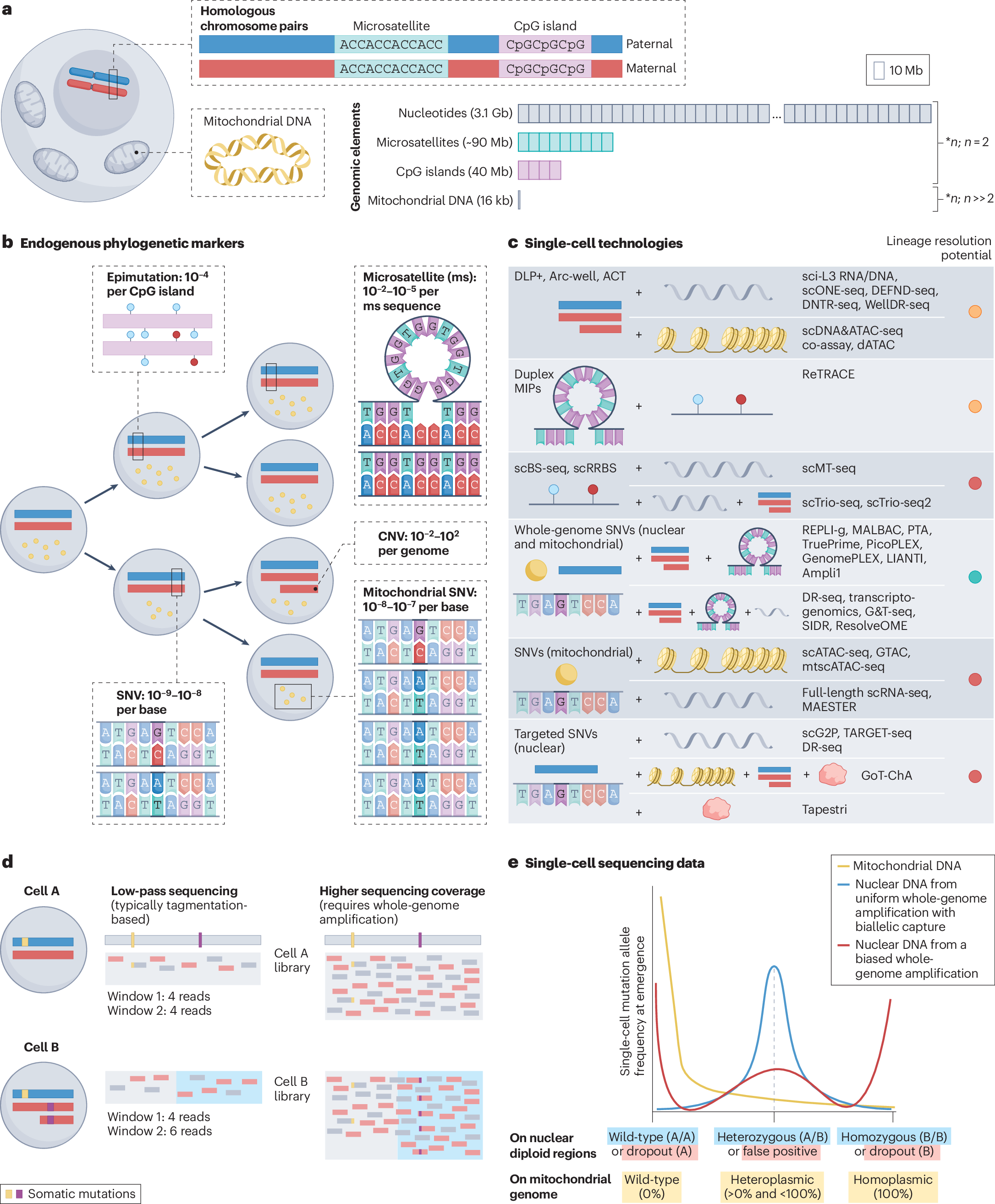
a, Illustration of chromosomal DNA in the nucleus and mtDNA in the mitochondria. Diploid chromosomal DNA comprising homologous chromosome pairs (paternal and maternal) harbour microsatellite repeats and CpG islands. b, Somatic variation acquired over successive cell divisions during somatic evolution can be used as endogenous phylogenetic markers. c, Single-cell genotyping technologies that can be used for lineage tracing. d, The inference of copy-number variants relies on read counts derived from two primary methods: direct single-cell tagmentation followed by shallow sequencing (left) or high-depth sequencing following single-cell whole-genome amplification (right). e, Expected variant allele frequency densities of somatic variants detected from single-cell sequencing data.
Clonal evolution begins before cancer
Genetic variation is not limited to tumors. Even healthy tissues can contain groups of cells that share acquired mutations and gradually expand over time.
This process, known as clonal mosaicism, may provide some of the early genetic changes that eventually contribute to cancer. Once a tumor forms, additional mutations can create multiple competing clones.
Treatment then acts as a selective pressure. Sensitive cells may die, while resistant clones survive and expand, increasing the risk of recurrence.
Understanding this process requires more than simply identifying mutations. Researchers also need to know what those mutations do to the cell.
Connecting genotype and phenotype in the same cell
Older sequencing approaches often measured genetic mutations and gene expression in separate samples. Multimodal single-cell technologies can now capture a cell’s genotype together with additional molecular features from that same cell.
These measurements may include RNA sequencing, chromatin accessibility, DNA methylation, protein expression, or other indicators of cell state. By combining them, researchers can determine whether a particular mutation is associated with a specific gene expression program or cellular behavior.
This is important because the same mutation may produce different effects depending on the type or state of the cell in which it occurs.
Finding vulnerabilities in mutant clones
Genotype-aware single-cell analysis can reveal traits that are specific to disease-causing clones.
For example, a mutation might push cells toward a particular developmental state, alter signaling pathways, or change how they respond to stress. If those effects are unique to mutant cells, they may provide therapeutic targets.
The goal is to identify ways to eliminate disease-propagating clones while minimizing damage to normal cells.
Reconstructing how clones evolve over time
Researchers can also use genetic differences between cells to reconstruct evolutionary relationships.
This creates a phylogenetic tree showing how individual clones are related and how they emerged from common ancestors. When these lineage relationships are combined with gene expression or other phenotypic measurements, scientists can begin to map when specific cell states appeared during disease progression.
This approach can also help distinguish stable, inherited cell states from more flexible states that cells can enter and leave depending on their environment.
Understanding treatment resistance
Clonal diversity is one reason cancer treatment can be so difficult.
A tumor may initially shrink because the dominant clone is sensitive to therapy, while a smaller resistant population survives. That population can later expand and drive relapse.
Single-cell RNA sequencing and multimodal approaches can help identify these resistant states before they become dominant. They can also reveal how mutations interact with cellular programs that promote survival under treatment.
A more complete view of cancer evolution
Studying genotype and phenotype together provides a more detailed view of how cancer develops than analyzing mutations alone.
By combining single-cell RNA sequencing with other molecular measurements and lineage reconstruction, researchers can trace how mutant clones arise, how their behavior changes, and which traits give them a selective advantage.
These approaches may eventually help identify more precise ways to target the cell populations most responsible for disease progression and treatment resistance.
Izzo F, Prieto T, Potenski C, Landau DA. (2026) A single-cell lens into the co-evolution of genotypes and phenotypes in cancer. Nature Reviews Cancer [Epub ahead of print]. [article]
Related Posts


Cancer develops through a process of evolution. As cells acquire mutations, some clones gain advantages that allow them to grow faster, survive longer, or resist treatment. Over time, these genetically distinct cell populations can make tumors increasingly difficult to eliminate.
Researchers at the Icahn School of Medicine at Mount Sinai and Weill Cornell Medicine in New York discuss the use of multimodal single-cell technologies to study, not only which mutations are present in individual cells, but also how those mutations affect cell behavior.
Endogenous variations and analytical tools suitable for phylogenetic reconstruction
a, Illustration of chromosomal DNA in the nucleus and mtDNA in the mitochondria. Diploid chromosomal DNA comprising homologous chromosome pairs (paternal and maternal) harbour microsatellite repeats and CpG islands. b, Somatic variation acquired over successive cell divisions during somatic evolution can be used as endogenous phylogenetic markers. c, Single-cell genotyping technologies that can be used for lineage tracing. d, The inference of copy-number variants relies on read counts derived from two primary methods: direct single-cell tagmentation followed by shallow sequencing (left) or high-depth sequencing following single-cell whole-genome amplification (right). e, Expected variant allele frequency densities of somatic variants detected from single-cell sequencing data.
Clonal evolution begins before cancer
Genetic variation is not limited to tumors. Even healthy tissues can contain groups of cells that share acquired mutations and gradually expand over time.
This process, known as clonal mosaicism, may provide some of the early genetic changes that eventually contribute to cancer. Once a tumor forms, additional mutations can create multiple competing clones.
Treatment then acts as a selective pressure. Sensitive cells may die, while resistant clones survive and expand, increasing the risk of recurrence.
Understanding this process requires more than simply identifying mutations. Researchers also need to know what those mutations do to the cell.
Connecting genotype and phenotype in the same cell
Older sequencing approaches often measured genetic mutations and gene expression in separate samples. Multimodal single-cell technologies can now capture a cell’s genotype together with additional molecular features from that same cell.
These measurements may include RNA sequencing, chromatin accessibility, DNA methylation, protein expression, or other indicators of cell state. By combining them, researchers can determine whether a particular mutation is associated with a specific gene expression program or cellular behavior.
This is important because the same mutation may produce different effects depending on the type or state of the cell in which it occurs.
Finding vulnerabilities in mutant clones
Genotype-aware single-cell analysis can reveal traits that are specific to disease-causing clones.
For example, a mutation might push cells toward a particular developmental state, alter signaling pathways, or change how they respond to stress. If those effects are unique to mutant cells, they may provide therapeutic targets.
The goal is to identify ways to eliminate disease-propagating clones while minimizing damage to normal cells.
Reconstructing how clones evolve over time
Researchers can also use genetic differences between cells to reconstruct evolutionary relationships.
This creates a phylogenetic tree showing how individual clones are related and how they emerged from common ancestors. When these lineage relationships are combined with gene expression or other phenotypic measurements, scientists can begin to map when specific cell states appeared during disease progression.
This approach can also help distinguish stable, inherited cell states from more flexible states that cells can enter and leave depending on their environment.
Understanding treatment resistance
Clonal diversity is one reason cancer treatment can be so difficult.
A tumor may initially shrink because the dominant clone is sensitive to therapy, while a smaller resistant population survives. That population can later expand and drive relapse.
Single-cell RNA sequencing and multimodal approaches can help identify these resistant states before they become dominant. They can also reveal how mutations interact with cellular programs that promote survival under treatment.
A more complete view of cancer evolution
Studying genotype and phenotype together provides a more detailed view of how cancer develops than analyzing mutations alone.
By combining single-cell RNA sequencing with other molecular measurements and lineage reconstruction, researchers can trace how mutant clones arise, how their behavior changes, and which traits give them a selective advantage.
These approaches may eventually help identify more precise ways to target the cell populations most responsible for disease progression and treatment resistance.
Izzo F, Prieto T, Potenski C, Landau DA. (2026) A single-cell lens into the co-evolution of genotypes and phenotypes in cancer. Nature Reviews Cancer [Epub ahead of print]. [article]
Related Posts
Recent Posts
 Scientists identify the neuroblastoma cells that signal poor outcomes
 GARAGE improves rare cell detection in single-cell RNA sequencing analysis using AI
 Machine learning reveals how RNA splicing is regulated in individual cell types
 Illumina releases SpliceAI2 to help advance rare disease research
 Postdoctoral Fellow – Long-Read RNA Methods Development for Neurodegeneration
 Novel biosensor uses DNA ‘barcodes’ to uncover disease signals in cells
RNA-Seq Products & Services


Stay Connected