After a person survives a heart attack, the heart has a brief window of time in which it can heal if the right circumstances exist. But most of the time, scar tissue forms in the areas that lacked oxygen during the heart attack. This scar tissue impairs heart function, which can worsen into heart failure, reducing quality of life and increasing the risk of early death.
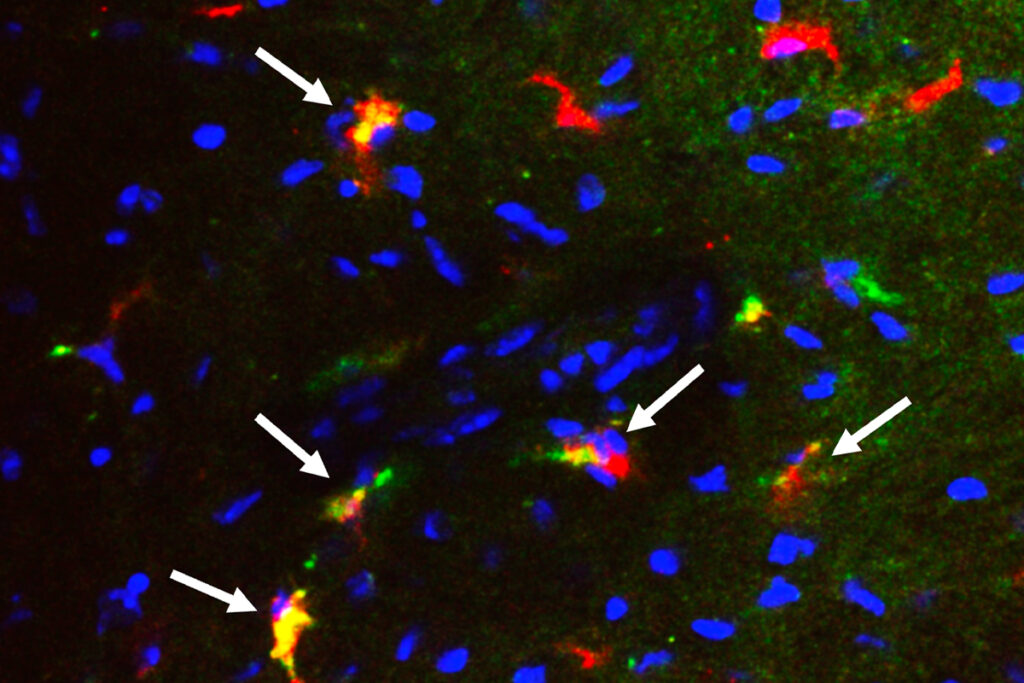
WashU Medicine researchers showed in mice that immediately after a heart attack, specialized immune cells (indicated by white arrows) are mobilized from the spleen to the heart to aid in cardiac healing. (Image: M. Ameen Ismahil/WashU Medicine)
A new study led by Sumanth D. Prabhu, MD, the Tobias and Hortense Lewin Distinguished Professor of Cardiovascular Diseases and director of the Cardiovascular Division at WashU Medicine, and Mohamed Ameen Ismahil, PhD, an assistant professor in the Cardiovascular Division, has identified a surprising role for the spleen — a small organ near the ribs that filters blood and fights infections — in helping the heart heal after a heart attack.
The research, published in Circulation, demonstrated in mice that specific immune cells called marginal metallophilic macrophages, which originate in the spleen, travel from the spleen to the heart and support a healing response after a heart attack.
Using mouse models, single-cell RNA sequencing and other advanced techniques, the researchers established that these specialized macrophages from the spleen help clear damaging immune cells, suppress inflammation and activate genes that help repair the injured cardiac tissue following a heart attack. To assess whether the same thing occurs in humans, the researchers measured levels of marginal metallophilic macrophages in blood samples collected from people upon their hospital admission due to a heart attack. The researchers compared these levels with those of cardiac patients who had coronary artery disease but had not recently had a heart attack. Prabhu and his colleagues found that levels of the specialized macrophages were higher in patients who had just had a heart attack.
The researchers also demonstrated that they could boost the numbers of these specialized immune cells in mice with an experimental drug, and that doing so improved the healing and anti-inflammatory effects. This medical intervention is not yet in clinical trials, but it suggests a possible future cardiac immunotherapy targeting the spleen to prevent heart failure in patients who survive a heart attack, which applies to hundreds of thousands of people in the U.S. each year.
Source – Washington University in St. Louis


After a person survives a heart attack, the heart has a brief window of time in which it can heal if the right circumstances exist. But most of the time, scar tissue forms in the areas that lacked oxygen during the heart attack. This scar tissue impairs heart function, which can worsen into heart failure, reducing quality of life and increasing the risk of early death.
WashU Medicine researchers showed in mice that immediately after a heart attack, specialized immune cells (indicated by white arrows) are mobilized from the spleen to the heart to aid in cardiac healing. (Image: M. Ameen Ismahil/WashU Medicine)
A new study led by Sumanth D. Prabhu, MD, the Tobias and Hortense Lewin Distinguished Professor of Cardiovascular Diseases and director of the Cardiovascular Division at WashU Medicine, and Mohamed Ameen Ismahil, PhD, an assistant professor in the Cardiovascular Division, has identified a surprising role for the spleen — a small organ near the ribs that filters blood and fights infections — in helping the heart heal after a heart attack.
The research, published in Circulation, demonstrated in mice that specific immune cells called marginal metallophilic macrophages, which originate in the spleen, travel from the spleen to the heart and support a healing response after a heart attack.
Using mouse models, single-cell RNA sequencing and other advanced techniques, the researchers established that these specialized macrophages from the spleen help clear damaging immune cells, suppress inflammation and activate genes that help repair the injured cardiac tissue following a heart attack. To assess whether the same thing occurs in humans, the researchers measured levels of marginal metallophilic macrophages in blood samples collected from people upon their hospital admission due to a heart attack. The researchers compared these levels with those of cardiac patients who had coronary artery disease but had not recently had a heart attack. Prabhu and his colleagues found that levels of the specialized macrophages were higher in patients who had just had a heart attack.
The researchers also demonstrated that they could boost the numbers of these specialized immune cells in mice with an experimental drug, and that doing so improved the healing and anti-inflammatory effects. This medical intervention is not yet in clinical trials, but it suggests a possible future cardiac immunotherapy targeting the spleen to prevent heart failure in patients who survive a heart attack, which applies to hundreds of thousands of people in the U.S. each year.
Source – Washington University in St. Louis
Ismahil M, Zhou G, Rajasekar S, Gao M, Bansal S, Patel B, Limdi N, Xie M, Antipenko S, Rokosh G, Hamid T, Prabhu S. (2025) Splenic CD169+Tim4+ Marginal Metallophilic Macrophages Are Essential for Wound Healing After Myocardial Infarction. Circulation 151(24):1712-1729. [article]
Related Posts
Novel biosensor uses DNA ‘barcodes’ to uncover disease signals in cells
CellART extracts single-cell information from high-resolution spatial transcriptomics
Cell2space restores spatial context to single-cell RNA sequencing data
Urine test may improve bladder cancer diagnosis and guide treatment decisions
DeCoRE – a computational method to resolve RNA structural heterogeneity from RNA structure probing data by direct RNA sequencing
Tracing 700 million years of cell evolution
How should biological replicates be handled in long-read RNA sequencing?
RNA-Seq reveals a new way the developing heart controls its growth
The Human RNome Project Consortium seeks to publish first-ever complete sequence of the body’s RNA
scFlowReport brings multiple single-cell RNA sequencing analyses into one workflow
Long-read RNA sequencing reveals how neurons choose alternative RNA endings
DeOPUS improves cell-type estimates from bulk RNA sequencing
ResolVI improves accuracy in spatial transcriptomics analysis
RNA sequencing reveals transcriptional allele differences in prostate cancer stem cells
Unmasking “zombie cells” in aging tissue with an AI-powered barcode
RNA variant imaging for cancer diagnosis
Autism-risk mutations reveal two opposing patterns of brain gene activity
A real-data approach to evaluating RNA transcript analysis methods
Detection and sequencing of Ap2N-capped RNAs in human cells
Single-cell RNA sequencing provides a closer look at the Aedes aegypti midgut
Stay Connected
Submit a Post to the Blog
Recent Posts
Subscribe to the RNA-Seq Blog
RNA-Seq Products & Services