

Neutrophils are the most abundant type of white blood cell in the human bloodstream and play a critical role in protecting the body against infections. These immune cells are among the first to respond to invading pathogens, helping destroy bacteria, regulate inflammation and coordinate other immune responses.Traditionally, neutrophils have been viewed as a relatively uniform population of immune cells. However, advances in single-cell RNA sequencing have revealed that neutrophils are much more diverse than previously recognized, with different populations performing specialized functions depending on their location and the body’s health.
Researchers at Stanford University have developed a comprehensive single-cell atlas of human neutrophils (SCAHN) to investigate this diversity. Their findings, published in Nature Immunology, provide new insights into how neutrophil populations change during infection, cancer and other health conditions.
SCAHN curates and integrates a comprehensive single-cell atlas of human neutrophils
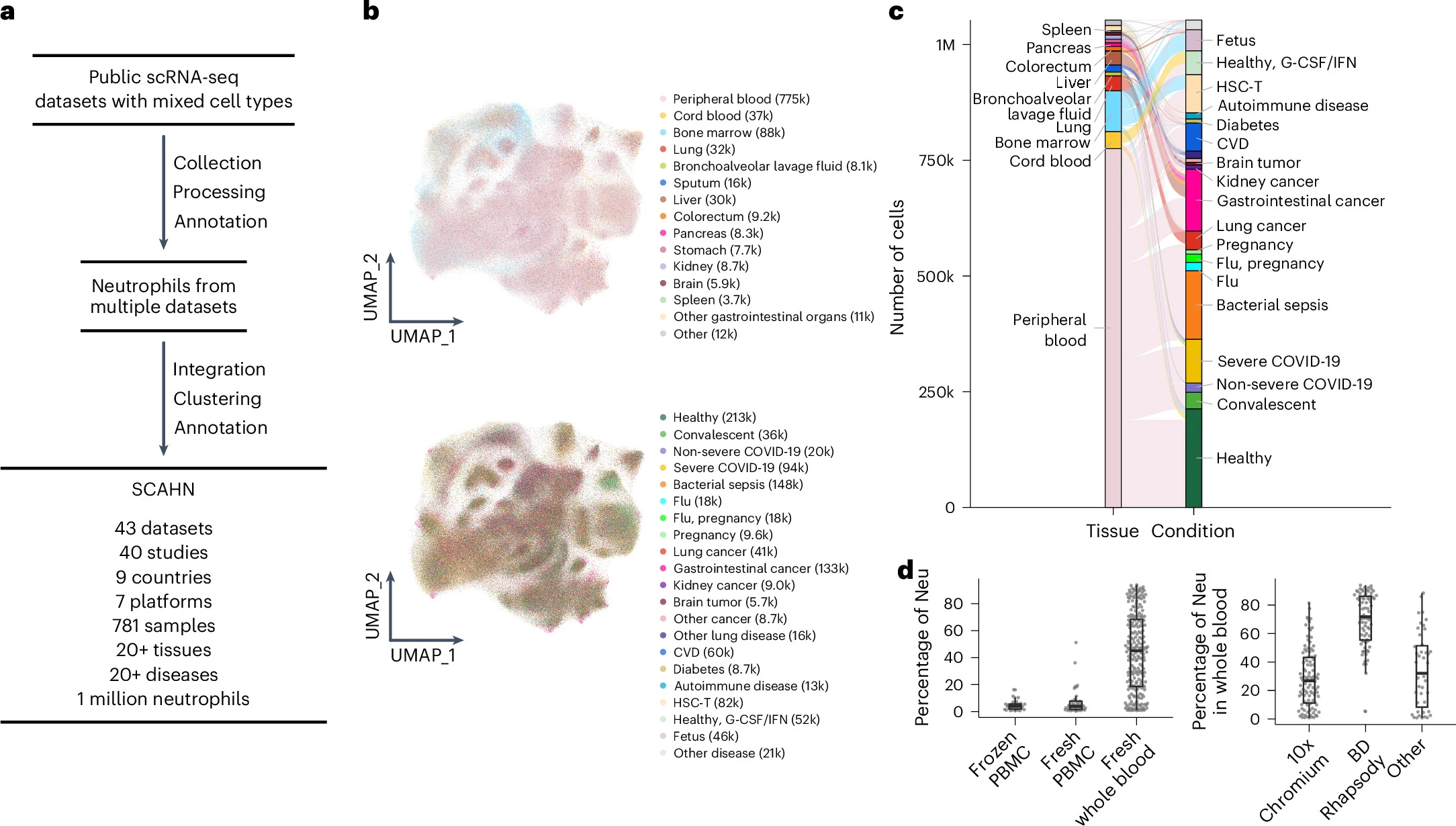
a, Schematic showing the collection and processing of human scRNA-seq datasets, and the generation of SCAHN by integrating and clustering neutrophils from each dataset. b, Uniform manifold approximation and projections (UMAPs) showing the tissue (top) and condition (bottom) composition of SCAHN neutrophils. Tissues represented in SCAHN are peripheral blood (samples n = 385); cord blood (13); bone marrow (31); lung (100); bronchoalveolar lavage fluid (11); sputum (30); liver (71); colorectum (10); pancreas (6); stomach (9); kidney (10); brain (13); spleen (10); and other gastrointestinal organs (33). Conditions represented in SCAHN are healthy (samples n = 103); convalescent (12); non-severe COVID-19 (19); severe COVID-19 (112); bacterial sepsis (56); influenza (4); influenza with pregnancy (3); pregnancy (2); lung cancer (87); gastrointestinal cancer (125); kidney cancer (7); brain tumor (11); other cancer (27); other lung disease (32); CVD (38); diabetes (9); and autoimmune diseases (32). c, Alluvial diagram showing the distribution of neutrophils across tissues and conditions. d, Box plots showing the proportion of neutrophils in peripheral blood according to preparation type (frozen PBMC, n = 34; fresh PBMC, n = 41; fresh whole blood, n = 225; left) and among the whole-blood samples according to sequencing platforms (10x Chromium, n = 102; BD Rhapsody, n = 80; other platform, n = 43; right). All PBMC and whole-blood samples included at least 30 neutrophils. All box plots represent the median (center line), interquartile range (IQR) (box) and 1.5 times the IQR (whiskers). G-CSF, granulocyte colony-stimulating factor; HSC-T, hematopoietic stem cell transplantation. Neu, neutrophil(s).
Building a comprehensive atlas of human neutrophils
The researchers combined single-cell RNA sequencing data from approximately one million neutrophils collected across 781 samples and 43 independent datasets.
Single-cell RNA sequencing allows scientists to measure gene expression in individual cells rather than averaging signals across an entire cell population. This makes it possible to identify distinct cell types and functional states that might otherwise remain hidden.
The resulting atlas included neutrophils from multiple tissues, including blood, bone marrow, lungs, liver and spleen, as well as samples from individuals with infections, cancer and other conditions.
By integrating these datasets, the researchers identified multiple neutrophil populations with distinct gene expression patterns associated with cellular development, inflammation, immune signaling and other biological functions.
How neutrophils change during infection and cancer
The researchers discovered substantial differences in neutrophil populations depending on disease severity and tissue environment.
In patients with severe COVID-19 or bacterial sepsis, immature neutrophil populations were more abundant than in healthy individuals or patients with less severe infections. These cells also showed increased activity of genes associated with inflammation and immune suppression.
In cancer samples, certain neutrophil populations expressed higher levels of genes involved in inflammatory signaling, blood vessel formation and immune regulation.
Some of these neutrophil signatures were associated with increased numbers of immune cells displaying features of exhaustion or suppression, suggesting that neutrophils may contribute to the immune environment surrounding tumors.
These findings highlight how neutrophils can have different effects depending on the disease, sometimes supporting protective immune responses while potentially contributing to harmful inflammation or immune suppression.
Identifying gene signatures associated with patient outcomes
To investigate whether neutrophil gene expression patterns could provide useful clinical information, the researchers analyzed 17,023 bulk blood transcriptome profiles from 40 datasets.
They identified neutrophil-specific gene signatures associated with several important health outcomes, including mortality risk in critically ill patients, cancer diagnosis and survival, and metabolic dysfunction.
Some signatures were associated with increased mortality among patients with severe illness, suggesting that the molecular characteristics of neutrophils may provide information beyond conventional white blood cell counts.
The researchers also examined electronic health records from more than 430,000 individuals, finding associations between neutrophil counts, chronic disease risk and long-term mortality.
Although these associations do not establish that neutrophils directly cause poor outcomes, they suggest that neutrophil measurements and gene expression profiles could eventually contribute to improved patient risk assessment.
Comparing neutrophils across species
The team also compared human neutrophil gene expression patterns with those from mice and nonhuman primates.
They identified several shared neutrophil populations and biological programs, suggesting that important aspects of neutrophil development and immune function are conserved across species.
However, they also found differences in genes involved in inflammatory signaling and antimicrobial activity.
These findings could help researchers determine which aspects of neutrophil biology can be investigated using animal models and which require direct examination of human cells.
Advancing immune research through single-cell RNA sequencing
SCAHN provides a comprehensive resource for understanding how neutrophils differ across tissues, individuals and disease conditions.
By combining single-cell RNA sequencing with large-scale transcriptomic and clinical datasets, the researchers identified molecular signatures associated with infection severity, cancer progression and long-term health outcomes.
The findings could support the development of more precise diagnostic tools and help identify new therapeutic strategies targeting specific neutrophil populations.
However, additional studies combining gene expression with protein measurements and prospective clinical validation will be necessary before these signatures can be incorporated into routine medical care.
The SCAHN atlas provides researchers with a foundation for exploring how neutrophil diversity influences immune responses and disease, highlighting the importance of studying individual immune cells rather than treating them as a single population.
Availability – The code for atlas construction and figure generation is available at https://github.com/Khatri-Lab/SCAHN.
Zheng H, Maestri E, Moore AR, Ganesan A, Enriquez J, Durán V, Einav S, van der Poll T, Bouma HR, Atreya MR, Efron PA, Moldawer LL, Sevransky J, Wright DW, Martin-Loeches I, Karvunidis T, Hinson J, Hager DN, Rothman RE, Giamarellos-Bourboulis EJ, Sweeney TE, Rogers AJ, Gombar S, Maddali MV, Chen JH, Shah N, Khatri P. (2026) A single-cell atlas of human neutrophils reveals neutrophil heterogeneity across health and disease. Nature Immunology [Epub ahead of print]. [article]
Related Posts


Neutrophils are the most abundant type of white blood cell in the human bloodstream and play a critical role in protecting the body against infections. These immune cells are among the first to respond to invading pathogens, helping destroy bacteria, regulate inflammation and coordinate other immune responses.Traditionally, neutrophils have been viewed as a relatively uniform population of immune cells. However, advances in single-cell RNA sequencing have revealed that neutrophils are much more diverse than previously recognized, with different populations performing specialized functions depending on their location and the body’s health.
Researchers at Stanford University have developed a comprehensive single-cell atlas of human neutrophils (SCAHN) to investigate this diversity. Their findings, published in Nature Immunology, provide new insights into how neutrophil populations change during infection, cancer and other health conditions.
SCAHN curates and integrates a comprehensive single-cell atlas of human neutrophils
a, Schematic showing the collection and processing of human scRNA-seq datasets, and the generation of SCAHN by integrating and clustering neutrophils from each dataset. b, Uniform manifold approximation and projections (UMAPs) showing the tissue (top) and condition (bottom) composition of SCAHN neutrophils. Tissues represented in SCAHN are peripheral blood (samples n = 385); cord blood (13); bone marrow (31); lung (100); bronchoalveolar lavage fluid (11); sputum (30); liver (71); colorectum (10); pancreas (6); stomach (9); kidney (10); brain (13); spleen (10); and other gastrointestinal organs (33). Conditions represented in SCAHN are healthy (samples n = 103); convalescent (12); non-severe COVID-19 (19); severe COVID-19 (112); bacterial sepsis (56); influenza (4); influenza with pregnancy (3); pregnancy (2); lung cancer (87); gastrointestinal cancer (125); kidney cancer (7); brain tumor (11); other cancer (27); other lung disease (32); CVD (38); diabetes (9); and autoimmune diseases (32). c, Alluvial diagram showing the distribution of neutrophils across tissues and conditions. d, Box plots showing the proportion of neutrophils in peripheral blood according to preparation type (frozen PBMC, n = 34; fresh PBMC, n = 41; fresh whole blood, n = 225; left) and among the whole-blood samples according to sequencing platforms (10x Chromium, n = 102; BD Rhapsody, n = 80; other platform, n = 43; right). All PBMC and whole-blood samples included at least 30 neutrophils. All box plots represent the median (center line), interquartile range (IQR) (box) and 1.5 times the IQR (whiskers). G-CSF, granulocyte colony-stimulating factor; HSC-T, hematopoietic stem cell transplantation. Neu, neutrophil(s).
Building a comprehensive atlas of human neutrophils
The researchers combined single-cell RNA sequencing data from approximately one million neutrophils collected across 781 samples and 43 independent datasets.
Single-cell RNA sequencing allows scientists to measure gene expression in individual cells rather than averaging signals across an entire cell population. This makes it possible to identify distinct cell types and functional states that might otherwise remain hidden.
The resulting atlas included neutrophils from multiple tissues, including blood, bone marrow, lungs, liver and spleen, as well as samples from individuals with infections, cancer and other conditions.
By integrating these datasets, the researchers identified multiple neutrophil populations with distinct gene expression patterns associated with cellular development, inflammation, immune signaling and other biological functions.
How neutrophils change during infection and cancer
The researchers discovered substantial differences in neutrophil populations depending on disease severity and tissue environment.
In patients with severe COVID-19 or bacterial sepsis, immature neutrophil populations were more abundant than in healthy individuals or patients with less severe infections. These cells also showed increased activity of genes associated with inflammation and immune suppression.
In cancer samples, certain neutrophil populations expressed higher levels of genes involved in inflammatory signaling, blood vessel formation and immune regulation.
Some of these neutrophil signatures were associated with increased numbers of immune cells displaying features of exhaustion or suppression, suggesting that neutrophils may contribute to the immune environment surrounding tumors.
These findings highlight how neutrophils can have different effects depending on the disease, sometimes supporting protective immune responses while potentially contributing to harmful inflammation or immune suppression.
Identifying gene signatures associated with patient outcomes
To investigate whether neutrophil gene expression patterns could provide useful clinical information, the researchers analyzed 17,023 bulk blood transcriptome profiles from 40 datasets.
They identified neutrophil-specific gene signatures associated with several important health outcomes, including mortality risk in critically ill patients, cancer diagnosis and survival, and metabolic dysfunction.
Some signatures were associated with increased mortality among patients with severe illness, suggesting that the molecular characteristics of neutrophils may provide information beyond conventional white blood cell counts.
The researchers also examined electronic health records from more than 430,000 individuals, finding associations between neutrophil counts, chronic disease risk and long-term mortality.
Although these associations do not establish that neutrophils directly cause poor outcomes, they suggest that neutrophil measurements and gene expression profiles could eventually contribute to improved patient risk assessment.
Comparing neutrophils across species
The team also compared human neutrophil gene expression patterns with those from mice and nonhuman primates.
They identified several shared neutrophil populations and biological programs, suggesting that important aspects of neutrophil development and immune function are conserved across species.
However, they also found differences in genes involved in inflammatory signaling and antimicrobial activity.
These findings could help researchers determine which aspects of neutrophil biology can be investigated using animal models and which require direct examination of human cells.
Advancing immune research through single-cell RNA sequencing
SCAHN provides a comprehensive resource for understanding how neutrophils differ across tissues, individuals and disease conditions.
By combining single-cell RNA sequencing with large-scale transcriptomic and clinical datasets, the researchers identified molecular signatures associated with infection severity, cancer progression and long-term health outcomes.
The findings could support the development of more precise diagnostic tools and help identify new therapeutic strategies targeting specific neutrophil populations.
However, additional studies combining gene expression with protein measurements and prospective clinical validation will be necessary before these signatures can be incorporated into routine medical care.
The SCAHN atlas provides researchers with a foundation for exploring how neutrophil diversity influences immune responses and disease, highlighting the importance of studying individual immune cells rather than treating them as a single population.
Availability – The code for atlas construction and figure generation is available at https://github.com/Khatri-Lab/SCAHN.
Zheng H, Maestri E, Moore AR, Ganesan A, Enriquez J, Durán V, Einav S, van der Poll T, Bouma HR, Atreya MR, Efron PA, Moldawer LL, Sevransky J, Wright DW, Martin-Loeches I, Karvunidis T, Hinson J, Hager DN, Rothman RE, Giamarellos-Bourboulis EJ, Sweeney TE, Rogers AJ, Gombar S, Maddali MV, Chen JH, Shah N, Khatri P. (2026) A single-cell atlas of human neutrophils reveals neutrophil heterogeneity across health and disease. Nature Immunology [Epub ahead of print]. [article]
Related Posts
Recent Posts
 PANGEA – an integrated cell atlas across diverse biological contexts enables systematic profiling of multicellular responses in human diseases
 UMIche – a UMI-centric analysis platform for enhancing molecular quantification accuracy in bulk and single-cell sequencing
 New AI tool uses RNA sequencing to uncover gene interactions in Alzheimer’s disease
 New RNA sequencing tool reveals how stem cells develop into heart cells
 Estimating the completeness of large-scale single-cell sequencing projects
 New RNA sequencing tool improves transcriptome reconstruction using machine learning
RNA-Seq Products & Services


Stay Connected