Why are newborns born to mothers with COVID-19 rarely infected? Researchers at the Wayne State University School of Medicine and the Perinatology Research Branch of National Institute of Child Health and Human Development/National Institutes of Health in Detroit have found that placental cells minimally express the instructions, or mRNA, required to generate the cell entry receptor and protease required by the virus that causes COVID-19 to invade human cells.
The pandemic caused by SARS-CoV-2 has infected more than 10 million people worldwide, including pregnant women, yet to date there is no consistent evidence that pregnant mothers pass the virus to their newborns.
While pregnant women represent a potential high-risk population given that other viral infections such as Zika, cytomegalovirus and rubella can be passed from mother to fetus, the evidence for vertical transmission of SARS-CoV-2 is rare, and acquisition of the virus in the nursery cannot be excluded.
A requirement for a virus to infect a cell is that cell surface expresses a receptor for the virus. The main receptor for the new coronavirus is the angiotensin converting enzyme 2, or ACE2. The spike protein of the virus – the spikes seen in the images of the virus – is activated by an enzyme called TMPRSS2. Cells that co-express ACE2 and TMPRSS2 such as those found in the lungs are particularly vulnerable to infection.
In the study “Does the human placenta express the canonical cell entry mediators for SARS-CoV-2?”, published today in the journal eLife, WSU and PRB researchers employed cutting-edge molecular techniques such as single-cell genomics to determine whether human placental cells express the mRNA for the mediators that the virus SARS-CoV-2 uses for entry into the cell. The researchers concluded that placental cells do not express the transcripts needed to develop the receptors that the virus requires to facilitate vertical transmission from mother to the fetus.
“The findings of this study help to understand why mother-to-fetus transmission is so rare (less than 2% of cases),” said Roberto Romero, M.D., D.Med.Sci, chief of the PRB. “The most likely explanation is that the cellular instructions for the production of the main receptor for SARS-CoV-2 are not expressed in the human placenta. In contrast, the receptors for other viruses known to cause fetal infection such as Zika and cytomegalovirus were found in placental cells.”
Roger Pique-Regi, Ph.D., assistant professor of the WSU Center for Molecular Medicine and Genetics, and of Obstetrics and Gynecology, first author of the study, explained that the single-cell genomics technology the researchers employed allows them to study the transcriptome of individual cells isolated in tiny oil droplets using microfluidics.
“This allows us to obtain at an unprecedented level of detail the multiple different cell types and the genes being expressed in gestational tissues,” said Dr. Pique-Regi, head of the Single-Cell Genomics Section of the PRB. “Here, we have dissected at the molecular level the different cell types of the human placenta across trimesters, and the membranes enveloping the fetus in the third trimester. This allowed us to determine which cell types are present and if they express the genes necessary for viral infection and spreading.”
While the study allows the possibility that SARS-CoV-2 could infect the placenta via alternate entry routes while interacting with other proteins, the findings provide strong evidence that it is unlikely to infect the placenta and fetus through the traditional cell entry mediators.
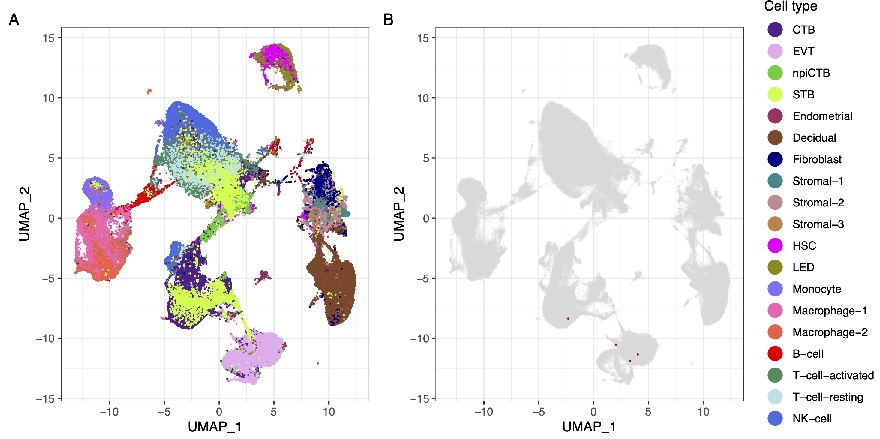
Transcriptional map of the human placenta. The uniform manifold approximation plot arranges the cell into clusters by gene expression. In (A) the cells/nuclei are colored illustrating the different cell types composing the human placenta. In (B) only the cells/nuclei that simultaneously co-express ACE2 and TMPRSS2 are colored in red, illustrating that the canonical transcripts that are necessary for SARS-CoV-2 viral infection are not present in most cells (colored in gray).
“Single-cell and single-nucleus RNA sequencing allowed us to investigate the expression of the main cell entry mediators for SARS-CoV-2 by the human placenta throughout pregnancy,” said Nardhy Gomez-Lopez, Ph.D., associate professor of the WSU Department of Obstetrics and Gynecology and head of the Immunobiology Section of the PRB. “Our findings revealed that the human placenta lacks expression of such mediators, providing an explanation for the paucity of vertical transmission in pregnant women with COVID-19. Yet, placental cells do express the receptors for other viruses such as Zika, cytomegalovirus and rubella, explaining why some infections affect the fetus and others are unlikely to do so.”
Source – Wayne State University School of Medicine
Pique-Regi R, Romero R, Tarca AL, Luca F, Xu Y, Alazizi A, Leng Y, Hsu CD, Gomez-Lopez N. (2020) Does the human placenta express the canonical cell entry mediators for SARS-CoV-2? eLife [online ahead of print]. [abstract]


Why are newborns born to mothers with COVID-19 rarely infected? Researchers at the Wayne State University School of Medicine and the Perinatology Research Branch of National Institute of Child Health and Human Development/National Institutes of Health in Detroit have found that placental cells minimally express the instructions, or mRNA, required to generate the cell entry receptor and protease required by the virus that causes COVID-19 to invade human cells.
The pandemic caused by SARS-CoV-2 has infected more than 10 million people worldwide, including pregnant women, yet to date there is no consistent evidence that pregnant mothers pass the virus to their newborns.
While pregnant women represent a potential high-risk population given that other viral infections such as Zika, cytomegalovirus and rubella can be passed from mother to fetus, the evidence for vertical transmission of SARS-CoV-2 is rare, and acquisition of the virus in the nursery cannot be excluded.
A requirement for a virus to infect a cell is that cell surface expresses a receptor for the virus. The main receptor for the new coronavirus is the angiotensin converting enzyme 2, or ACE2. The spike protein of the virus – the spikes seen in the images of the virus – is activated by an enzyme called TMPRSS2. Cells that co-express ACE2 and TMPRSS2 such as those found in the lungs are particularly vulnerable to infection.
In the study “Does the human placenta express the canonical cell entry mediators for SARS-CoV-2?”, published today in the journal eLife, WSU and PRB researchers employed cutting-edge molecular techniques such as single-cell genomics to determine whether human placental cells express the mRNA for the mediators that the virus SARS-CoV-2 uses for entry into the cell. The researchers concluded that placental cells do not express the transcripts needed to develop the receptors that the virus requires to facilitate vertical transmission from mother to the fetus.
Roger Pique-Regi, Ph.D., assistant professor of the WSU Center for Molecular Medicine and Genetics, and of Obstetrics and Gynecology, first author of the study, explained that the single-cell genomics technology the researchers employed allows them to study the transcriptome of individual cells isolated in tiny oil droplets using microfluidics.
While the study allows the possibility that SARS-CoV-2 could infect the placenta via alternate entry routes while interacting with other proteins, the findings provide strong evidence that it is unlikely to infect the placenta and fetus through the traditional cell entry mediators.
Transcriptional map of the human placenta. The uniform manifold approximation plot arranges the cell into clusters by gene expression. In (A) the cells/nuclei are colored illustrating the different cell types composing the human placenta. In (B) only the cells/nuclei that simultaneously co-express ACE2 and TMPRSS2 are colored in red, illustrating that the canonical transcripts that are necessary for SARS-CoV-2 viral infection are not present in most cells (colored in gray).
Source – Wayne State University School of Medicine
Pique-Regi R, Romero R, Tarca AL, Luca F, Xu Y, Alazizi A, Leng Y, Hsu CD, Gomez-Lopez N. (2020) Does the human placenta express the canonical cell entry mediators for SARS-CoV-2? eLife [online ahead of print]. [abstract]
Related Posts
Researchers create first whole-body single-cell atlas of an adult vertebrate
UAlbany Joins $10 Million Effort to Map RNA Modifications in the Human Body
Overlooked ‘off switch’ in lung tumors may explain why immunotherapy doesn’t work for everyone
Squids Edit RNA for Novel Protein Functions
New marker panel and web tool help define early human cell fates
Researchers Develop AI Tool to Map MicroRNA Binding Sites on Circular RNAs
“Raman Genome” for SARS-CoV-2: new Raman technology distinguishes viral variants by their molecular RNA architecture
Advanced paternal age has sex-specific effects on fetal brain gene expression
Exercise is good for us—but why?
Heart failure reshapes bone marrow to create inflammation-related immune memory
Overlooked DNA regions surrounding ‘microexons’ hold missing pieces of autism’s genetic puzzle
An anti-senescence gene may fight spinal disc deterioration
Scientists identify the neuroblastoma cells that signal poor outcomes
Urine test may improve bladder cancer diagnosis and guide treatment decisions
Tracing 700 million years of cell evolution
RNA-Seq reveals a new way the developing heart controls its growth
The Human RNome Project Consortium seeks to publish first-ever complete sequence of the body’s RNA
Unmasking “zombie cells” in aging tissue with an AI-powered barcode
RNA variant imaging for cancer diagnosis
Autism-risk mutations reveal two opposing patterns of brain gene activity
Stay Connected
Submit a Post to the Blog
Recent Posts
Subscribe to the RNA-Seq Blog
RNA-Seq Products & Services