

Researchers from the Beijing Institute of Genomics have created a new computational framework called SCSES (Single-Cell Splicing EStimation) that improves how scientists study alternative splicing using RNA sequencing data from individual cells.
Alternative splicing is a process that allows a single gene to produce multiple different RNA transcripts, which helps explain the vast diversity of proteins in our cells. However, accurately tracking splicing events in single cells has been a major challenge because single-cell RNA sequencing often captures incomplete or noisy data.
The team behind SCSES solved this problem by developing an algorithm that “fills in” missing splicing information. It does this by comparing data from similar cells and events to infer what is likely missing. This method, known as data diffusion, enables the software to create more complete and reliable maps of splicing variation across large cell populations.
Overview of the SCSES framework
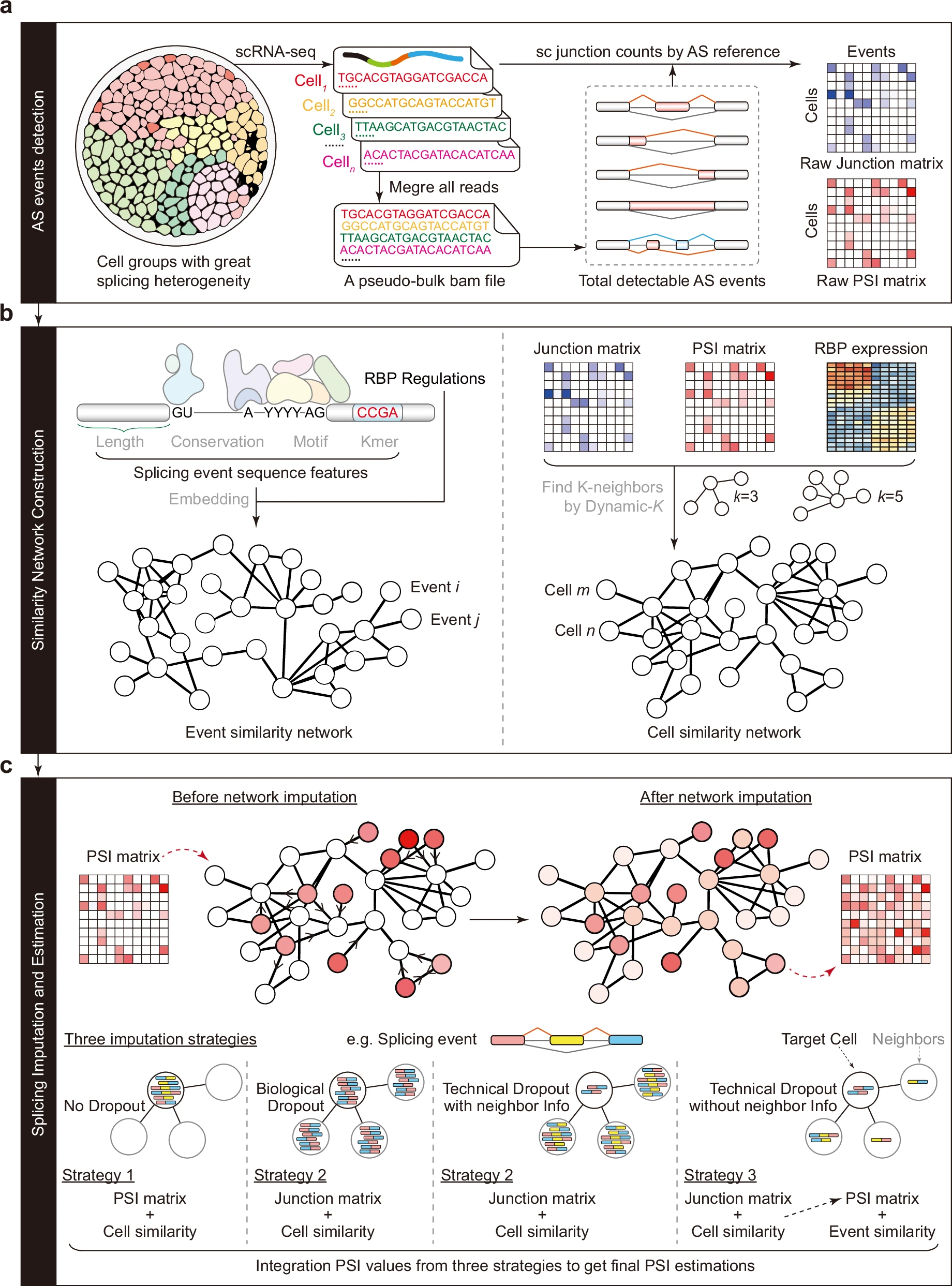
a SCSES creates a pseudo-bulk bam file by merging all single-cell reads. Conventional AS detection algorithms are used to detect all kinds of AS events. Raw junction read counts can then be retrieved based on this splicing reference. Raw PSI values can be calculated by raw junction read counts. b Cell splicing similarities can be built by three types of matrices. AS event similarities are measured by combining the RBP-event regulation relationship and event sequence features. KNN algorithm is used to create cell/event similarity networks. Dynamic-K strategy is introduced to select optimal K for each cell. Random walk with restart (RWR) algorithm is used to capture the global topological similarities in both networks. c Event-cell pairs are divided into four types based on the dropout of target cell and neighbor cells. SCSES introduces three imputation strategies for different event-cell groups. Final imputed PSI values are the linear combination of different imputation values with predicted group probabilities as coefficients.
When tested on multiple datasets, SCSES not only outperformed existing methods in detecting splicing changes but also revealed unique cell subgroups with distinct splicing patterns that standard clustering techniques could not identify. This ability to uncover hidden splicing diversity could deepen our understanding of how gene regulation contributes to cell identity, disease mechanisms, and development.
By improving single-cell RNA sequencing analysis, SCSES offers researchers a more powerful way to explore the complexity of gene expression and its role in human health and disease.
Availability – The open-source SCSES R package and tutorial are available at GitHub (https://github.com/lvxuan12/SCSES)
Wen X, Lv X, Guo D, Han N, Zhou L, Wang P, Liu Z. (2025) Deciphering splicing heterogeneity at single-cell resolution by SCSES. Nature Communications 16(1): 9459. [article]
Related Posts


Researchers from the Beijing Institute of Genomics have created a new computational framework called SCSES (Single-Cell Splicing EStimation) that improves how scientists study alternative splicing using RNA sequencing data from individual cells.
Alternative splicing is a process that allows a single gene to produce multiple different RNA transcripts, which helps explain the vast diversity of proteins in our cells. However, accurately tracking splicing events in single cells has been a major challenge because single-cell RNA sequencing often captures incomplete or noisy data.
The team behind SCSES solved this problem by developing an algorithm that “fills in” missing splicing information. It does this by comparing data from similar cells and events to infer what is likely missing. This method, known as data diffusion, enables the software to create more complete and reliable maps of splicing variation across large cell populations.
Overview of the SCSES framework
a SCSES creates a pseudo-bulk bam file by merging all single-cell reads. Conventional AS detection algorithms are used to detect all kinds of AS events. Raw junction read counts can then be retrieved based on this splicing reference. Raw PSI values can be calculated by raw junction read counts. b Cell splicing similarities can be built by three types of matrices. AS event similarities are measured by combining the RBP-event regulation relationship and event sequence features. KNN algorithm is used to create cell/event similarity networks. Dynamic-K strategy is introduced to select optimal K for each cell. Random walk with restart (RWR) algorithm is used to capture the global topological similarities in both networks. c Event-cell pairs are divided into four types based on the dropout of target cell and neighbor cells. SCSES introduces three imputation strategies for different event-cell groups. Final imputed PSI values are the linear combination of different imputation values with predicted group probabilities as coefficients.
When tested on multiple datasets, SCSES not only outperformed existing methods in detecting splicing changes but also revealed unique cell subgroups with distinct splicing patterns that standard clustering techniques could not identify. This ability to uncover hidden splicing diversity could deepen our understanding of how gene regulation contributes to cell identity, disease mechanisms, and development.
By improving single-cell RNA sequencing analysis, SCSES offers researchers a more powerful way to explore the complexity of gene expression and its role in human health and disease.
Availability – The open-source SCSES R package and tutorial are available at GitHub (https://github.com/lvxuan12/SCSES)
Wen X, Lv X, Guo D, Han N, Zhou L, Wang P, Liu Z. (2025) Deciphering splicing heterogeneity at single-cell resolution by SCSES. Nature Communications 16(1): 9459. [article]
Related Posts
Recent Posts
 RNAmel simplifies RNA sequencing data analysis with a reproducible, integrated platform
 Heart failure reshapes bone marrow to create inflammation-related immune memory
 Overlooked DNA regions surrounding ‘microexons’ hold missing pieces of autism’s genetic puzzle
 RiboBA improves detection of hidden protein-coding regions using ribosome profiling
 An anti-senescence gene may fight spinal disc deterioration
 Bulk RNA-seq Analysis: A Complete Beginner’s Guide
RNA-Seq Products & Services


Stay Connected