

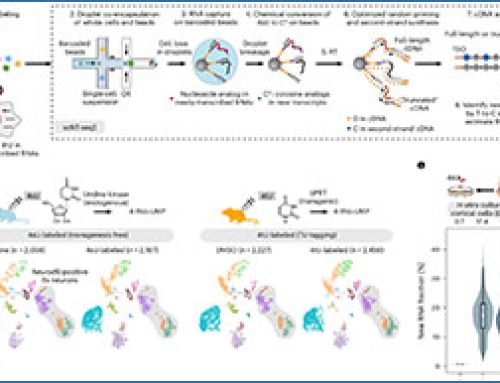
Prevalent single cell RNA amplification and sequencing chemistries mainly focus on polyadenylated RNAs in eukaryotic cells by using oligo(dT) primers for reverse transcription. Researchers from Peking University have developed a new RNA amplification method, “easier-seq”, to reverse transcribe and amplify the total RNAs, both with and without polyadenylate tails, from a single cell for transcriptome sequencing with high efficiency, reproducibility, and accuracy. By distributing the reverse transcribed cDNA molecules into 1.5×10⁵ aqueous droplets in oil, the cDNAs are isothermally amplified using random primers in each of these 65-picoliter reactors separately. This new method greatly improves the ease of single-cell RNA sequencing by reducing the experimental steps. With less chance to induce errors, this method can easily maintain the quality of single-cell sequencing. In addition, this polyadenylate-tail-independent method can be seamlessly applied to prokaryotic cell RNA sequencing.

Fu Y, Chen H, Liu L, Huang Y. (2016) Single cell total RNA sequencing through isothermal amplification in picoliter-droplet emulsion. Anal Chem [Epub ahead of print]. [abstract]
Related Posts




Prevalent single cell RNA amplification and sequencing chemistries mainly focus on polyadenylated RNAs in eukaryotic cells by using oligo(dT) primers for reverse transcription. Researchers from Peking University have developed a new RNA amplification method, “easier-seq”, to reverse transcribe and amplify the total RNAs, both with and without polyadenylate tails, from a single cell for transcriptome sequencing with high efficiency, reproducibility, and accuracy. By distributing the reverse transcribed cDNA molecules into 1.5×10⁵ aqueous droplets in oil, the cDNAs are isothermally amplified using random primers in each of these 65-picoliter reactors separately. This new method greatly improves the ease of single-cell RNA sequencing by reducing the experimental steps. With less chance to induce errors, this method can easily maintain the quality of single-cell sequencing. In addition, this polyadenylate-tail-independent method can be seamlessly applied to prokaryotic cell RNA sequencing.
Fu Y, Chen H, Liu L, Huang Y. (2016) Single cell total RNA sequencing through isothermal amplification in picoliter-droplet emulsion. Anal Chem [Epub ahead of print]. [abstract]
Related Posts
Recent Posts
 DeMixNB: deconvolution of sparse-count RNA sequencing data for tumor cells
 New RNA sequencing method improves tRNA analysis using deep learning
 mobileRNA – an integrative, automated tool for accurate identification of mobile RNA molecules based on multiple genome mapping
 The Festival of Genomics & Biodata
 Researchers create first whole-body single-cell atlas of an adult vertebrate
 RNA sequencing reveals functional gene similarities across species
RNA-Seq Products & Services


Stay Connected