

Formalin-fixed paraffin-embedded (FFPE) tissue samples are a cornerstone of clinical research and pathology. These preserved samples hold a treasure trove of information, often linked to detailed patient histories, disease progressions, and treatment outcomes. However, unlocking their molecular information, especially at the single-cell or single-nucleus level, has been extremely difficult because the preservation process can damage or fragment RNA molecules — making traditional RNA sequencing techniques less effective.
To address this challenge, researchers at Zhejiang University School of Medicine have developed an innovative technology called snRandom-seq. This method is specifically designed to perform single-nucleus total RNA sequencing on FFPE samples. Rather than relying on conventional targeted approaches, snRandom-seq uses random primers inside droplets to capture all types of RNA from isolated nuclei — including messenger RNAs, non-coding RNAs, and newly transcribed RNAs (called nascent RNAs).
Workflow for microfluidic barcoding and library generation
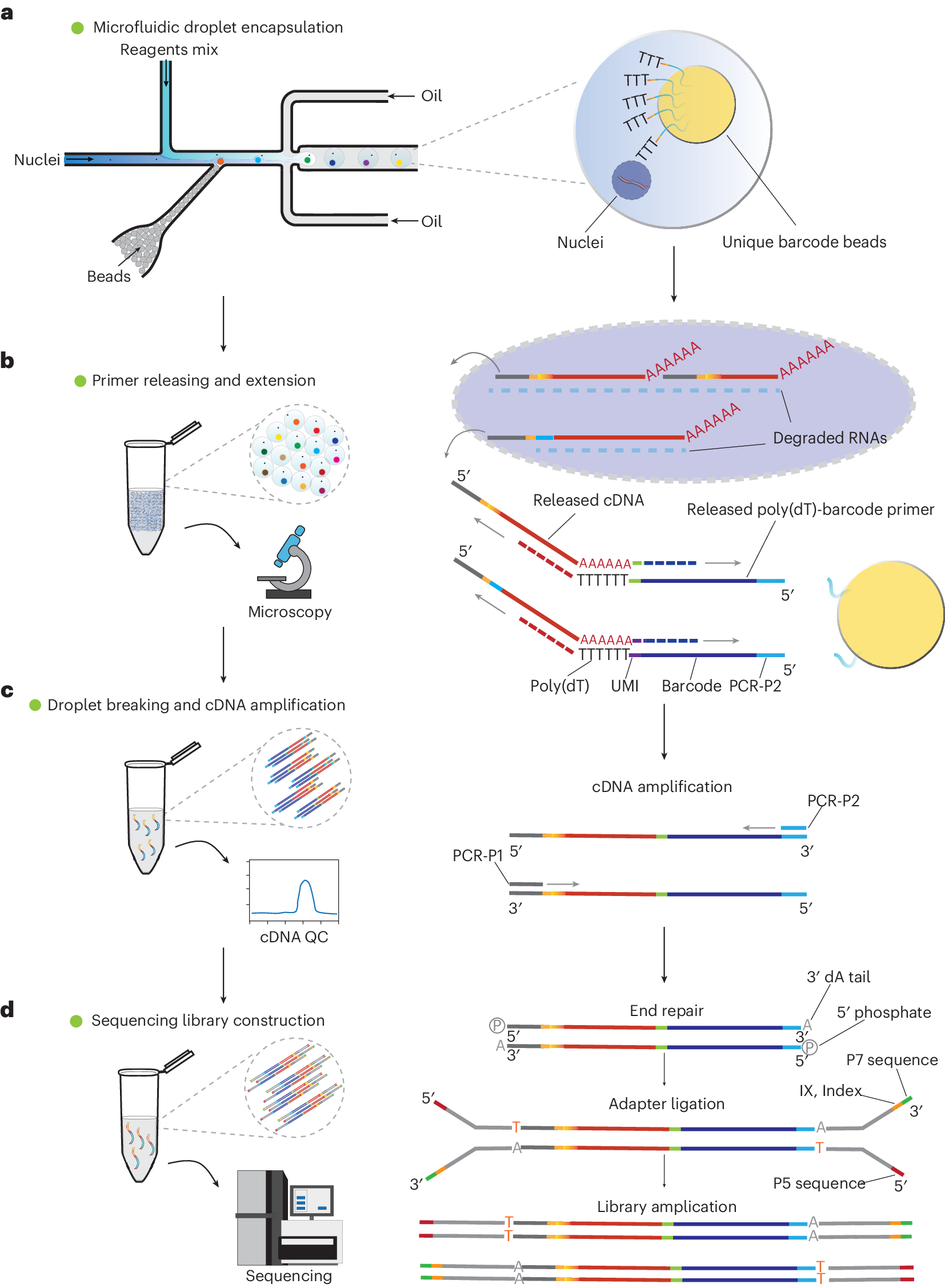
a, Nuclei, reagent mixtures and barcode beads were encapsulated into droplets by using a microfluidic platform. Each droplet contained one unique barcode bead, one nucleus and the necessary reagent mixtures. b, During the second-strand cDNA synthesis reaction within the droplet, RNAs were degraded, and poly(dT)-barcode primers were cleaved. The cDNAs were released along with the poly(dT)-barcode primers, which then bound to the poly(dA) tail at the 3′ end of the cDNAs. Subsequently, the poly(dT)-barcode primers and cDNAs were extended, synthesizing the second-strand cDNA and adding a specific barcode to each cDNA within the droplet. These droplets were microscopically examined after the second-strand cDNA synthesis reaction. c, After the barcoding reaction, droplets were broken, and the cDNA was purified. The barcoded cDNA was then amplified by using PCR with primers PCR-P1 and PCR-P2. The size distribution of the amplified cDNA fragments was analyzed by using the DNA fragment analyzer to ensure product quality. d, After amplification and purification, a sequencing library was constructed. During the end-repair reaction, a dA tail was added to the 3′ end of the cDNA, and a phosphate group was added to the 5′ end. Subsequently, an index and P7 sequence were added to the 3′ end, and a P5 sequence was added to the 5′ end during the adapter ligation reaction. Library amplification and paired-end sequencing with 150-bp reads were performed. UMI, unique molecular identifier.
One of the standout features of snRandom-seq is its extremely low doublet rate (only 0.3%), meaning the chance of two nuclei being captured together and confusing the data is very small. Additionally, snRandom-seq offers much broader RNA coverage than existing methods, allowing researchers to gain a more complete picture of gene activity within each nucleus. This opens new possibilities for studying complex tissues, identifying rare cell types, and better understanding diseases at a molecular level.
The protocol itself is well-structured and accessible: it covers steps from isolating single nuclei from FFPE tissues, performing in situ DNA blocking to prevent unwanted reactions, synthesizing complementary DNA (cDNA) from the RNA, and barcoding each nucleus for tracking, all the way through to preparing libraries for sequencing. Amazingly, the entire workflow can be completed in just four days.
By enabling reliable RNA sequencing from FFPE specimens, snRandom-seq paves the way for researchers to revisit decades’ worth of archived clinical samples — now with the high-resolution lens of single-nucleus RNA sequencing. This could dramatically enhance studies of cancer, brain disorders, aging, and many other fields where valuable tissue samples have been stored but largely inaccessible at the molecular level until now.
Xu Z, Lyu Y, Chen H, Chen Y, Wang Y. (2025) Single-nucleus total RNA sequencing of formalin-fixed paraffin-embedded samples using snRandom-seq. Nature Protocols [Online ahead of print]. [article]
Related Posts




Formalin-fixed paraffin-embedded (FFPE) tissue samples are a cornerstone of clinical research and pathology. These preserved samples hold a treasure trove of information, often linked to detailed patient histories, disease progressions, and treatment outcomes. However, unlocking their molecular information, especially at the single-cell or single-nucleus level, has been extremely difficult because the preservation process can damage or fragment RNA molecules — making traditional RNA sequencing techniques less effective.
To address this challenge, researchers at Zhejiang University School of Medicine have developed an innovative technology called snRandom-seq. This method is specifically designed to perform single-nucleus total RNA sequencing on FFPE samples. Rather than relying on conventional targeted approaches, snRandom-seq uses random primers inside droplets to capture all types of RNA from isolated nuclei — including messenger RNAs, non-coding RNAs, and newly transcribed RNAs (called nascent RNAs).
Workflow for microfluidic barcoding and library generation
a, Nuclei, reagent mixtures and barcode beads were encapsulated into droplets by using a microfluidic platform. Each droplet contained one unique barcode bead, one nucleus and the necessary reagent mixtures. b, During the second-strand cDNA synthesis reaction within the droplet, RNAs were degraded, and poly(dT)-barcode primers were cleaved. The cDNAs were released along with the poly(dT)-barcode primers, which then bound to the poly(dA) tail at the 3′ end of the cDNAs. Subsequently, the poly(dT)-barcode primers and cDNAs were extended, synthesizing the second-strand cDNA and adding a specific barcode to each cDNA within the droplet. These droplets were microscopically examined after the second-strand cDNA synthesis reaction. c, After the barcoding reaction, droplets were broken, and the cDNA was purified. The barcoded cDNA was then amplified by using PCR with primers PCR-P1 and PCR-P2. The size distribution of the amplified cDNA fragments was analyzed by using the DNA fragment analyzer to ensure product quality. d, After amplification and purification, a sequencing library was constructed. During the end-repair reaction, a dA tail was added to the 3′ end of the cDNA, and a phosphate group was added to the 5′ end. Subsequently, an index and P7 sequence were added to the 3′ end, and a P5 sequence was added to the 5′ end during the adapter ligation reaction. Library amplification and paired-end sequencing with 150-bp reads were performed. UMI, unique molecular identifier.
One of the standout features of snRandom-seq is its extremely low doublet rate (only 0.3%), meaning the chance of two nuclei being captured together and confusing the data is very small. Additionally, snRandom-seq offers much broader RNA coverage than existing methods, allowing researchers to gain a more complete picture of gene activity within each nucleus. This opens new possibilities for studying complex tissues, identifying rare cell types, and better understanding diseases at a molecular level.
The protocol itself is well-structured and accessible: it covers steps from isolating single nuclei from FFPE tissues, performing in situ DNA blocking to prevent unwanted reactions, synthesizing complementary DNA (cDNA) from the RNA, and barcoding each nucleus for tracking, all the way through to preparing libraries for sequencing. Amazingly, the entire workflow can be completed in just four days.
By enabling reliable RNA sequencing from FFPE specimens, snRandom-seq paves the way for researchers to revisit decades’ worth of archived clinical samples — now with the high-resolution lens of single-nucleus RNA sequencing. This could dramatically enhance studies of cancer, brain disorders, aging, and many other fields where valuable tissue samples have been stored but largely inaccessible at the molecular level until now.
Xu Z, Lyu Y, Chen H, Chen Y, Wang Y. (2025) Single-nucleus total RNA sequencing of formalin-fixed paraffin-embedded samples using snRandom-seq. Nature Protocols [Online ahead of print]. [article]
Related Posts
Recent Posts
 RNAmel simplifies RNA sequencing data analysis with a reproducible, integrated platform
 Heart failure reshapes bone marrow to create inflammation-related immune memory
 Overlooked DNA regions surrounding ‘microexons’ hold missing pieces of autism’s genetic puzzle
 RiboBA improves detection of hidden protein-coding regions using ribosome profiling
 An anti-senescence gene may fight spinal disc deterioration
 Bulk RNA-seq Analysis: A Complete Beginner’s Guide
RNA-Seq Products & Services


Stay Connected