The immune system responds to an infection by producing antibodies that recognize and bind to the cell surface of the pathogen, thus marking it as an intruder and triggering an immune response. For this to work, the antibodies produced must exactly fit the membrane molecules of the pathogen, like a key fitting a lock.
Many pathogens evade the host’s immune response by periodically changing their surface antigens so that existing antibodies no longer recognize them.
“This strategy is known as antigenic variation,” explains physicist Maria Colomé-Tatché, who is Professor of Functional Genomics and Cell Biology at LMU’s Biomedical Center and leader of the Computational Epigenomics research group at Helmholtz Munich. “Antigenic variation is evident in a wide range of evolutionarily distant pathogens,” adds Professor Nicolai Siegel, biochemist and leader of the Molecular Parasitology research group (Chair of Experimental Parasitology, Department of Veterinary Sciences) at the Biomedical Center.
In a study published recently in the journal Nature, Colomé-Tatché and Siegel investigated the gene expression of the model parasite Trypanosoma brucei, which is transmitted via tsetse flies and causes African sleeping sickness in humans and nagana pest in animals.
“Trypanosomes are masters at hiding from the immune system through antigenic variation,” says Siegel. “Their cells are enshrouded by a dense, homogeneous coat of surface glycoproteins, which they switch in periodic, non-random patterns.”
Until now, little was known about the mechanisms behind these changes in antigen expression. This gap in our knowledge has been filled by the study led by Colomé-Tatché and Siegel, which has discovered how the sequence of antigen expression is determined.
“We can now predict which antigen is activated next and appears on the surface of trypanosomes,” says Colomé-Tatché. In addition to experts from LMU, the study included researchers from Helmholtz Munich and international cooperation partners from the United States and the United Kingdom.
One of the biggest challenges for the team was to track transcriptome changes and potential genomic rearrangements in individual cells during a switch event. For that, the researchers established a highly sensitive single-cell RNA sequencing approach to accomplish precisely this task.
An important trigger for antigen switching is a double-strand break in the transcribed antigen-coding gene.
“Our data show that the type of repair mechanism and the resultant antigen expression depend on the availability of a homologous repair template in the genome,” says Colomé-Tatché.
When such a template was available, repair proceeded through segmental gene conversion, creating new, mosaic antigen-coding genes. Conversely, in the absence of a suitable template, a telomere-adjacent antigen-coding gene from a different part of the genome was activated.
The research team is convinced that the discovery of these mechanisms for controlling antigenic variation can make a decisive contribution to the development of new drugs – and not just against trypanosomes, but also many other pathogens.
“Additionally, our study demonstrates the power of highly sensitive single-cell RNA sequencing methods in detecting genomic rearrangements that drive transcriptional changes at the single-cell level,” says Siegel.
SL-Smart-seq3xpress is a highly sensitive and specific scRNA-seq approach
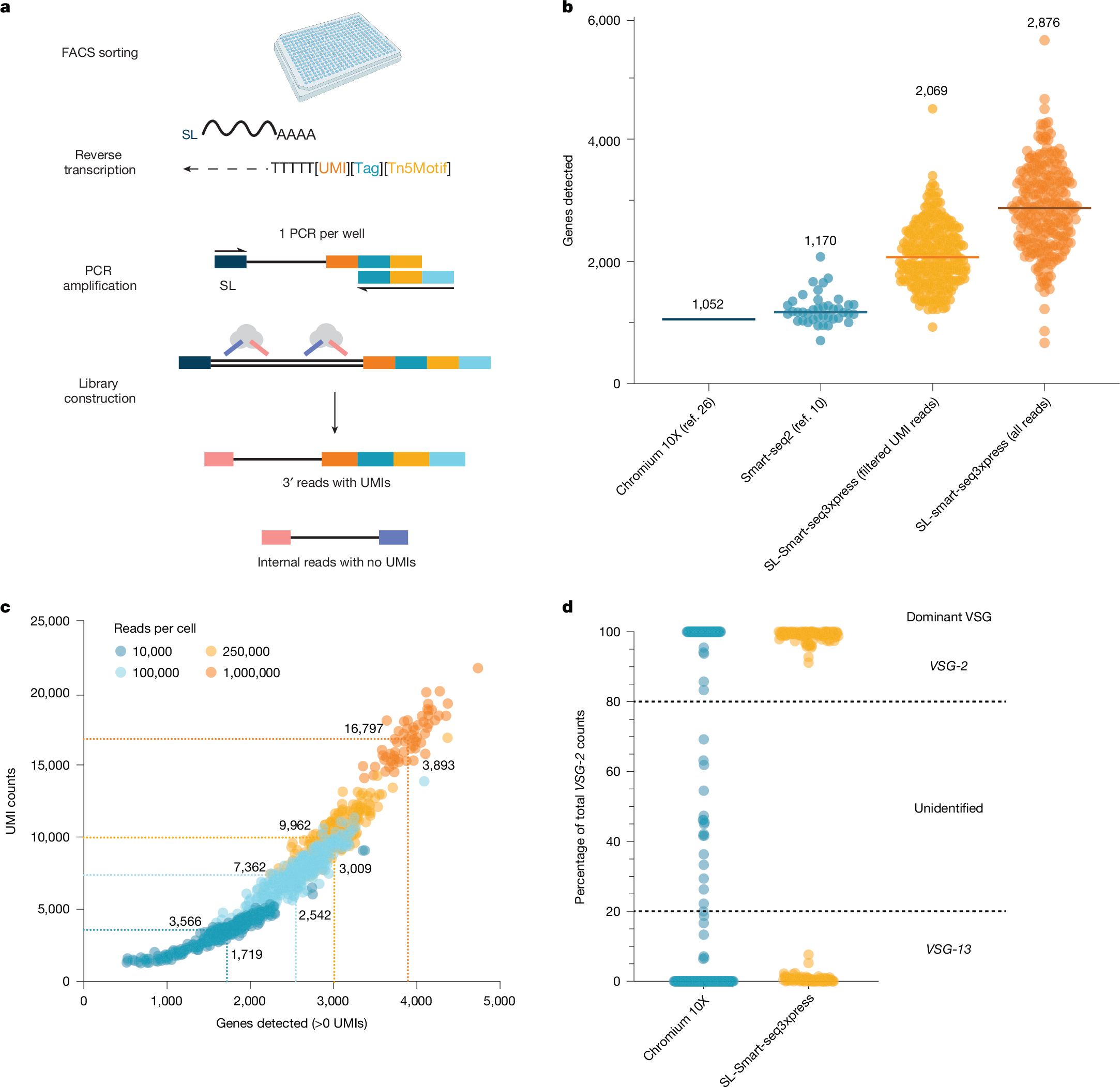
a, Schematic of SL-Smart-seq3xpress library preparation. b, Comparison of the median number of genes detected by Chromium 10X, Smart-seq2 or SL-Smart-seq3xpress. The median UMI–gene count is shown as a number above a dataset and as a bold line. For the Smart-seq2 and SL-Smart-seq3xpress datasets, each dot represents an individual cell. For the Chromium 10X dataset, the line represents the median UMI–gene count. Libraries are downsampled to 75,000 reads per cell. Number of cells analysed: Chromium 10X, 8,599; Smart-seq2, 40; SL-Smart-seq3xpress, 292. c, Detected UMIs versus genes in a SL-Smart-seq3xpress library at increasing read depth. Each single cell is represented by a coloured dot. The median gene versus UMI count for each read depth is represented by the dotted lines and numbers. d, Percentage of VSG-2 transcript counts, relative to the sum of VSG-2 and VSG-13 transcript counts, in Chromium 10X and SL-Smart-seq3xpress single-cell libraries prepared from mixed populations of VSG-2 expressing (P10 cell line) and VSG-13 expressing (N50 cell line) cells. The thresholds for defining a cell as VSG-2 or VSG-13 expressing (above 80% and below 20%, respectively) are indicated by the dotted lines. Total number of cells analysed: Chromium 10X, 185; SL-Smart-seq3xpress, 185.
The close proximity of the two research groups at LMU’s Biomedical Center (Chair of Physiological Chemistry) and the complementary research interests of Siegel (molecular and systems biology in pathogens) and Colomé-Tatché (computational biology and epigenetics) have led to various joint projects in recent years, including within the Marie Skłodowska-Curie Doctoral Network “Cell2Cell” and the Collaborative Research Centre 1064 (Chromatin Dynamics).
Source – Ludwig-Maximilians-Universität München


The immune system responds to an infection by producing antibodies that recognize and bind to the cell surface of the pathogen, thus marking it as an intruder and triggering an immune response. For this to work, the antibodies produced must exactly fit the membrane molecules of the pathogen, like a key fitting a lock.
Many pathogens evade the host’s immune response by periodically changing their surface antigens so that existing antibodies no longer recognize them.
In a study published recently in the journal Nature, Colomé-Tatché and Siegel investigated the gene expression of the model parasite Trypanosoma brucei, which is transmitted via tsetse flies and causes African sleeping sickness in humans and nagana pest in animals.
Until now, little was known about the mechanisms behind these changes in antigen expression. This gap in our knowledge has been filled by the study led by Colomé-Tatché and Siegel, which has discovered how the sequence of antigen expression is determined.
One of the biggest challenges for the team was to track transcriptome changes and potential genomic rearrangements in individual cells during a switch event. For that, the researchers established a highly sensitive single-cell RNA sequencing approach to accomplish precisely this task.
An important trigger for antigen switching is a double-strand break in the transcribed antigen-coding gene.
When such a template was available, repair proceeded through segmental gene conversion, creating new, mosaic antigen-coding genes. Conversely, in the absence of a suitable template, a telomere-adjacent antigen-coding gene from a different part of the genome was activated.
The research team is convinced that the discovery of these mechanisms for controlling antigenic variation can make a decisive contribution to the development of new drugs – and not just against trypanosomes, but also many other pathogens.
SL-Smart-seq3xpress is a highly sensitive and specific scRNA-seq approach
a, Schematic of SL-Smart-seq3xpress library preparation. b, Comparison of the median number of genes detected by Chromium 10X, Smart-seq2 or SL-Smart-seq3xpress. The median UMI–gene count is shown as a number above a dataset and as a bold line. For the Smart-seq2 and SL-Smart-seq3xpress datasets, each dot represents an individual cell. For the Chromium 10X dataset, the line represents the median UMI–gene count. Libraries are downsampled to 75,000 reads per cell. Number of cells analysed: Chromium 10X, 8,599; Smart-seq2, 40; SL-Smart-seq3xpress, 292. c, Detected UMIs versus genes in a SL-Smart-seq3xpress library at increasing read depth. Each single cell is represented by a coloured dot. The median gene versus UMI count for each read depth is represented by the dotted lines and numbers. d, Percentage of VSG-2 transcript counts, relative to the sum of VSG-2 and VSG-13 transcript counts, in Chromium 10X and SL-Smart-seq3xpress single-cell libraries prepared from mixed populations of VSG-2 expressing (P10 cell line) and VSG-13 expressing (N50 cell line) cells. The thresholds for defining a cell as VSG-2 or VSG-13 expressing (above 80% and below 20%, respectively) are indicated by the dotted lines. Total number of cells analysed: Chromium 10X, 185; SL-Smart-seq3xpress, 185.
The close proximity of the two research groups at LMU’s Biomedical Center (Chair of Physiological Chemistry) and the complementary research interests of Siegel (molecular and systems biology in pathogens) and Colomé-Tatché (computational biology and epigenetics) have led to various joint projects in recent years, including within the Marie Skłodowska-Curie Doctoral Network “Cell2Cell” and the Collaborative Research Centre 1064 (Chromatin Dynamics).
Source – Ludwig-Maximilians-Universität München
Keneskhanova Z, McWilliam KR, Cosentino RO, Barcons-Simon A, Dobrynin A, Smith JE, Subota I, Mugnier MR, Colomé-Tatché M, Siegel TN. (2025) Genomic determinants of antigen expression hierarchy in African trypanosomes. Nature [Epub ahead of print]. [article]
Related Posts
RNAmel simplifies RNA sequencing data analysis with a reproducible, integrated platform
Heart failure reshapes bone marrow to create inflammation-related immune memory
Overlooked DNA regions surrounding ‘microexons’ hold missing pieces of autism’s genetic puzzle
RiboBA improves detection of hidden protein-coding regions using ribosome profiling
An anti-senescence gene may fight spinal disc deterioration
Scientists identify the neuroblastoma cells that signal poor outcomes
Novel biosensor uses DNA ‘barcodes’ to uncover disease signals in cells
CellART extracts single-cell information from high-resolution spatial transcriptomics
Cell2space restores spatial context to single-cell RNA sequencing data
Urine test may improve bladder cancer diagnosis and guide treatment decisions
DeCoRE – a computational method to resolve RNA structural heterogeneity from RNA structure probing data by direct RNA sequencing
Tracing 700 million years of cell evolution
How should biological replicates be handled in long-read RNA sequencing?
RNA-Seq reveals a new way the developing heart controls its growth
The Human RNome Project Consortium seeks to publish first-ever complete sequence of the body’s RNA
scFlowReport brings multiple single-cell RNA sequencing analyses into one workflow
Long-read RNA sequencing reveals how neurons choose alternative RNA endings
DeOPUS improves cell-type estimates from bulk RNA sequencing
ResolVI improves accuracy in spatial transcriptomics analysis
RNA sequencing reveals transcriptional allele differences in prostate cancer stem cells
Stay Connected
Submit a Post to the Blog
Recent Posts
Subscribe to the RNA-Seq Blog
RNA-Seq Products & Services