

Small nucleolar RNAs, or snoRNAs, are short RNA molecules best known for helping modify and process other RNAs inside cells. Researchers have also discovered that snoRNAs can be cut into even smaller fragments called snoRNA-derived RNAs, or sdRNAs.
The biological roles of these sdRNAs are still being worked out, especially in blood formation and acute myeloid leukemia, or AML. A recent study by researchers at the University Hospital Heidelberg in Germany examined whether sdRNAs are simply byproducts of snoRNA processing or whether they can act as independent regulators of gene expression.
Cell-type-specific expression signatures of snoRNA-derived RNAs (sdRNAs) in HSPCs and differentiated WBCs
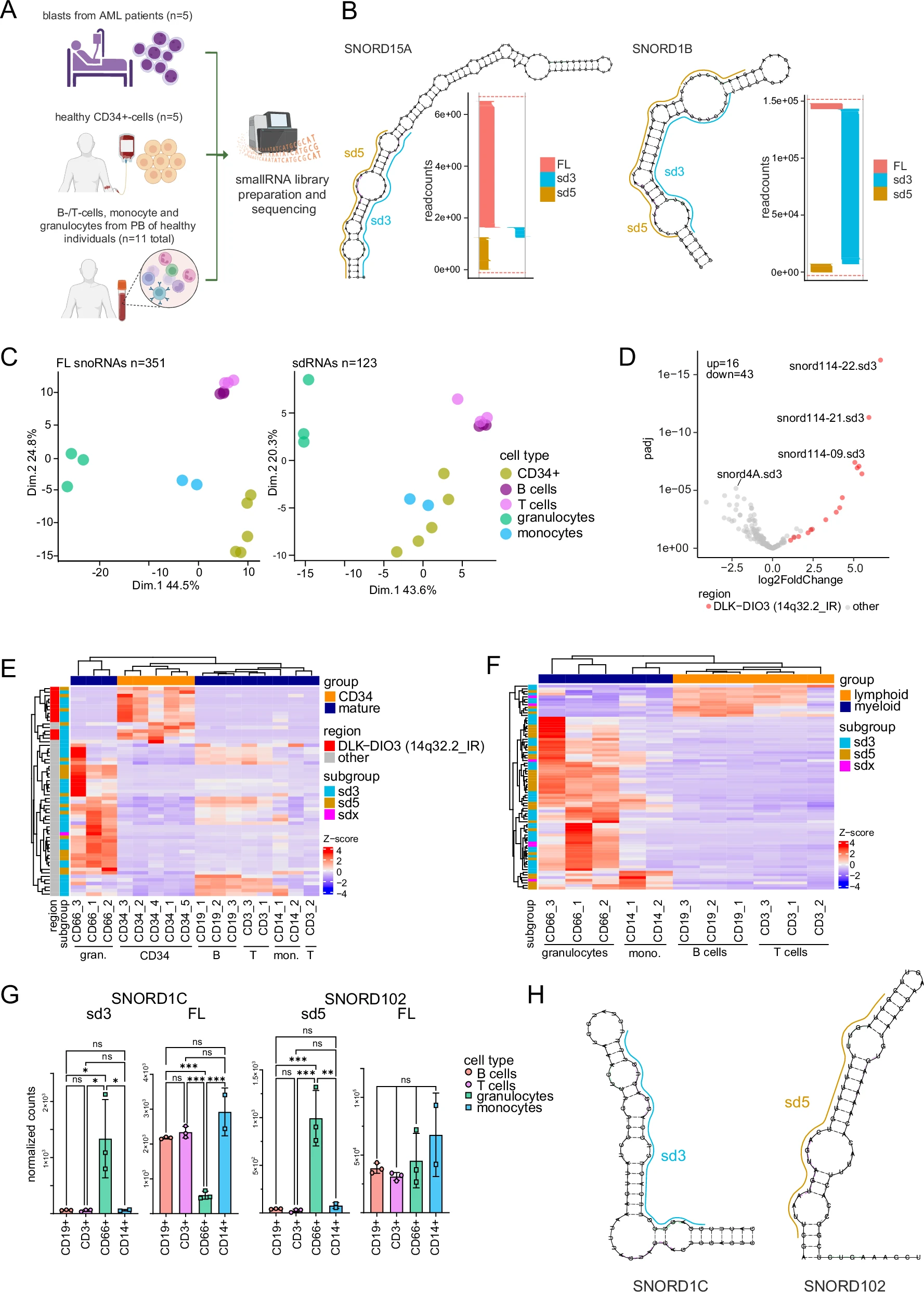
A Small RNA sequencing was performed in five primary AML samples, as well as five CD34+ HSPCs and 11 differentiated WBC samples from healthy donors. Scheme created in BioRender. Rohde, C. (2026) B Read assignment for sdRNAs and full-length snoRNA expression is exemplarily shown for SNORD15A (left) and SNORD1B (right). Depicted are reads assigned to full-length snoRNAs (sdRNA hostgene, red), 3’-sdRNAs (blue) and 5’-sdRNAs (yellow). The predicted secondary structure of the full-length snoRNA is depicted, the sequences corresponding to 3’-sdRNAs (blue) and 5’-sdRNAs (yellow), as well as box sequences (green/purple) and rRNA complementary region (gray) are highlighted. C Principal component analysis (PCA) of FL snoRNA (left) and sdRNA (right) expression in HSPCs and several differentiated WBC populations. D Volcano plot showing differential sdRNA expression in CD34+ HSPCs vs. differentiated WBCs. sdRNAs derived from the DLK-DIO3-locus on chromosome 14 are highlighted. E Heatmap depicting differentially expressed sdRNAs in CD34+ HSPCs and differentiated WBCs. sdRNAs derived from the DLK-DIO3-locus on chromosome 14 are highlighted. F Heatmap comparing sdRNA signatures of myeloid cells (CD66+ granulocytes, CD14+ monocytes) vs. lymphoid cells (CD19+ B-lymphocytes, CD3+ T-lymphocytes). Shown are significantly differentially expressed sdRNAs. G Expression of specific sdRNAs in differentiated WBCs is cell-type specific. sd3’-SNORD1C and sd5’-SNORD102 are almost exclusively expressed in granulocytes (CD66+), whereas expression of their host gene is not affected or even lower in granulocytes (CD66+). H The predicted secondary structure of SNORD1C and SNORD102 full-length snoRNA is depicted, the sequences corresponding to 3’-sdRNAs (blue) and 5’-sdRNAs (yellow), as well as box sequences (green/purple) and rRNA complementary region (gray) are highlighted.
Distinct sdRNA patterns in healthy and leukemic cells
The researchers analyzed sdRNA and snoRNA expression in healthy hematopoietic stem and progenitor cells, mature white blood cells, and samples from 159 patients with AML.
Using small RNA sequencing, they found that these cell populations had distinct sdRNA expression patterns. Healthy stem and progenitor cells, mature blood cells, and AML blasts could be differentiated based on their sdRNA profiles.
This suggests that sdRNAs are not produced randomly. Instead, their expression appears to be linked to cell identity and biological state.
sdRNA levels may be linked to patient outcome
The researchers also examined the relationship between sdRNA expression and clinical outcomes in AML.
They found that high ratios of certain 3′-derived sdRNAs relative to their full-length snoRNAs or host genes were associated with poorer outcomes. This relationship was particularly notable in patients with NPM1-mutated AML who otherwise had favorable risk characteristics and good initial responses to therapy.
High sdRNA ratios were also associated with changes in pathways involved in cancer signaling, inflammation, and immune responses.
Testing whether sdRNAs affect leukemia biology
To determine whether sdRNAs could actively influence cell behavior, the researchers increased the expression of individual sdRNAs, including sd3′-SNORD78, sd3′-SNORD76, and sd5′-SNORD93.
Higher levels of these sdRNAs increased the clonogenic potential of AML cells, meaning the cells became better able to form new colonies. The same sdRNAs also produced distinct gene expression changes in both AML cells and healthy hematopoietic stem and progenitor cells.
These results support the idea that sdRNAs can act as functional regulatory molecules rather than simply representing degradation products.
Identifying a target of sd3′-SNORD78
The researchers examined sd3′-SNORD78 in more detail and identified NUDT21 as a potential downstream target.
NUDT21 helps regulate alternative polyadenylation, a process that determines where messenger RNAs are cut and given their poly(A) tails. Changes in this process can affect RNA stability, protein production, and oncogenic gene expression.
By influencing NUDT21, sd3′-SNORD78 may therefore alter broader gene expression programs that contribute to leukemia biology.
Expanding the role of small RNAs in AML
The findings suggest that snoRNA-derived RNAs represent an additional layer of gene regulation in both normal blood development and AML.
Small RNA sequencing was important for distinguishing full-length snoRNAs from their shorter sdRNA products and identifying cell-type-specific expression patterns. The work also suggests that sdRNA measurements could eventually have diagnostic, prognostic, or therapeutic relevance in AML, although further research will be needed to determine how these molecules could be used clinically.
Zinz R, Rohde C, Pauli C, Zhou F, Syed AA, Heid D, Shah V, Wahl NA, Ray A, Renders S, Werner L, Förmer S, Ahrens C, Baldus C, Bornhäuser M, Röllig C, Serve H, Sauer T, Krijgsveld J, Müller-Tidow C, Blank MF. (2026) Functional characterization of snoRNA-derived RNA (sdRNA) expression in healthy hematopoiesis and acute myeloid leukemia. Leukemia [Epub ahead of print]. [article]
Related Posts






Small nucleolar RNAs, or snoRNAs, are short RNA molecules best known for helping modify and process other RNAs inside cells. Researchers have also discovered that snoRNAs can be cut into even smaller fragments called snoRNA-derived RNAs, or sdRNAs.
The biological roles of these sdRNAs are still being worked out, especially in blood formation and acute myeloid leukemia, or AML. A recent study by researchers at the University Hospital Heidelberg in Germany examined whether sdRNAs are simply byproducts of snoRNA processing or whether they can act as independent regulators of gene expression.
Cell-type-specific expression signatures of snoRNA-derived RNAs (sdRNAs) in HSPCs and differentiated WBCs
A Small RNA sequencing was performed in five primary AML samples, as well as five CD34+ HSPCs and 11 differentiated WBC samples from healthy donors. Scheme created in BioRender. Rohde, C. (2026) B Read assignment for sdRNAs and full-length snoRNA expression is exemplarily shown for SNORD15A (left) and SNORD1B (right). Depicted are reads assigned to full-length snoRNAs (sdRNA hostgene, red), 3’-sdRNAs (blue) and 5’-sdRNAs (yellow). The predicted secondary structure of the full-length snoRNA is depicted, the sequences corresponding to 3’-sdRNAs (blue) and 5’-sdRNAs (yellow), as well as box sequences (green/purple) and rRNA complementary region (gray) are highlighted. C Principal component analysis (PCA) of FL snoRNA (left) and sdRNA (right) expression in HSPCs and several differentiated WBC populations. D Volcano plot showing differential sdRNA expression in CD34+ HSPCs vs. differentiated WBCs. sdRNAs derived from the DLK-DIO3-locus on chromosome 14 are highlighted. E Heatmap depicting differentially expressed sdRNAs in CD34+ HSPCs and differentiated WBCs. sdRNAs derived from the DLK-DIO3-locus on chromosome 14 are highlighted. F Heatmap comparing sdRNA signatures of myeloid cells (CD66+ granulocytes, CD14+ monocytes) vs. lymphoid cells (CD19+ B-lymphocytes, CD3+ T-lymphocytes). Shown are significantly differentially expressed sdRNAs. G Expression of specific sdRNAs in differentiated WBCs is cell-type specific. sd3’-SNORD1C and sd5’-SNORD102 are almost exclusively expressed in granulocytes (CD66+), whereas expression of their host gene is not affected or even lower in granulocytes (CD66+). H The predicted secondary structure of SNORD1C and SNORD102 full-length snoRNA is depicted, the sequences corresponding to 3’-sdRNAs (blue) and 5’-sdRNAs (yellow), as well as box sequences (green/purple) and rRNA complementary region (gray) are highlighted.
Distinct sdRNA patterns in healthy and leukemic cells
The researchers analyzed sdRNA and snoRNA expression in healthy hematopoietic stem and progenitor cells, mature white blood cells, and samples from 159 patients with AML.
Using small RNA sequencing, they found that these cell populations had distinct sdRNA expression patterns. Healthy stem and progenitor cells, mature blood cells, and AML blasts could be differentiated based on their sdRNA profiles.
This suggests that sdRNAs are not produced randomly. Instead, their expression appears to be linked to cell identity and biological state.
sdRNA levels may be linked to patient outcome
The researchers also examined the relationship between sdRNA expression and clinical outcomes in AML.
They found that high ratios of certain 3′-derived sdRNAs relative to their full-length snoRNAs or host genes were associated with poorer outcomes. This relationship was particularly notable in patients with NPM1-mutated AML who otherwise had favorable risk characteristics and good initial responses to therapy.
High sdRNA ratios were also associated with changes in pathways involved in cancer signaling, inflammation, and immune responses.
Testing whether sdRNAs affect leukemia biology
To determine whether sdRNAs could actively influence cell behavior, the researchers increased the expression of individual sdRNAs, including sd3′-SNORD78, sd3′-SNORD76, and sd5′-SNORD93.
Higher levels of these sdRNAs increased the clonogenic potential of AML cells, meaning the cells became better able to form new colonies. The same sdRNAs also produced distinct gene expression changes in both AML cells and healthy hematopoietic stem and progenitor cells.
These results support the idea that sdRNAs can act as functional regulatory molecules rather than simply representing degradation products.
Identifying a target of sd3′-SNORD78
The researchers examined sd3′-SNORD78 in more detail and identified NUDT21 as a potential downstream target.
NUDT21 helps regulate alternative polyadenylation, a process that determines where messenger RNAs are cut and given their poly(A) tails. Changes in this process can affect RNA stability, protein production, and oncogenic gene expression.
By influencing NUDT21, sd3′-SNORD78 may therefore alter broader gene expression programs that contribute to leukemia biology.
Expanding the role of small RNAs in AML
The findings suggest that snoRNA-derived RNAs represent an additional layer of gene regulation in both normal blood development and AML.
Small RNA sequencing was important for distinguishing full-length snoRNAs from their shorter sdRNA products and identifying cell-type-specific expression patterns. The work also suggests that sdRNA measurements could eventually have diagnostic, prognostic, or therapeutic relevance in AML, although further research will be needed to determine how these molecules could be used clinically.
Zinz R, Rohde C, Pauli C, Zhou F, Syed AA, Heid D, Shah V, Wahl NA, Ray A, Renders S, Werner L, Förmer S, Ahrens C, Baldus C, Bornhäuser M, Röllig C, Serve H, Sauer T, Krijgsveld J, Müller-Tidow C, Blank MF. (2026) Functional characterization of snoRNA-derived RNA (sdRNA) expression in healthy hematopoiesis and acute myeloid leukemia. Leukemia [Epub ahead of print]. [article]
Related Posts
Recent Posts
 Scientists identify the neuroblastoma cells that signal poor outcomes
 GARAGE improves rare cell detection in single-cell RNA sequencing analysis using AI
 Machine learning reveals how RNA splicing is regulated in individual cell types
 Illumina releases SpliceAI2 to help advance rare disease research
 Postdoctoral Fellow – Long-Read RNA Methods Development for Neurodegeneration
 Novel biosensor uses DNA ‘barcodes’ to uncover disease signals in cells
RNA-Seq Products & Services


Stay Connected