Cellular differentiation of stem cells into specialized cells requires many steps, including division, to create more cells; fate determination, which is a commitment to a specific lineage or developmental path; and migration, to integrate the cell into its final location.
Previous in vitro work has shown that stem cells can spontaneously self-organize into groups of specialized cell types, yet little is known about how that happens in living animals, where densely populated microenvironments have high degrees of noise in cell-to-cell signaling and variations in gene expression.
In their study and a featured cover image in a special issue of Stem Cell Reports on Neural Stem Cells, researchers at the University of Alabama at Birmingham and the University of Illinois Chicago describe signaling mechanisms that determine one such example of vertebrate development, the transition from olfactory stem cells into highly regenerative olfactory neurons that are responsible for the sense of smell.

Applying multiple techniques including high-resolution imaging of live zebrafish embryos, quantitative tracking of cell fate and single-cell RNA sequencing, researchers identified a unique bistable toggle switch that assigns divergent cell fates to progenitor cells and drives their assembly into cellular “neighborhoods.” In doing so, they showed how signaling that guides continuous neural development is integrated at multiple scales, single cells, small clusters of cells and between entire organs.
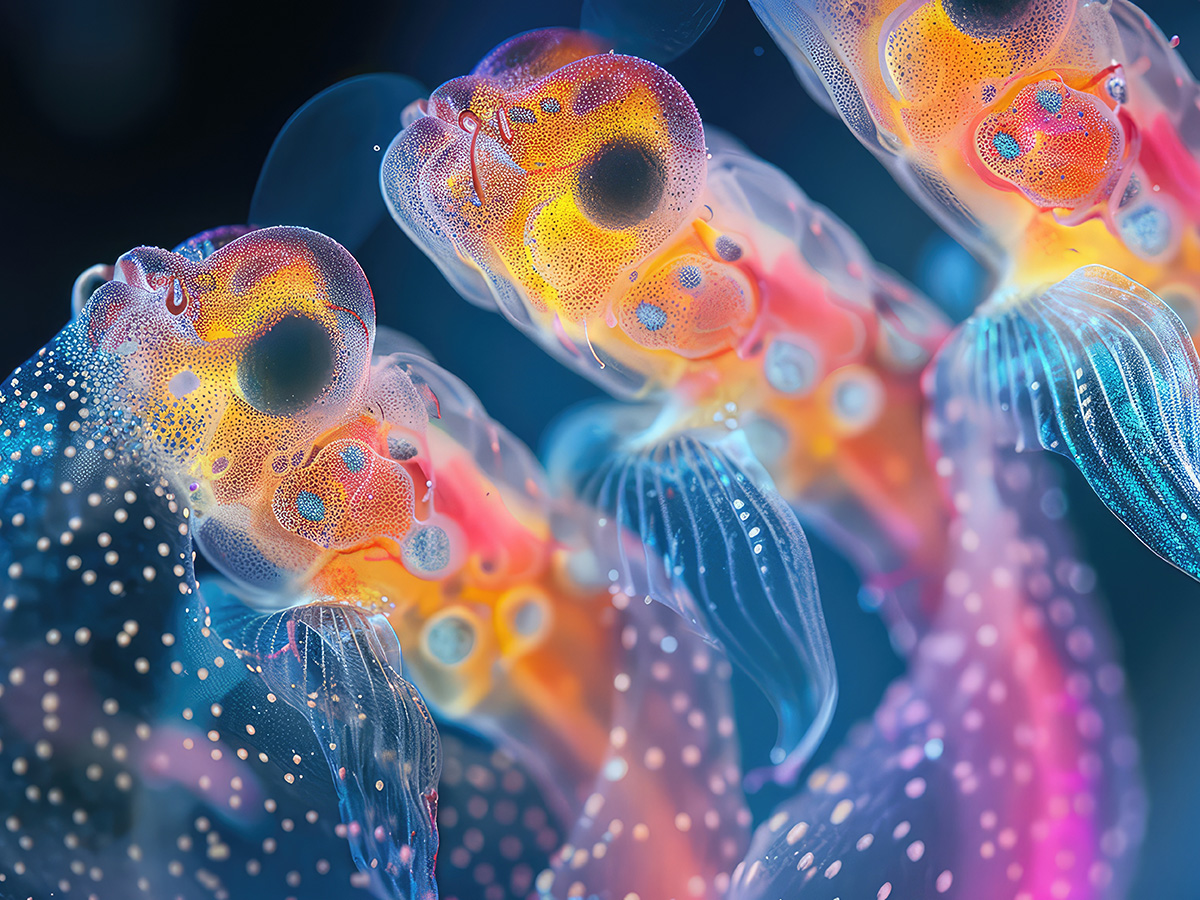
The study describes “a previously unknown paradigm of cellular neighborhood assembly through which the olfactory epithelium integrates fluctuating, stochastic signals to streamline fate commitment, differentiation and integration into the olfactory neuronal rosette,” wrote lead author Sriivatsan Govinda Rajan, Ph.D., and corresponding author Ankur Saxena, Ph.D., UAB Department of Cell, Developmental and Integrative Biology.
“These findings reveal how stochastic signaling networks spatiotemporally regulate a balance between progenitors and derivatives, driving sustained neurogenesis in an intricate organ system.”
“Remarkably, the human nose turns over its neurons every couple of months or so throughout our lifetimes,” Saxena said. “Given this unusual neuroregeneration, we wanted to answer a fundamental question: How do stem cells funnel fluctuating signals to make new neurons over and over again? Now, we’re building on our molecular ‘answers’ from the zebrafish model system by asking if the identified molecular pathways can be applied in other contexts to shape the nervous system across vertebrates. Long-term, our hope is to discover new therapeutic avenues for patients with neurodevelopmental or neurodegenerative disorders.”
Co-authors with Rajan and Saxena in the study, “Progenitor neighborhoods function as transient niches to sustain olfactory neurogenesis,” are Lynne M. Nacke, UAB Department of Cell, Developmental and Integrative Biology; and Joseph N. Lombardo, Farid Manuchehrfar, Kaelan Wong, Pinal Kanabar, Elizabeth A. Somodji, Jocelyn Garcia, Mark Maienschein-Cline and Jie Liang, University of Illinois Chicago.
Source – University of Alabama at Birmingham


Cellular differentiation of stem cells into specialized cells requires many steps, including division, to create more cells; fate determination, which is a commitment to a specific lineage or developmental path; and migration, to integrate the cell into its final location.
Previous in vitro work has shown that stem cells can spontaneously self-organize into groups of specialized cell types, yet little is known about how that happens in living animals, where densely populated microenvironments have high degrees of noise in cell-to-cell signaling and variations in gene expression.
In their study and a featured cover image in a special issue of Stem Cell Reports on Neural Stem Cells, researchers at the University of Alabama at Birmingham and the University of Illinois Chicago describe signaling mechanisms that determine one such example of vertebrate development, the transition from olfactory stem cells into highly regenerative olfactory neurons that are responsible for the sense of smell.
Applying multiple techniques including high-resolution imaging of live zebrafish embryos, quantitative tracking of cell fate and single-cell RNA sequencing, researchers identified a unique bistable toggle switch that assigns divergent cell fates to progenitor cells and drives their assembly into cellular “neighborhoods.” In doing so, they showed how signaling that guides continuous neural development is integrated at multiple scales, single cells, small clusters of cells and between entire organs.
The study describes “a previously unknown paradigm of cellular neighborhood assembly through which the olfactory epithelium integrates fluctuating, stochastic signals to streamline fate commitment, differentiation and integration into the olfactory neuronal rosette,” wrote lead author Sriivatsan Govinda Rajan, Ph.D., and corresponding author Ankur Saxena, Ph.D., UAB Department of Cell, Developmental and Integrative Biology.
Co-authors with Rajan and Saxena in the study, “Progenitor neighborhoods function as transient niches to sustain olfactory neurogenesis,” are Lynne M. Nacke, UAB Department of Cell, Developmental and Integrative Biology; and Joseph N. Lombardo, Farid Manuchehrfar, Kaelan Wong, Pinal Kanabar, Elizabeth A. Somodji, Jocelyn Garcia, Mark Maienschein-Cline and Jie Liang, University of Illinois Chicago.
Source – University of Alabama at Birmingham
Rajan SG, Nacke LM, Lombardo JN, Manuchehrfar F, Wong K, Kanabar P, Somodji EA, Garcia J, Maienschein-Cline M, Liang J, Saxena A. (2025) Progenitor neighborhoods function as transient niches to sustain olfactory neurogenesis. Stem Cell Reports 21(7): 102575. [article]
Related Posts
Novel biosensor uses DNA ‘barcodes’ to uncover disease signals in cells
CellART extracts single-cell information from high-resolution spatial transcriptomics
Cell2space restores spatial context to single-cell RNA sequencing data
Urine test may improve bladder cancer diagnosis and guide treatment decisions
DeCoRE – a computational method to resolve RNA structural heterogeneity from RNA structure probing data by direct RNA sequencing
Tracing 700 million years of cell evolution
How should biological replicates be handled in long-read RNA sequencing?
RNA-Seq reveals a new way the developing heart controls its growth
The Human RNome Project Consortium seeks to publish first-ever complete sequence of the body’s RNA
scFlowReport brings multiple single-cell RNA sequencing analyses into one workflow
Long-read RNA sequencing reveals how neurons choose alternative RNA endings
DeOPUS improves cell-type estimates from bulk RNA sequencing
ResolVI improves accuracy in spatial transcriptomics analysis
RNA sequencing reveals transcriptional allele differences in prostate cancer stem cells
Unmasking “zombie cells” in aging tissue with an AI-powered barcode
RNA variant imaging for cancer diagnosis
Autism-risk mutations reveal two opposing patterns of brain gene activity
A real-data approach to evaluating RNA transcript analysis methods
Detection and sequencing of Ap2N-capped RNAs in human cells
Single-cell RNA sequencing provides a closer look at the Aedes aegypti midgut
Stay Connected
Submit a Post to the Blog
Recent Posts
Subscribe to the RNA-Seq Blog
RNA-Seq Products & Services