

RNA sequencing allows researchers to identify and measure RNA molecules produced by cells, providing important insights into gene expression, RNA splicing and cellular function. However, RNA sequencing data often contain background noise that makes it difficult to distinguish genuine RNA transcripts from misleading signals.
These unwanted signals can create problems when researchers attempt to reconstruct complete RNA transcripts from sequencing data. Inaccurate transcript models can interfere with gene annotation and make it more difficult to understand how genes are expressed and regulated.
Researchers at the Department of Computer Science and Center for Computational Biology at Johns Hopkins University have developed SpliceCOV, a machine learning-based tool designed to improve the accuracy of transcript identification. Their findings, published in *Genes*, demonstrate how filtering unreliable RNA sequencing signals can improve transcriptome assembly while preserving biologically meaningful information.
Workflow of the SpliceCOV pipeline for filtering splice-sites and TSS/TES candidates
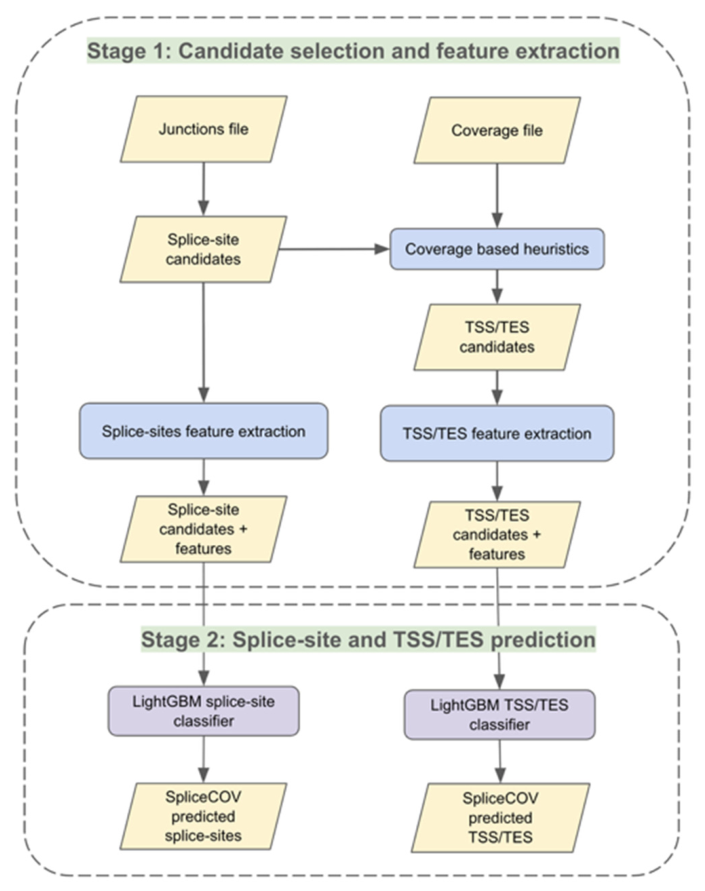
The workflow diagram illustrates the steps of the SpliceCOV pipeline. Either single-sample or multi-sample coverage and junction files can be used as input. When multiple single-sample files are available, we recommend first preprocessing them with TieBrush and TieCov. The resulting coverage and junction data are then preprocessed and used for downstream feature extraction. Feature extraction is then performed on the candidate TSS/TES and splice sites. These features are fed into two SpliceCOV classifiers: one for TSS/TES prediction and another for splice site prediction, resulting in the final predicted sites.
RNA sequencing generates millions of short sequence reads that researchers align to a reference genome. These reads provide information about which genes are active and how their RNA transcripts are assembled.
However, not every signal represents a genuine RNA feature. Technical artifacts, incomplete RNA processing and background transcription can produce misleading evidence of splice sites and transcript boundaries.
Splice sites are locations where sections of RNA are joined together during RNA processing, while transcript boundaries identify where RNA molecules begin and end.
Incorrectly identifying these features can lead to false transcript models, reducing the reliability of downstream gene expression analyses.
How SpliceCOV improves transcript identification
SpliceCOV uses supervised machine learning to distinguish likely genuine transcript features from unreliable candidates.
Unlike approaches that simply detect changes in RNA sequencing coverage, SpliceCOV examines multiple types of evidence, including sequencing read coverage and support from splice junctions.
The framework uses LightGBM, a machine learning algorithm trained to recognize patterns associated with reliable splice sites and transcript boundaries.
By evaluating these features together, SpliceCOV assigns confidence to candidate RNA structures and filters out signals that are more likely to represent noise.
This approach allows researchers to retain important RNA features while reducing the number of incorrect predictions.
Improved performance across human tissues
The researchers evaluated SpliceCOV using RNA sequencing datasets from the Genotype-Tissue Expression (GTEx) project, which contains gene expression information from numerous human tissues.
Across the evaluated datasets, SpliceCOV substantially reduced likely false-positive splice sites while retaining most sites supported by existing gene annotations.
For example, in bladder tissue, the tool eliminated approximately 91% of candidates that did not match reference splice-site annotations while preserving 90% of annotation-supported sites.
The researchers also tested whether the filtered information could improve transcript reconstruction using StringTie, a widely used transcriptome assembly program.
When SpliceCOV-filtered features were supplied to StringTie, transcript-level precision improved across five evaluated tissues, including bladder, small intestine, breast, heart and colon.
Importantly, these improvements occurred without substantially reducing the number of correctly reconstructed transcripts.
Applications across tissues and species
The researchers investigated whether SpliceCOV could analyze RNA sequencing data beyond the datasets used for training.
The tool demonstrated consistent performance across different human tissues and chromosomes, suggesting that it can recognize reliable transcript features under varying biological conditions.
SpliceCOV also successfully filtered RNA sequencing data from mice without requiring additional training, although improvements in downstream transcript assembly were smaller than those observed in human datasets.
These findings suggest that SpliceCOV could support transcriptome analysis across multiple experimental systems.
Advancing RNA sequencing data analysis
Accurate transcript reconstruction is essential for studying alternative splicing, identifying previously unknown RNA isoforms and improving genome annotations.
By reducing transcriptional noise before transcriptome assembly, SpliceCOV helps researchers produce more reliable transcript models without sacrificing substantial amounts of useful biological information.
The framework could be particularly valuable for large-scale RNA sequencing projects involving multiple tissues or experimental conditions.
SpliceCOV provides an additional quality-filtering step for RNA sequencing workflows, helping researchers distinguish meaningful transcript structures from background signals and improving the reliability of downstream transcriptomic analyses.
Availability – The tool is freely available at https://github.com/celinehohzm/SpliceCOV.
Hoh C, Shinder I, Chao KH, Varabyou A, Pertea M. (2026) SpliceCOV: Supervised filtering of RNA-Seq-derived transcript features improves transcriptome assembly. Genes 17(10): 1307. [article]
Related Posts


RNA sequencing allows researchers to identify and measure RNA molecules produced by cells, providing important insights into gene expression, RNA splicing and cellular function. However, RNA sequencing data often contain background noise that makes it difficult to distinguish genuine RNA transcripts from misleading signals.
These unwanted signals can create problems when researchers attempt to reconstruct complete RNA transcripts from sequencing data. Inaccurate transcript models can interfere with gene annotation and make it more difficult to understand how genes are expressed and regulated.
Researchers at the Department of Computer Science and Center for Computational Biology at Johns Hopkins University have developed SpliceCOV, a machine learning-based tool designed to improve the accuracy of transcript identification. Their findings, published in *Genes*, demonstrate how filtering unreliable RNA sequencing signals can improve transcriptome assembly while preserving biologically meaningful information.
Workflow of the SpliceCOV pipeline for filtering splice-sites and TSS/TES candidates
The workflow diagram illustrates the steps of the SpliceCOV pipeline. Either single-sample or multi-sample coverage and junction files can be used as input. When multiple single-sample files are available, we recommend first preprocessing them with TieBrush and TieCov. The resulting coverage and junction data are then preprocessed and used for downstream feature extraction. Feature extraction is then performed on the candidate TSS/TES and splice sites. These features are fed into two SpliceCOV classifiers: one for TSS/TES prediction and another for splice site prediction, resulting in the final predicted sites.
RNA sequencing generates millions of short sequence reads that researchers align to a reference genome. These reads provide information about which genes are active and how their RNA transcripts are assembled.
However, not every signal represents a genuine RNA feature. Technical artifacts, incomplete RNA processing and background transcription can produce misleading evidence of splice sites and transcript boundaries.
Splice sites are locations where sections of RNA are joined together during RNA processing, while transcript boundaries identify where RNA molecules begin and end.
Incorrectly identifying these features can lead to false transcript models, reducing the reliability of downstream gene expression analyses.
How SpliceCOV improves transcript identification
SpliceCOV uses supervised machine learning to distinguish likely genuine transcript features from unreliable candidates.
Unlike approaches that simply detect changes in RNA sequencing coverage, SpliceCOV examines multiple types of evidence, including sequencing read coverage and support from splice junctions.
The framework uses LightGBM, a machine learning algorithm trained to recognize patterns associated with reliable splice sites and transcript boundaries.
By evaluating these features together, SpliceCOV assigns confidence to candidate RNA structures and filters out signals that are more likely to represent noise.
This approach allows researchers to retain important RNA features while reducing the number of incorrect predictions.
Improved performance across human tissues
The researchers evaluated SpliceCOV using RNA sequencing datasets from the Genotype-Tissue Expression (GTEx) project, which contains gene expression information from numerous human tissues.
Across the evaluated datasets, SpliceCOV substantially reduced likely false-positive splice sites while retaining most sites supported by existing gene annotations.
For example, in bladder tissue, the tool eliminated approximately 91% of candidates that did not match reference splice-site annotations while preserving 90% of annotation-supported sites.
The researchers also tested whether the filtered information could improve transcript reconstruction using StringTie, a widely used transcriptome assembly program.
When SpliceCOV-filtered features were supplied to StringTie, transcript-level precision improved across five evaluated tissues, including bladder, small intestine, breast, heart and colon.
Importantly, these improvements occurred without substantially reducing the number of correctly reconstructed transcripts.
Applications across tissues and species
The researchers investigated whether SpliceCOV could analyze RNA sequencing data beyond the datasets used for training.
The tool demonstrated consistent performance across different human tissues and chromosomes, suggesting that it can recognize reliable transcript features under varying biological conditions.
SpliceCOV also successfully filtered RNA sequencing data from mice without requiring additional training, although improvements in downstream transcript assembly were smaller than those observed in human datasets.
These findings suggest that SpliceCOV could support transcriptome analysis across multiple experimental systems.
Advancing RNA sequencing data analysis
Accurate transcript reconstruction is essential for studying alternative splicing, identifying previously unknown RNA isoforms and improving genome annotations.
By reducing transcriptional noise before transcriptome assembly, SpliceCOV helps researchers produce more reliable transcript models without sacrificing substantial amounts of useful biological information.
The framework could be particularly valuable for large-scale RNA sequencing projects involving multiple tissues or experimental conditions.
SpliceCOV provides an additional quality-filtering step for RNA sequencing workflows, helping researchers distinguish meaningful transcript structures from background signals and improving the reliability of downstream transcriptomic analyses.
Availability – The tool is freely available at https://github.com/celinehohzm/SpliceCOV.
Hoh C, Shinder I, Chao KH, Varabyou A, Pertea M. (2026) SpliceCOV: Supervised filtering of RNA-Seq-derived transcript features improves transcriptome assembly. Genes 17(10): 1307. [article]
Related Posts
Recent Posts
 PANGEA – an integrated cell atlas across diverse biological contexts enables systematic profiling of multicellular responses in human diseases
 UMIche – a UMI-centric analysis platform for enhancing molecular quantification accuracy in bulk and single-cell sequencing
 New AI tool uses RNA sequencing to uncover gene interactions in Alzheimer’s disease
 New RNA sequencing tool reveals how stem cells develop into heart cells
 Estimating the completeness of large-scale single-cell sequencing projects
 New RNA sequencing tool improves transcriptome reconstruction using machine learning
RNA-Seq Products & Services


Stay Connected