

Cells make many different versions of RNA from the same gene through processes like splicing and alternative 3′ end usage. This transcript diversity helps cells adapt to their environment and maintain their identity, especially in complex tissues like the brain. While RNA sequencing has shown how diverse transcripts can be, understanding how different RNA isoforms are organized across physical space in tissues has remained a major challenge.
Researchers at Columbia University have developed a new computational method called SPLISOSM to address this gap. SPLISOSM is designed to analyze spatial transcriptomics data at the level of RNA isoforms rather than just total gene expression. By using advanced statistical modeling that accounts for dependencies between spatial locations and transcript variants, the method can detect meaningful spatial patterns even in sparse datasets.
A computational toolbox for spatial isoform pattern discovery
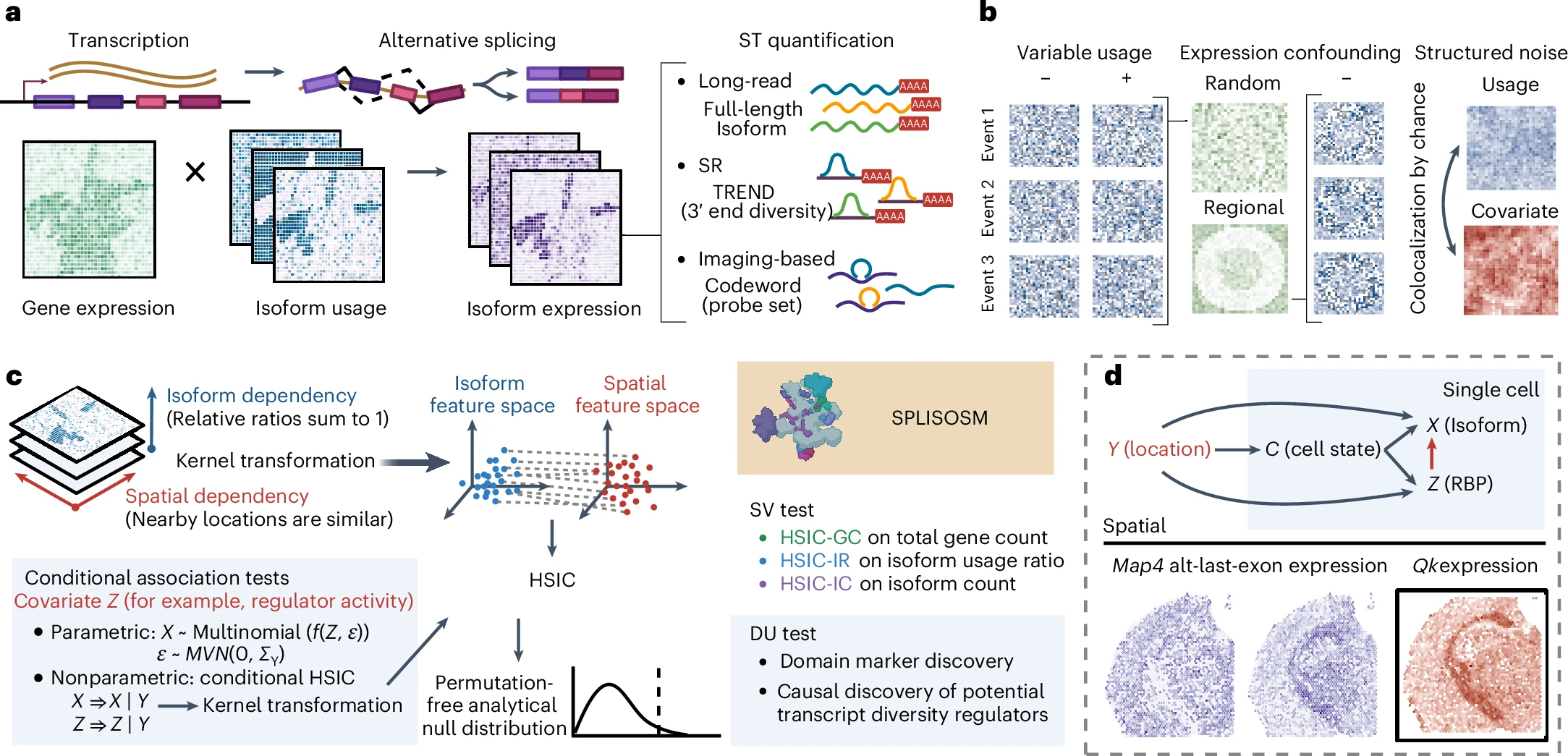
a, Alternative pre-mRNA processing generates multiple isoforms from the same gene, creating varying molecular transcript diversity detectable by major ST platforms. b, Isoform quantification from ST data is multivariate, sparse and confounded by gene expression and spatial autocorrelation. c, SPLISOSM addresses challenges in spatial isoform analysis by recasting SV and DU detections as multivariate independence tests. For SV testing, isoform usage and spatial coordinates are projected into feature spaces to assess nonlinear dependencies using the HSIC with optimized spatial and isoform kernels. For DU testing, nonparametric conditional HSIC test and parametric GLMM control for confounding spatial autocorrelation and reduce spurious associations. d, SPLISOSM enables cell-type-agnostic detection of SVP genes and their potential regulators.
When applied to the mouse brain, SPLISOSM identified more than 1,000 transcript diversity events that vary by location. Many of these events were linked to synaptic signaling pathways, which are critical for communication between neurons and are often implicated in neuropsychiatric disorders. The analysis also uncovered both known and previously unrecognized relationships between RNA isoform usage and region-specific RNA binding proteins, suggesting new layers of post-transcriptional regulation in the brain.
The researchers extended their analysis to human tissue and found that many of these spatial isoform patterns are conserved between mouse and human prefrontal cortex. This conservation points to a fundamental biological role for spatially organized transcript diversity. In human glioblastoma samples, SPLISOSM revealed widespread changes in RNA isoforms involved in antigen presentation and cell adhesion, linking transcript diversity to specific tumor microenvironment conditions.
By enabling isoform-level analysis in spatial transcriptomics, SPLISOSM adds an important new dimension to RNA sequencing studies. This approach helps connect RNA processing mechanisms to tissue structure, brain function, and disease, offering deeper insight into how cells regulate gene output in both healthy and diseased states.
Availability – The SPLISOSM Python package is available via GitHub from https://github.com/JiayuSuPKU/SPLISOSM under BSD-3 License.
Su J, Qu Y, Schertzer M, Yang H, Jiang J, Lhakhang T, Nelson T M, Park S, Lai Q, Fu X, Choi S W, Knowles D A, Rabadan R. (2026) Mapping isoforms and regulatory mechanisms from spatial transcriptomics data with SPLISOSM. Nature Biotechnology [Epub ahead of print]. [article]
Related Posts




Cells make many different versions of RNA from the same gene through processes like splicing and alternative 3′ end usage. This transcript diversity helps cells adapt to their environment and maintain their identity, especially in complex tissues like the brain. While RNA sequencing has shown how diverse transcripts can be, understanding how different RNA isoforms are organized across physical space in tissues has remained a major challenge.
Researchers at Columbia University have developed a new computational method called SPLISOSM to address this gap. SPLISOSM is designed to analyze spatial transcriptomics data at the level of RNA isoforms rather than just total gene expression. By using advanced statistical modeling that accounts for dependencies between spatial locations and transcript variants, the method can detect meaningful spatial patterns even in sparse datasets.
A computational toolbox for spatial isoform pattern discovery
a, Alternative pre-mRNA processing generates multiple isoforms from the same gene, creating varying molecular transcript diversity detectable by major ST platforms. b, Isoform quantification from ST data is multivariate, sparse and confounded by gene expression and spatial autocorrelation. c, SPLISOSM addresses challenges in spatial isoform analysis by recasting SV and DU detections as multivariate independence tests. For SV testing, isoform usage and spatial coordinates are projected into feature spaces to assess nonlinear dependencies using the HSIC with optimized spatial and isoform kernels. For DU testing, nonparametric conditional HSIC test and parametric GLMM control for confounding spatial autocorrelation and reduce spurious associations. d, SPLISOSM enables cell-type-agnostic detection of SVP genes and their potential regulators.
When applied to the mouse brain, SPLISOSM identified more than 1,000 transcript diversity events that vary by location. Many of these events were linked to synaptic signaling pathways, which are critical for communication between neurons and are often implicated in neuropsychiatric disorders. The analysis also uncovered both known and previously unrecognized relationships between RNA isoform usage and region-specific RNA binding proteins, suggesting new layers of post-transcriptional regulation in the brain.
The researchers extended their analysis to human tissue and found that many of these spatial isoform patterns are conserved between mouse and human prefrontal cortex. This conservation points to a fundamental biological role for spatially organized transcript diversity. In human glioblastoma samples, SPLISOSM revealed widespread changes in RNA isoforms involved in antigen presentation and cell adhesion, linking transcript diversity to specific tumor microenvironment conditions.
By enabling isoform-level analysis in spatial transcriptomics, SPLISOSM adds an important new dimension to RNA sequencing studies. This approach helps connect RNA processing mechanisms to tissue structure, brain function, and disease, offering deeper insight into how cells regulate gene output in both healthy and diseased states.
Availability – The SPLISOSM Python package is available via GitHub from https://github.com/JiayuSuPKU/SPLISOSM under BSD-3 License.
Su J, Qu Y, Schertzer M, Yang H, Jiang J, Lhakhang T, Nelson T M, Park S, Lai Q, Fu X, Choi S W, Knowles D A, Rabadan R. (2026) Mapping isoforms and regulatory mechanisms from spatial transcriptomics data with SPLISOSM. Nature Biotechnology [Epub ahead of print]. [article]
Related Posts
Recent Posts
 Scientists identify the neuroblastoma cells that signal poor outcomes
 GARAGE improves rare cell detection in single-cell RNA sequencing analysis using AI
 Machine learning reveals how RNA splicing is regulated in individual cell types
 Illumina releases SpliceAI2 to help advance rare disease research
 Postdoctoral Fellow – Long-Read RNA Methods Development for Neurodegeneration
 Novel biosensor uses DNA ‘barcodes’ to uncover disease signals in cells
RNA-Seq Products & Services


Stay Connected