

As scientists explore how genes are expressed in different parts of tissues, they increasingly rely on spatially resolved transcriptomics (SRT), a type of RNA sequencing that provides both gene activity and spatial location information. However, ensuring the quality of data from SRT experiments is challenging. Traditional quality control methods borrowed from single-cell sequencing often miss important spatial issues or fail to detect tissue damage that can distort the results.
To address this, researchers from Johns Hopkins University developed SpotSweeper, a new quality control tool designed specifically for spatial transcriptomics. SpotSweeper looks at each spot on the tissue slide in the context of its surrounding neighbors. This spatial awareness helps identify individual outlier spots as well as broader regional artifacts, such as tears in the tissue or processing errors that can affect large areas of the sample.
An overview of SpotSweeper: spatially aware QC methods to identify and eliminate
low-quality spots and region-level artifacts in SRT data
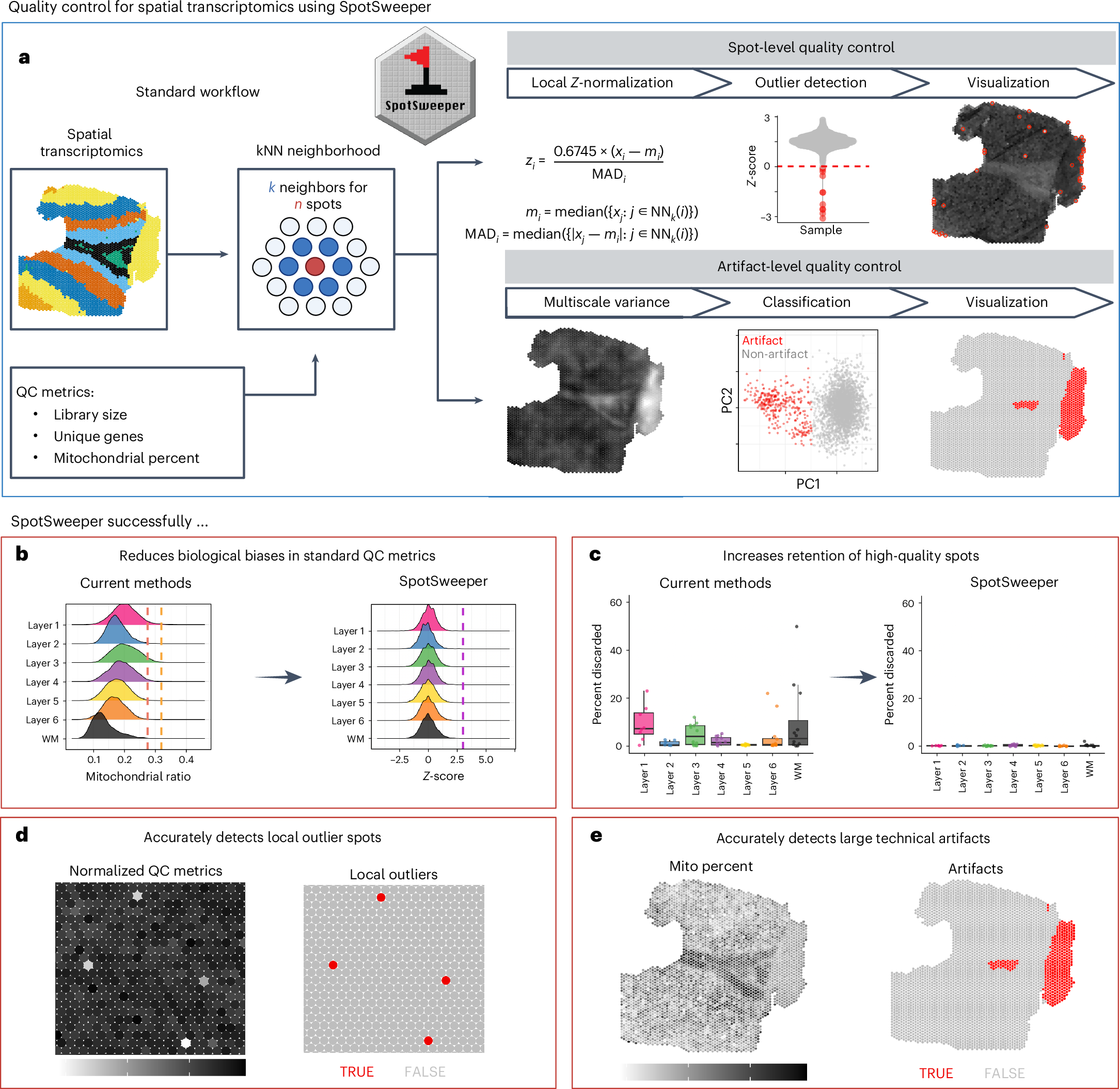
The data are postmortem human brain tissue sections profiled on the 10x Genomics Visium Spatial Gene Expression platform with annotated spatial domains for gray matter (layers 1–6) and WM. a, Using the k-nearest neighbors of each spot, SpotSweeper identifies region-level artifacts and low-quality spots. b–e, In contrast to existing QC metrics for SRT data, key advantages of SpotSweeper are that it is less biased by differences across spatial domains (b), retains more high-quality spots (c), accurately detects local outliers (d) and accurately detects compromised spots due to region-level artifacts (e).
When applied to publicly available datasets, SpotSweeper reliably flagged spots with poor quality signals and revealed two major types of regional artifacts that other tools missed. Its flexible and robust framework works across different experimental conditions and platforms, making it a valuable tool for researchers who need to trust the results of their spatial gene expression studies.
SpotSweeper represents an important advancement in improving data reliability for spatial transcriptomics, ultimately helping researchers make more accurate discoveries about how cells behave in their natural tissue environments.
Availability – The open-source software package SpotSweeper is available in the R programming language and freely available on Bioconductor (https://bioconductor.org/packages/SpotSweeper).
Totty M, Hicks SC, Guo B. (2025) SpotSweeper: spatially aware quality control for spatial transcriptomics. Nature Methods [Epub ahead of print]. [article]
Related Posts





As scientists explore how genes are expressed in different parts of tissues, they increasingly rely on spatially resolved transcriptomics (SRT), a type of RNA sequencing that provides both gene activity and spatial location information. However, ensuring the quality of data from SRT experiments is challenging. Traditional quality control methods borrowed from single-cell sequencing often miss important spatial issues or fail to detect tissue damage that can distort the results.
To address this, researchers from Johns Hopkins University developed SpotSweeper, a new quality control tool designed specifically for spatial transcriptomics. SpotSweeper looks at each spot on the tissue slide in the context of its surrounding neighbors. This spatial awareness helps identify individual outlier spots as well as broader regional artifacts, such as tears in the tissue or processing errors that can affect large areas of the sample.
An overview of SpotSweeper: spatially aware QC methods to identify and eliminate
low-quality spots and region-level artifacts in SRT data
The data are postmortem human brain tissue sections profiled on the 10x Genomics Visium Spatial Gene Expression platform with annotated spatial domains for gray matter (layers 1–6) and WM. a, Using the k-nearest neighbors of each spot, SpotSweeper identifies region-level artifacts and low-quality spots. b–e, In contrast to existing QC metrics for SRT data, key advantages of SpotSweeper are that it is less biased by differences across spatial domains (b), retains more high-quality spots (c), accurately detects local outliers (d) and accurately detects compromised spots due to region-level artifacts (e).
When applied to publicly available datasets, SpotSweeper reliably flagged spots with poor quality signals and revealed two major types of regional artifacts that other tools missed. Its flexible and robust framework works across different experimental conditions and platforms, making it a valuable tool for researchers who need to trust the results of their spatial gene expression studies.
SpotSweeper represents an important advancement in improving data reliability for spatial transcriptomics, ultimately helping researchers make more accurate discoveries about how cells behave in their natural tissue environments.
Availability – The open-source software package SpotSweeper is available in the R programming language and freely available on Bioconductor (https://bioconductor.org/packages/SpotSweeper).
Totty M, Hicks SC, Guo B. (2025) SpotSweeper: spatially aware quality control for spatial transcriptomics. Nature Methods [Epub ahead of print]. [article]
Related Posts
Recent Posts
 Scientists identify the neuroblastoma cells that signal poor outcomes
 GARAGE improves rare cell detection in single-cell RNA sequencing analysis using AI
 Machine learning reveals how RNA splicing is regulated in individual cell types
 Illumina releases SpliceAI2 to help advance rare disease research
 Postdoctoral Fellow – Long-Read RNA Methods Development for Neurodegeneration
 Novel biosensor uses DNA ‘barcodes’ to uncover disease signals in cells
RNA-Seq Products & Services



Stay Connected