A new study has uncovered how stress experienced by mothers during pregnancy leaves a molecular imprint on their babies—starting before birth. The research shows that prenatal stress alters the expression of tiny RNA molecules in newborn blood, particularly in girls, and affects key enzymes in the brain’s stress-regulation system. These changes may help explain why some children are more vulnerable to developmental or psychiatric challenges. The study opens new possibilities for early diagnosis and interventions targeting stress-related health risks.
A new study led by Prof. Hermona Soreq and Shani Vaknine Treidel from the Edmond and Lily Safra Center of Brain Science (ELSC) at Hebrew University, uncovers how stress experienced during pregnancy can affect newborns at the molecular level – with significant differences between male and female babies.
The study, published in Molecular Psychiatry, focused on perceived prenatal stress (PPS) – the mother’s own sense of psychological stress during pregnancy – and discovered that it can reprogram key molecular pathways in the baby’s body, especially those linked to the cholinergic system, which governs stress response and inflammation.
“We found that even before babies take their first breath, the stress their mothers experience can shape how their bodies manage stress themselves,” said Prof. Soreq.
The team analyzed umbilical cord blood from babies born to mothers who reported high stress levels during the third trimester. They focused on small RNA molecules called tRNA fragments (tRFs), which regulate gene expression much like microRNAs. What they found was remarkable: the stress didn’t just alter individual tRFs—it affected entire families of tRFs, particularly those with origins in mitochondrial DNA.
These changes were sex-specific, with female newborns showing the most dramatic shifts, including a near-complete decline in specific mitochondrial tRFs. Many of these tRFs, termed “CholinotRFs,” target genes that govern acetylcholine, a neurotransmitter essential for both brain function and immune regulation.
CholinotRFs and CholinomiRs are predicted to target specific genes in the cholinergic system
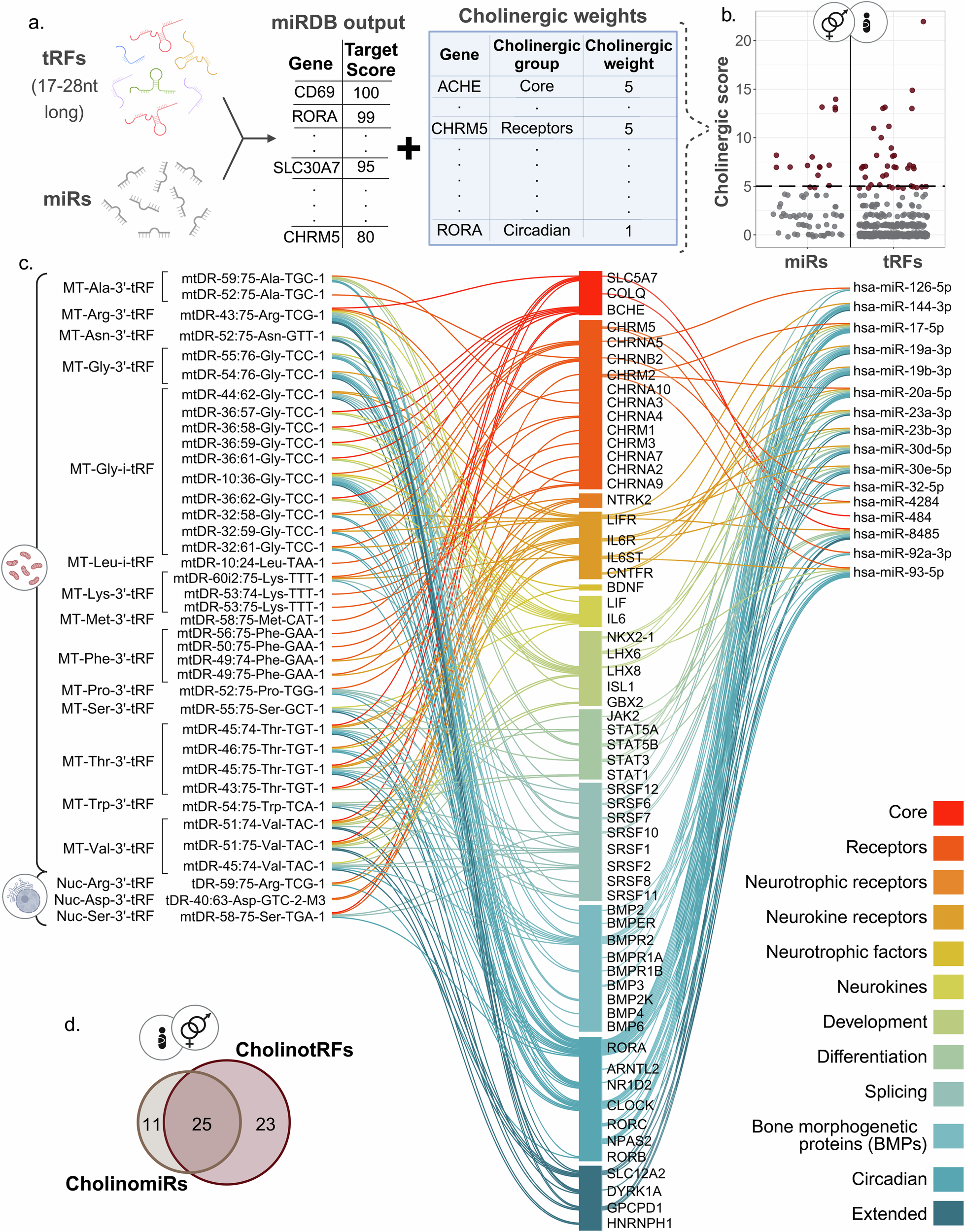
a Combining the miRDB sequence-based prediction algorithm with our in-house cholinergic scoring system revealed 16 CholinomiRs and 38 CholinotRFs expressed in newborns. b Dot plot showing cholinergic score distribution across UCS miRs and tRFs in both male and female newborns. c Network plot presenting predicted targets of the newborn CholinomiRs (right-hand list), and CholinotRFs which are grouped according to their tRF families (left-hand list). tRF families with more than one cholinergic member are framed by black lines. The central list of 51 cholinergic genes that are predicted targets of the CholinomiRs and CholinotRFs is colored according to the class within the cholinergic pathway. d Venn plot presenting the number of cholinergic gene targets shared between the newborn CholinomiRs and CholinotRFs.
The study also measured levels of acetylcholinesterase (AChE), an enzyme that breaks down acetylcholine. Newborns of stressed mothers—especially boys—had significantly higher levels of AChE, suggesting an imbalance in their stress-response system right from birth.
These molecular changes could help explain why children exposed to high maternal stress during pregnancy may be more vulnerable to neurodevelopmental and psychiatric conditions later in life.
By using machine learning techniques, the researchers were able to accurately classify female newborns as exposed or unexposed to maternal stress based on their CholinotRF profiles, achieving a classification success rate (AUC) of 95%. This opens the door to new diagnostic tools for detecting prenatal stress effects and possibly even early interventions.
“This study provides a powerful glimpse into how the maternal environment can leave a lasting biological imprint on the next generation,” said Vaknine Treidel. “It also underscores the importance of recognizing and supporting mental health during pregnancy—not just for the mother, but for the lifelong health of the child.”
This study was conducted as part of the international FELICITy project, in collaboration with the Technical University of Munich and the University of Washington, among others. Blood samples were collected from over 120 mother-infant pairs and analyzed at the Hebrew University’s Center for Genomic Technologies.


A new study has uncovered how stress experienced by mothers during pregnancy leaves a molecular imprint on their babies—starting before birth. The research shows that prenatal stress alters the expression of tiny RNA molecules in newborn blood, particularly in girls, and affects key enzymes in the brain’s stress-regulation system. These changes may help explain why some children are more vulnerable to developmental or psychiatric challenges. The study opens new possibilities for early diagnosis and interventions targeting stress-related health risks.
A new study led by Prof. Hermona Soreq and Shani Vaknine Treidel from the Edmond and Lily Safra Center of Brain Science (ELSC) at Hebrew University, uncovers how stress experienced during pregnancy can affect newborns at the molecular level – with significant differences between male and female babies.
The study, published in Molecular Psychiatry, focused on perceived prenatal stress (PPS) – the mother’s own sense of psychological stress during pregnancy – and discovered that it can reprogram key molecular pathways in the baby’s body, especially those linked to the cholinergic system, which governs stress response and inflammation.
The team analyzed umbilical cord blood from babies born to mothers who reported high stress levels during the third trimester. They focused on small RNA molecules called tRNA fragments (tRFs), which regulate gene expression much like microRNAs. What they found was remarkable: the stress didn’t just alter individual tRFs—it affected entire families of tRFs, particularly those with origins in mitochondrial DNA.
These changes were sex-specific, with female newborns showing the most dramatic shifts, including a near-complete decline in specific mitochondrial tRFs. Many of these tRFs, termed “CholinotRFs,” target genes that govern acetylcholine, a neurotransmitter essential for both brain function and immune regulation.
CholinotRFs and CholinomiRs are predicted to target specific genes in the cholinergic system
a Combining the miRDB sequence-based prediction algorithm with our in-house cholinergic scoring system revealed 16 CholinomiRs and 38 CholinotRFs expressed in newborns. b Dot plot showing cholinergic score distribution across UCS miRs and tRFs in both male and female newborns. c Network plot presenting predicted targets of the newborn CholinomiRs (right-hand list), and CholinotRFs which are grouped according to their tRF families (left-hand list). tRF families with more than one cholinergic member are framed by black lines. The central list of 51 cholinergic genes that are predicted targets of the CholinomiRs and CholinotRFs is colored according to the class within the cholinergic pathway. d Venn plot presenting the number of cholinergic gene targets shared between the newborn CholinomiRs and CholinotRFs.
The study also measured levels of acetylcholinesterase (AChE), an enzyme that breaks down acetylcholine. Newborns of stressed mothers—especially boys—had significantly higher levels of AChE, suggesting an imbalance in their stress-response system right from birth.
These molecular changes could help explain why children exposed to high maternal stress during pregnancy may be more vulnerable to neurodevelopmental and psychiatric conditions later in life.
By using machine learning techniques, the researchers were able to accurately classify female newborns as exposed or unexposed to maternal stress based on their CholinotRF profiles, achieving a classification success rate (AUC) of 95%. This opens the door to new diagnostic tools for detecting prenatal stress effects and possibly even early interventions.
This study was conducted as part of the international FELICITy project, in collaboration with the Technical University of Munich and the University of Washington, among others. Blood samples were collected from over 120 mother-infant pairs and analyzed at the Hebrew University’s Center for Genomic Technologies.
Vaknine Treidel S, Lobmaier SM, Sharma R, Madrer N, Dubnov S, Shulman D, Greenberg P, Bennett ER, Greenberg DS, Turjeman A, Zelgert C, Zimmermann P, Frasch MG, Carmel L, Antonelli MC, Soreq H. (2025) Maternal prenatal stress induces sex-dependent changes in tRNA fragment families and cholinergic pathways in newborns. Molecular Psychiatry[Epub ahead of print]. [article]
Related Posts
RNAmel simplifies RNA sequencing data analysis with a reproducible, integrated platform
Heart failure reshapes bone marrow to create inflammation-related immune memory
Overlooked DNA regions surrounding ‘microexons’ hold missing pieces of autism’s genetic puzzle
RiboBA improves detection of hidden protein-coding regions using ribosome profiling
An anti-senescence gene may fight spinal disc deterioration
Scientists identify the neuroblastoma cells that signal poor outcomes
Novel biosensor uses DNA ‘barcodes’ to uncover disease signals in cells
CellART extracts single-cell information from high-resolution spatial transcriptomics
Cell2space restores spatial context to single-cell RNA sequencing data
Urine test may improve bladder cancer diagnosis and guide treatment decisions
DeCoRE – a computational method to resolve RNA structural heterogeneity from RNA structure probing data by direct RNA sequencing
Tracing 700 million years of cell evolution
How should biological replicates be handled in long-read RNA sequencing?
RNA-Seq reveals a new way the developing heart controls its growth
The Human RNome Project Consortium seeks to publish first-ever complete sequence of the body’s RNA
scFlowReport brings multiple single-cell RNA sequencing analyses into one workflow
Long-read RNA sequencing reveals how neurons choose alternative RNA endings
DeOPUS improves cell-type estimates from bulk RNA sequencing
ResolVI improves accuracy in spatial transcriptomics analysis
RNA sequencing reveals transcriptional allele differences in prostate cancer stem cells
Stay Connected
Submit a Post to the Blog
Recent Posts
Subscribe to the RNA-Seq Blog
RNA-Seq Products & Services