

Understanding how genes are turned on and off requires looking at both gene expression and the regulatory elements that control it. Single cell technologies now allow scientists to examine these processes in individual cells, helping reveal cellular diversity and regulatory networks. However, combining measurements of chromatin accessibility and gene expression in the same cell can be technically complex and expensive.
A new method called SUM-seq addresses these challenges. a team led by researchers at the European Molecular Biology Laboratory, Germany have developed a single cell ultra high throughput multiplexed sequencing approach to profile chromatin accessibility and gene expression at the same time. SUM-seq enables researchers to capture both types of information from single nuclei in a scalable and cost effective way.
The technique combines in situ barcoding of accessible DNA and messenger RNA with droplet based microfluidic barcoding. This allows multiple samples to be processed together in a single experiment. By introducing sample multiplexing and resolving droplets that contain more than one nucleus, SUM-seq increases throughput while maintaining single cell resolution.
Overview of the SUM-seq workflow
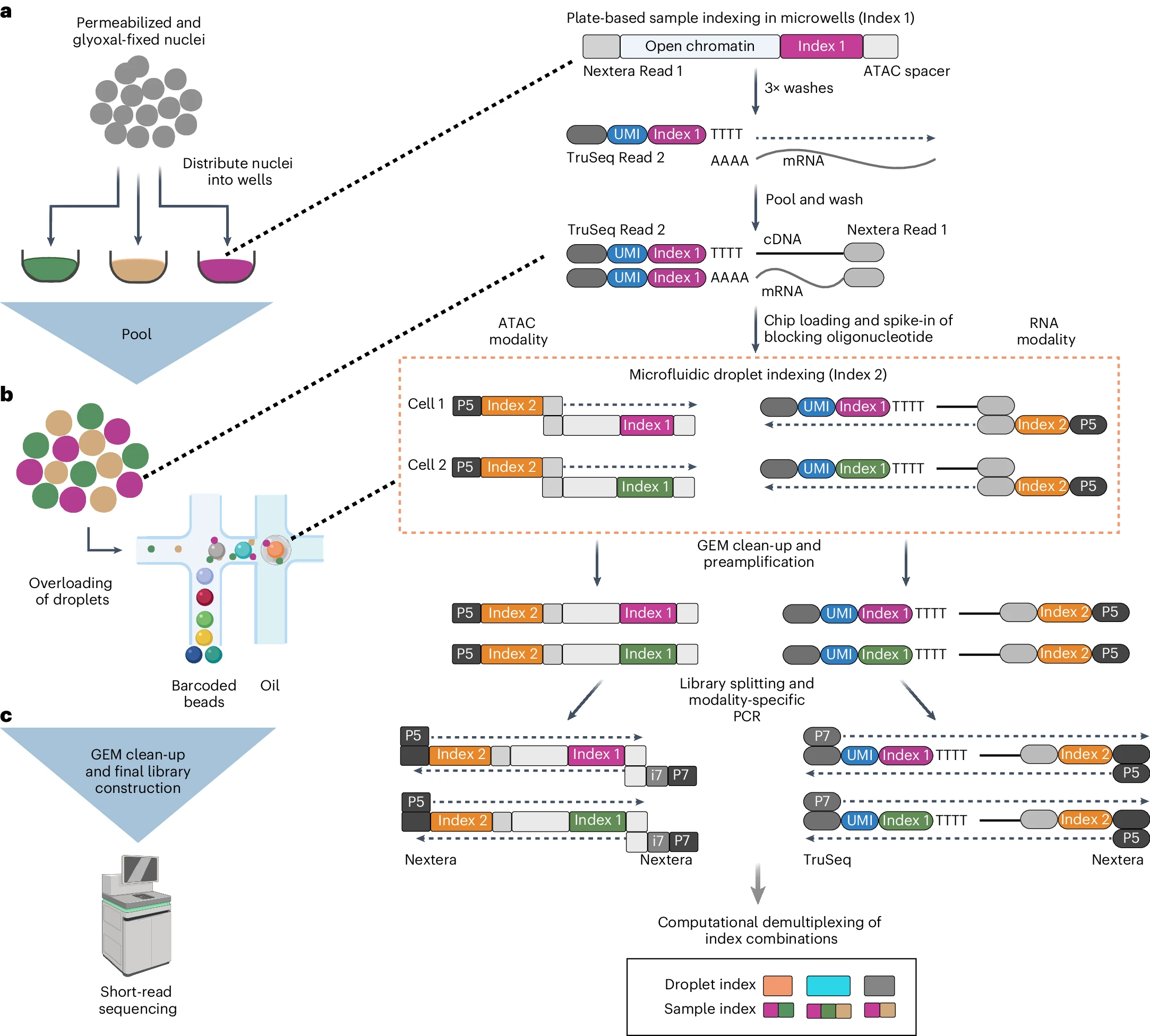
a–c, A schematic depiction of the library preparation steps of SUM-seq. Glyoxal-fixed and permeabilized nuclei are split into subpools that are assigned a unique combination of ATAC and RNA preindices (a). These indices are appended to open chromatin and nuclear mRNA via in situ chromatin tagmentation and RT, respectively. Additional washes are performed after the chromatin tagmentation step to remove excess unbound Tn5 molecules. After RT, individual samples are pooled. A Nextera Read 1 primer binding site, which is required for downstream microfluidic indexing, is appended to the cDNA–mRNA hybrids via tagmentation and gap repair. Pooled nuclei are purified and loaded onto the microfluidic device (for example, 10x Chromium) for secondary microfluidic indexing (b). A 3′-inverted dT oligonucleotide is spiked-in to this reaction to prevent index barcode hopping. Droplet emulsions are disrupted, followed by DNA purification and initial amplification with universal primers that bind open chromatin fragments as well as cDNA molecules (c). The preamplified library is physically split into two and modality-specific primer pairs are used to specifically enrich for the ATAC (Nextera P5 and custom_spacer-Nextera P7 combination) and RNA modalities (TruSeq P7 and Nextera P5 combination).
Compared with existing multimodal single cell methods, SUM-seq supports much larger experiments. This makes it well suited for large scale atlas projects, time course studies, and perturbation screens. Researchers can analyze more samples and more nuclei in one run, significantly reducing cost per cell.
From sample collection to library preparation, the protocol can be completed in two to three days, followed by sequencing and approximately one day of data processing. Although prior experience with single cell assays is helpful, the workflow can be implemented by researchers with general molecular biology training.
By combining chromatin accessibility and RNA sequencing in a highly multiplexed format, SUM-seq provides a practical framework for dissecting gene regulatory networks and understanding how different cell states are established and maintained.
Availability – The described computational pipeline for processing SUM-seq sequencing data is available at GitHub via https://git.embl.de/grp-zaugg/SUMseq.
Yildiz U, Lobato-Moreno S, Claringbould A, Bauersachs HG, Servaas NH, Vlachou EP, Arnold C, Campos-Fornés V, Prummel KD, Zaugg JB, Noh KM, Marttinen M. (2026) Single-cell ultra-high-throughput multiplexed chromatin accessibility and gene expression sequencing (SUM-seq). Nature Protocols [Epub ahead of print]. [article]
Related Posts






Understanding how genes are turned on and off requires looking at both gene expression and the regulatory elements that control it. Single cell technologies now allow scientists to examine these processes in individual cells, helping reveal cellular diversity and regulatory networks. However, combining measurements of chromatin accessibility and gene expression in the same cell can be technically complex and expensive.
A new method called SUM-seq addresses these challenges. a team led by researchers at the European Molecular Biology Laboratory, Germany have developed a single cell ultra high throughput multiplexed sequencing approach to profile chromatin accessibility and gene expression at the same time. SUM-seq enables researchers to capture both types of information from single nuclei in a scalable and cost effective way.
The technique combines in situ barcoding of accessible DNA and messenger RNA with droplet based microfluidic barcoding. This allows multiple samples to be processed together in a single experiment. By introducing sample multiplexing and resolving droplets that contain more than one nucleus, SUM-seq increases throughput while maintaining single cell resolution.
Overview of the SUM-seq workflow
a–c, A schematic depiction of the library preparation steps of SUM-seq. Glyoxal-fixed and permeabilized nuclei are split into subpools that are assigned a unique combination of ATAC and RNA preindices (a). These indices are appended to open chromatin and nuclear mRNA via in situ chromatin tagmentation and RT, respectively. Additional washes are performed after the chromatin tagmentation step to remove excess unbound Tn5 molecules. After RT, individual samples are pooled. A Nextera Read 1 primer binding site, which is required for downstream microfluidic indexing, is appended to the cDNA–mRNA hybrids via tagmentation and gap repair. Pooled nuclei are purified and loaded onto the microfluidic device (for example, 10x Chromium) for secondary microfluidic indexing (b). A 3′-inverted dT oligonucleotide is spiked-in to this reaction to prevent index barcode hopping. Droplet emulsions are disrupted, followed by DNA purification and initial amplification with universal primers that bind open chromatin fragments as well as cDNA molecules (c). The preamplified library is physically split into two and modality-specific primer pairs are used to specifically enrich for the ATAC (Nextera P5 and custom_spacer-Nextera P7 combination) and RNA modalities (TruSeq P7 and Nextera P5 combination).
Compared with existing multimodal single cell methods, SUM-seq supports much larger experiments. This makes it well suited for large scale atlas projects, time course studies, and perturbation screens. Researchers can analyze more samples and more nuclei in one run, significantly reducing cost per cell.
From sample collection to library preparation, the protocol can be completed in two to three days, followed by sequencing and approximately one day of data processing. Although prior experience with single cell assays is helpful, the workflow can be implemented by researchers with general molecular biology training.
By combining chromatin accessibility and RNA sequencing in a highly multiplexed format, SUM-seq provides a practical framework for dissecting gene regulatory networks and understanding how different cell states are established and maintained.
Availability – The described computational pipeline for processing SUM-seq sequencing data is available at GitHub via https://git.embl.de/grp-zaugg/SUMseq.
Yildiz U, Lobato-Moreno S, Claringbould A, Bauersachs HG, Servaas NH, Vlachou EP, Arnold C, Campos-Fornés V, Prummel KD, Zaugg JB, Noh KM, Marttinen M. (2026) Single-cell ultra-high-throughput multiplexed chromatin accessibility and gene expression sequencing (SUM-seq). Nature Protocols [Epub ahead of print]. [article]
Related Posts
Recent Posts
 Scientists identify the neuroblastoma cells that signal poor outcomes
 GARAGE improves rare cell detection in single-cell RNA sequencing analysis using AI
 Machine learning reveals how RNA splicing is regulated in individual cell types
 Illumina releases SpliceAI2 to help advance rare disease research
 Postdoctoral Fellow – Long-Read RNA Methods Development for Neurodegeneration
 Novel biosensor uses DNA ‘barcodes’ to uncover disease signals in cells
RNA-Seq Products & Services


Stay Connected