Pulmonary arterial hypertension, or PAH, is a rare and severe disease characterized by elevated blood pressure in the pulmonary arteries, which transport blood from the heart to the lungs. This can eventually lead to right heart failure, when the heart’s right ventricle becomes too weak to pump sufficient blood through the lungs and to the rest of the body.
Current treatments for PAH have improved the outcome for patients, but the prognosis for this disease is still poor and some patients end up needing lung transplants. C-type natriuretic peptide, or CNP, is a hormone involved in the regulation of vascular function, and a team of researchers at Kyoto University and collaborating institutions wondered whether it might also have therapeutic potential in PAH.
“CNP has been studied mainly in cardiovascular biology, but we wondered whether it might also play an important protective role in pulmonary vascular disease,” says first author Hiromu Yanagisawa.
The role of this hormone and its receptor GC-B in the pulmonary vasculature and the development of PAH has remained unclear, so the team was motivated to investigate.
Using mouse models of pulmonary hypertension, the researchers examined the effects of disrupting the CNP/GC-B pathway specifically in endothelial cells and vascular smooth muscle cells. They also tested the effects of CNP administration in experimental pulmonary hypertension and analyzed publicly available single-cell RNA-sequencing datasets from patients with PAH.
Proposed role of CNP/GC-B signaling in PAH
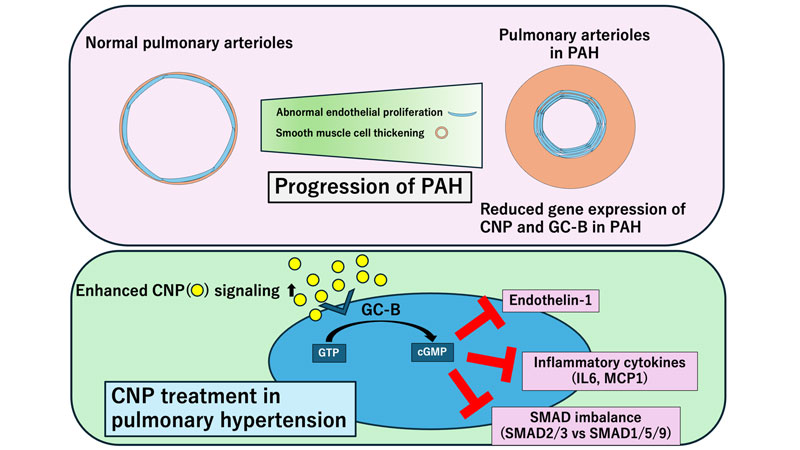
In PAH, expression of CNP and its receptor GC-B is reduced in the pulmonary vasculature. Endothelial cell-specific CNP or GC-B knockout mice, but not smooth muscle cell-specific GC-B knockout mice, showed more severe PH in mice. Administration of CNP activates endothelial GC-B signaling, which suppresses endothelin-1, inflammatory cytokines, and SMAD imbalance, thereby attenuating pulmonary vascular remodeling and disease progression.(KyotoU / Hiromu Yanagisawa)
The researchers found that the expression of both CNP and GC-B was consistently reduced across the experimental models and RNA-sequencing datasets, showing that CNP/GC-B signaling is downregulated in pulmonary hypertension. They also found that pulmonary hypertension became more severe in endothelial cell-specific knockout mice, but not in vascular smooth muscle cell-specific knockout mice, demonstrating that the protective effect depends specifically on endothelial CNP/GC-B signaling.
These results reveal that in endothelial CNP/GC-B signaling plays a protective role against pulmonary arterial hypertension, and that administration of CNP ameliorates experimental pulmonary hypertension through endothelial GC-B.
The findings provide new insight into the mechanisms underlying the development and progression of PAH, and suggest that targeting the CNP/GC-B signaling pathway may represent a promising approach for the development of new therapies for this severe disease.
“This study builds on many years of research in our laboratory, so it was especially meaningful for us to uncover a new protective role for endothelial CNP/GC-B signaling in PAH,” says first author Hiromu Yanagisawa. “We hope this will pave the way toward new treatment strategies for patients with PAH.”
Next, the team plans to further explore the therapeutic potential of the CNP/GC-B pathway and hope that it will contribute to the development of new treatment strategies for PAH patients.
Source – Kyoto University


Pulmonary arterial hypertension, or PAH, is a rare and severe disease characterized by elevated blood pressure in the pulmonary arteries, which transport blood from the heart to the lungs. This can eventually lead to right heart failure, when the heart’s right ventricle becomes too weak to pump sufficient blood through the lungs and to the rest of the body.
Current treatments for PAH have improved the outcome for patients, but the prognosis for this disease is still poor and some patients end up needing lung transplants. C-type natriuretic peptide, or CNP, is a hormone involved in the regulation of vascular function, and a team of researchers at Kyoto University and collaborating institutions wondered whether it might also have therapeutic potential in PAH.
The role of this hormone and its receptor GC-B in the pulmonary vasculature and the development of PAH has remained unclear, so the team was motivated to investigate.
Using mouse models of pulmonary hypertension, the researchers examined the effects of disrupting the CNP/GC-B pathway specifically in endothelial cells and vascular smooth muscle cells. They also tested the effects of CNP administration in experimental pulmonary hypertension and analyzed publicly available single-cell RNA-sequencing datasets from patients with PAH.
Proposed role of CNP/GC-B signaling in PAH
In PAH, expression of CNP and its receptor GC-B is reduced in the pulmonary vasculature. Endothelial cell-specific CNP or GC-B knockout mice, but not smooth muscle cell-specific GC-B knockout mice, showed more severe PH in mice. Administration of CNP activates endothelial GC-B signaling, which suppresses endothelin-1, inflammatory cytokines, and SMAD imbalance, thereby attenuating pulmonary vascular remodeling and disease progression.(KyotoU / Hiromu Yanagisawa)
The researchers found that the expression of both CNP and GC-B was consistently reduced across the experimental models and RNA-sequencing datasets, showing that CNP/GC-B signaling is downregulated in pulmonary hypertension. They also found that pulmonary hypertension became more severe in endothelial cell-specific knockout mice, but not in vascular smooth muscle cell-specific knockout mice, demonstrating that the protective effect depends specifically on endothelial CNP/GC-B signaling.
These results reveal that in endothelial CNP/GC-B signaling plays a protective role against pulmonary arterial hypertension, and that administration of CNP ameliorates experimental pulmonary hypertension through endothelial GC-B.
The findings provide new insight into the mechanisms underlying the development and progression of PAH, and suggest that targeting the CNP/GC-B signaling pathway may represent a promising approach for the development of new therapies for this severe disease.
Next, the team plans to further explore the therapeutic potential of the CNP/GC-B pathway and hope that it will contribute to the development of new treatment strategies for PAH patients.
Source – Kyoto University
Yanagisawa H, Kuwahara K, Nakagawa Y, Moriuchi K, Kinoshita H, Inazumi H, Kanamori T, Nishikimi T, Oya M, Nakao K, Ueda Y, Nakamura D, Shimizu K, Yoshie K, Tanaka S, Nakajima D, Sakanoue I, Yasoda A, Nakao K, Kimura T, Ono K. (2026) Endothelial C-type natriuretic peptide/guanylyl cyclase-B signaling prevents pulmonary arterial hypertension. Nature Communications 17(1): 2331. [article]
Related Posts
RNAmel simplifies RNA sequencing data analysis with a reproducible, integrated platform
Heart failure reshapes bone marrow to create inflammation-related immune memory
Overlooked DNA regions surrounding ‘microexons’ hold missing pieces of autism’s genetic puzzle
RiboBA improves detection of hidden protein-coding regions using ribosome profiling
An anti-senescence gene may fight spinal disc deterioration
Scientists identify the neuroblastoma cells that signal poor outcomes
Novel biosensor uses DNA ‘barcodes’ to uncover disease signals in cells
CellART extracts single-cell information from high-resolution spatial transcriptomics
Cell2space restores spatial context to single-cell RNA sequencing data
Urine test may improve bladder cancer diagnosis and guide treatment decisions
DeCoRE – a computational method to resolve RNA structural heterogeneity from RNA structure probing data by direct RNA sequencing
Tracing 700 million years of cell evolution
How should biological replicates be handled in long-read RNA sequencing?
RNA-Seq reveals a new way the developing heart controls its growth
The Human RNome Project Consortium seeks to publish first-ever complete sequence of the body’s RNA
scFlowReport brings multiple single-cell RNA sequencing analyses into one workflow
Long-read RNA sequencing reveals how neurons choose alternative RNA endings
DeOPUS improves cell-type estimates from bulk RNA sequencing
ResolVI improves accuracy in spatial transcriptomics analysis
RNA sequencing reveals transcriptional allele differences in prostate cancer stem cells
Stay Connected
Submit a Post to the Blog
Recent Posts
Subscribe to the RNA-Seq Blog
RNA-Seq Products & Services