


Understanding what genes do inside cells is one of the biggest goals in biology. Researchers often study gene function by turning genes on or off and observing what changes happen in the cell. New technologies have made this possible at a very large scale, allowing scientists to test hundreds or even thousands of genes at the same time.
One important approach is called Perturb-seq. This method combines genome editing with single-cell RNA sequencing, allowing researchers to see how individual cells respond when specific genes are altered. Because the analysis happens at the single-cell level, scientists can observe detailed biological responses that would otherwise be hidden in bulk experiments.
However, traditional Perturb-seq comes with a major challenge. It measures the entire transcriptome, meaning all RNA molecules in every cell are analyzed. While powerful, this requires deep sequencing and generates large amounts of data, making experiments expensive and limiting wider adoption.
To address this issue, researchers at the European Molecular Biology Laboratory developed Targeted Perturb-seq, also called TAP-seq.
Instead of sequencing every RNA transcript inside a cell, TAP-seq focuses only on selected genes that are most relevant to the experiment. Researchers choose hundreds of target transcripts beforehand and design primers specifically for those genes. This targeted strategy greatly reduces sequencing requirements while maintaining sensitivity.
The workflow includes selecting genes of interest, designing targeted assays, performing a pilot experiment, running the full screen, and analyzing perturbation effects. The result is a detailed view of how genetic changes affect expression patterns in individual cells.
TAP-seq workflow
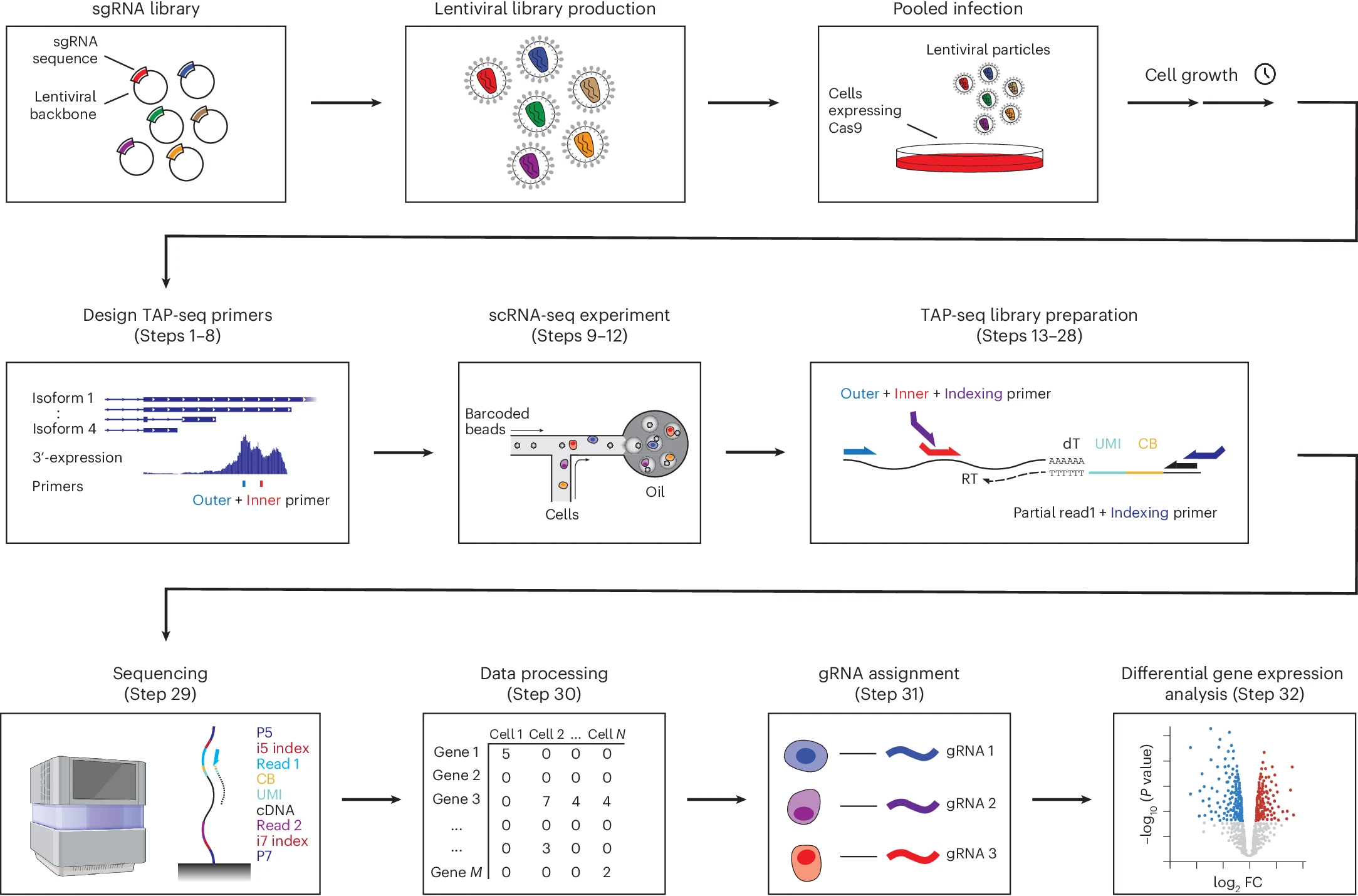
TAP-seq detects gene expression effects caused by CRISPR perturbations using targeted scRNA-seq. Input material to TAP-seq are single-cell suspensions coming out of a pooled CRISPR screening experiment (top row). After selecting genes of interest for readout, the TAP-seq library preparation workflow begins with designing primers for gene amplification (middle row). Standard scRNA-seq chemistry (such as the first steps of the 10x Genomics 3′ scRNA-seq protocol) are used to generate cDNA, followed by two TAP-seq nested multiplex PCRs and an Illumina indexing PCR (middle row). After sequencing, available computational tools are used for data processing, gRNA detection and differential gene expression analysis (bottom row). CB, cell barcode; FC, fold change; P5, P7, Illumina oligonucleotide adapter sequences.
Importantly, TAP-seq still provides several key outputs researchers need, including gene expression measurements, guide RNA assignments for each cell, and differential expression results that reveal how genetic perturbations alter cellular behavior.
Another advantage is flexibility. The protocol can be adapted to all major single-cell RNA sequencing platforms currently available, making it broadly useful for laboratories already working with single-cell technologies.
The protocol described by the authors can be completed in approximately two days, excluding data analysis, and offers a practical way to perform sensitive and scalable functional genomics screens at lower cost.
As single-cell methods continue to expand across biology, targeted approaches such as TAP-seq may help more laboratories perform large-scale functional studies without the financial burden of whole-transcriptome sequencing.
Schraivogel D, Gschwind AR, Milbank JH, Leonce DR, Jakob P, Mathur L, Korbel JO, Merten CA, Velten L, Steinmetz LM. (2020) Targeted Perturb-seq enables genome-scale genetic screens in single cells. Nature Methods 17(6):629-635. [article]
Related Posts






Understanding what genes do inside cells is one of the biggest goals in biology. Researchers often study gene function by turning genes on or off and observing what changes happen in the cell. New technologies have made this possible at a very large scale, allowing scientists to test hundreds or even thousands of genes at the same time.
One important approach is called Perturb-seq. This method combines genome editing with single-cell RNA sequencing, allowing researchers to see how individual cells respond when specific genes are altered. Because the analysis happens at the single-cell level, scientists can observe detailed biological responses that would otherwise be hidden in bulk experiments.
However, traditional Perturb-seq comes with a major challenge. It measures the entire transcriptome, meaning all RNA molecules in every cell are analyzed. While powerful, this requires deep sequencing and generates large amounts of data, making experiments expensive and limiting wider adoption.
To address this issue, researchers at the European Molecular Biology Laboratory developed Targeted Perturb-seq, also called TAP-seq.
Instead of sequencing every RNA transcript inside a cell, TAP-seq focuses only on selected genes that are most relevant to the experiment. Researchers choose hundreds of target transcripts beforehand and design primers specifically for those genes. This targeted strategy greatly reduces sequencing requirements while maintaining sensitivity.
The workflow includes selecting genes of interest, designing targeted assays, performing a pilot experiment, running the full screen, and analyzing perturbation effects. The result is a detailed view of how genetic changes affect expression patterns in individual cells.
TAP-seq workflow
TAP-seq detects gene expression effects caused by CRISPR perturbations using targeted scRNA-seq. Input material to TAP-seq are single-cell suspensions coming out of a pooled CRISPR screening experiment (top row). After selecting genes of interest for readout, the TAP-seq library preparation workflow begins with designing primers for gene amplification (middle row). Standard scRNA-seq chemistry (such as the first steps of the 10x Genomics 3′ scRNA-seq protocol) are used to generate cDNA, followed by two TAP-seq nested multiplex PCRs and an Illumina indexing PCR (middle row). After sequencing, available computational tools are used for data processing, gRNA detection and differential gene expression analysis (bottom row). CB, cell barcode; FC, fold change; P5, P7, Illumina oligonucleotide adapter sequences.
Importantly, TAP-seq still provides several key outputs researchers need, including gene expression measurements, guide RNA assignments for each cell, and differential expression results that reveal how genetic perturbations alter cellular behavior.
Another advantage is flexibility. The protocol can be adapted to all major single-cell RNA sequencing platforms currently available, making it broadly useful for laboratories already working with single-cell technologies.
The protocol described by the authors can be completed in approximately two days, excluding data analysis, and offers a practical way to perform sensitive and scalable functional genomics screens at lower cost.
As single-cell methods continue to expand across biology, targeted approaches such as TAP-seq may help more laboratories perform large-scale functional studies without the financial burden of whole-transcriptome sequencing.
Schraivogel D, Gschwind AR, Milbank JH, Leonce DR, Jakob P, Mathur L, Korbel JO, Merten CA, Velten L, Steinmetz LM. (2020) Targeted Perturb-seq enables genome-scale genetic screens in single cells. Nature Methods 17(6):629-635. [article]
Related Posts
Recent Posts
 Machine learning reveals how RNA splicing is regulated in individual cell types
 Illumina releases SpliceAI2 to help advance rare disease research
 Postdoctoral Fellow – Long-Read RNA Methods Development for Neurodegeneration
 Novel biosensor uses DNA ‘barcodes’ to uncover disease signals in cells
 GP-DHT uses single-cell RNA sequencing to map gene regulatory networks
 Boehringer taps Envisagenics’ AI to mine RNA splicing for cancer targets
RNA-Seq Products & Services



Stay Connected