Comprehensive RNA sequencing is becoming an important part of how cancers are analyzed and treated. While DNA sequencing has long been used to identify mutations that drive cancer, RNA sequencing adds another layer of information by showing which genes are actually turned on or off inside tumor cells. This can reveal therapeutic opportunities that DNA-based tests alone may miss.
In a recent perspective article, researchers from The University of Texas MD Anderson Cancer Center and colleagues outline a practical framework for incorporating RNA sequencing into routine precision oncology workflows. They explain that modern RNA-seq assays are now robust, relatively affordable, and fast enough to fit into clinical decision making, with turnaround times measured in weeks rather than months.
Actionability of RNA-derived biomarkers for diagnostic, prognostic or predictive utility
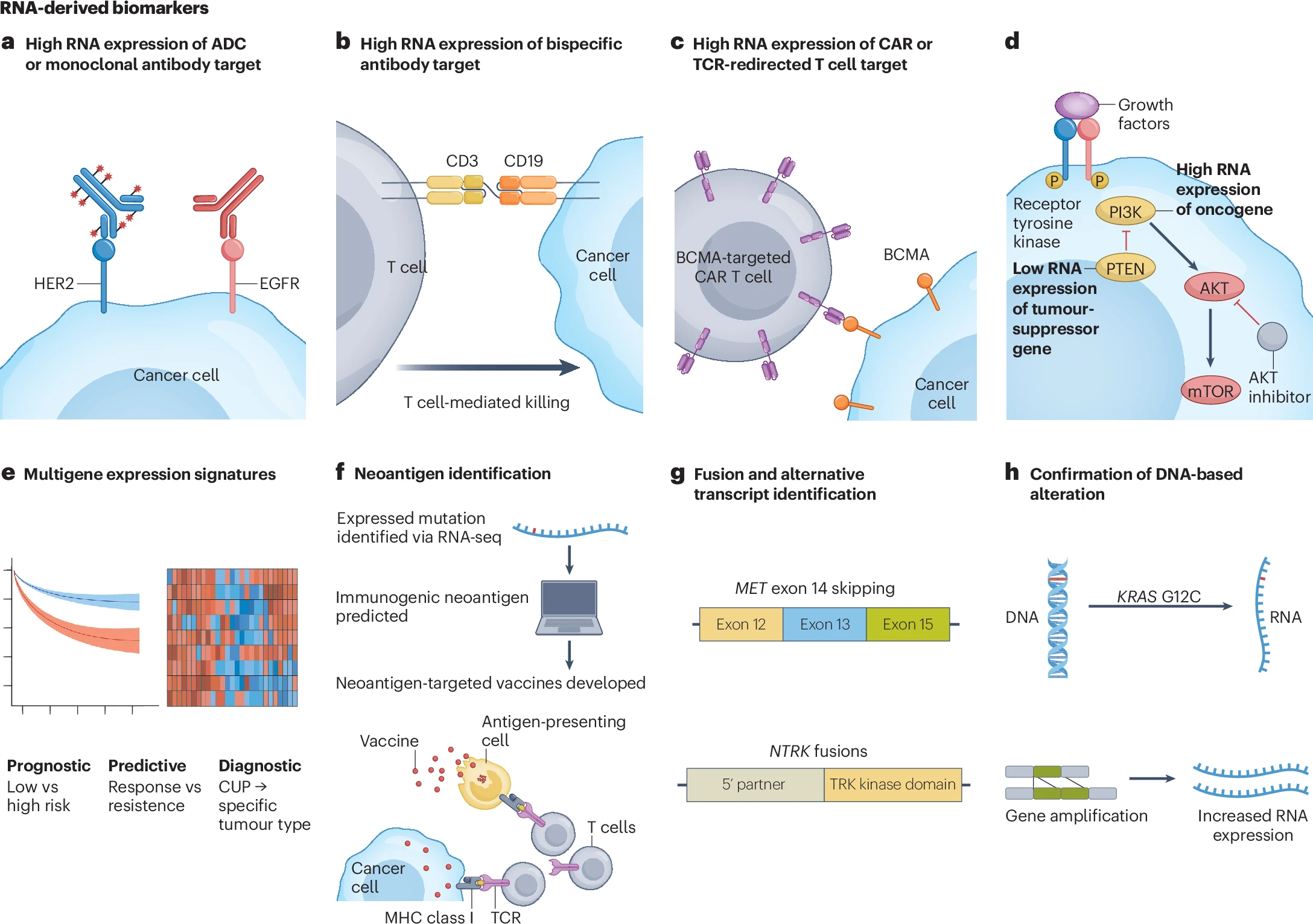
a–h, Therapeutically actionable RNA biomarkers that can be detected through RNA sequencing (RNA-seq) include cell-surface markers targeted by antibody–drug conjugates (ADCs) or monoclonal antibodies (a), bispecific antibodies (b), chimeric antigen receptor (CAR) or T cell receptor (TCR)-engineered T cell therapies (c). Additionally, high RNA expression of oncogenes or loss of tumour-suppressor gene expression at the RNA level (d); multigene RNA signatures (e); neoantigens (f), gene fusions and alternatively spliced transcripts identified via RNA-seq (g); and RNA-based confirmation of DNA-based alterations (h) can all have actionable implications for diagnostic, prognostic and predictive utility. Selected RNA-derived biomarkers from the Precision Oncology Decision Support actionable transcriptome list are provided as examples. BCMA, B cell maturation antigen; CUP, cancer of unknown primary; EGFR, epidermal growth factor receptor; mTOR, mammalian target of rapamycin.
The researchers describe how RNA data can be used in multiple clinically relevant ways. Measuring RNA expression levels can highlight overactive oncogenes or underexpressed tumor suppressor genes, even when no obvious DNA mutation is present. This is particularly useful for identifying patients who may benefit from targeted therapies based on gene expression rather than genetic alterations alone.
The framework also emphasizes the value of RNA sequencing for detecting gene fusions and splice variants, which can create abnormal proteins that drive cancer growth. Some of these fusion events are difficult to detect reliably with DNA-only approaches. RNA sequencing can also support RNA-based variant calling, reveal viral gene expression in virus-associated cancers, and capture multigene expression signatures used for diagnosis, prognosis, or therapy selection.
A key contribution of the article is the introduction of an actionable transcriptome gene list. This curated set of genes focuses on targets where RNA-level changes have predictive value, including cell surface proteins that are relevant for antibody-based and cellular therapies. RNA profiling has shown that many tumors express these targets at clinically meaningful levels, even when DNA testing does not suggest a clear option.
The researchers also discuss how RNA expression patterns can reflect broader biological features, such as defects in homologous recombination or DNA mismatch repair. These patterns may help guide treatment strategies, including the use of specific chemotherapies or immunotherapies.
Overall, this framework highlights how comprehensive RNA sequencing can expand the range of actionable findings beyond traditional low-plex assays like immunohistochemistry or in situ hybridization. By integrating RNA data with existing DNA-based approaches, clinicians may be better equipped to personalize cancer treatment and uncover therapeutic opportunities that would otherwise remain hidden.


Comprehensive RNA sequencing is becoming an important part of how cancers are analyzed and treated. While DNA sequencing has long been used to identify mutations that drive cancer, RNA sequencing adds another layer of information by showing which genes are actually turned on or off inside tumor cells. This can reveal therapeutic opportunities that DNA-based tests alone may miss.
In a recent perspective article, researchers from The University of Texas MD Anderson Cancer Center and colleagues outline a practical framework for incorporating RNA sequencing into routine precision oncology workflows. They explain that modern RNA-seq assays are now robust, relatively affordable, and fast enough to fit into clinical decision making, with turnaround times measured in weeks rather than months.
Actionability of RNA-derived biomarkers for diagnostic, prognostic or predictive utility
a–h, Therapeutically actionable RNA biomarkers that can be detected through RNA sequencing (RNA-seq) include cell-surface markers targeted by antibody–drug conjugates (ADCs) or monoclonal antibodies (a), bispecific antibodies (b), chimeric antigen receptor (CAR) or T cell receptor (TCR)-engineered T cell therapies (c). Additionally, high RNA expression of oncogenes or loss of tumour-suppressor gene expression at the RNA level (d); multigene RNA signatures (e); neoantigens (f), gene fusions and alternatively spliced transcripts identified via RNA-seq (g); and RNA-based confirmation of DNA-based alterations (h) can all have actionable implications for diagnostic, prognostic and predictive utility. Selected RNA-derived biomarkers from the Precision Oncology Decision Support actionable transcriptome list are provided as examples. BCMA, B cell maturation antigen; CUP, cancer of unknown primary; EGFR, epidermal growth factor receptor; mTOR, mammalian target of rapamycin.
The researchers describe how RNA data can be used in multiple clinically relevant ways. Measuring RNA expression levels can highlight overactive oncogenes or underexpressed tumor suppressor genes, even when no obvious DNA mutation is present. This is particularly useful for identifying patients who may benefit from targeted therapies based on gene expression rather than genetic alterations alone.
The framework also emphasizes the value of RNA sequencing for detecting gene fusions and splice variants, which can create abnormal proteins that drive cancer growth. Some of these fusion events are difficult to detect reliably with DNA-only approaches. RNA sequencing can also support RNA-based variant calling, reveal viral gene expression in virus-associated cancers, and capture multigene expression signatures used for diagnosis, prognosis, or therapy selection.
A key contribution of the article is the introduction of an actionable transcriptome gene list. This curated set of genes focuses on targets where RNA-level changes have predictive value, including cell surface proteins that are relevant for antibody-based and cellular therapies. RNA profiling has shown that many tumors express these targets at clinically meaningful levels, even when DNA testing does not suggest a clear option.
The researchers also discuss how RNA expression patterns can reflect broader biological features, such as defects in homologous recombination or DNA mismatch repair. These patterns may help guide treatment strategies, including the use of specific chemotherapies or immunotherapies.
Overall, this framework highlights how comprehensive RNA sequencing can expand the range of actionable findings beyond traditional low-plex assays like immunohistochemistry or in situ hybridization. By integrating RNA data with existing DNA-based approaches, clinicians may be better equipped to personalize cancer treatment and uncover therapeutic opportunities that would otherwise remain hidden.
Johnson A, Shen Y, Zheng X, Su F, Zeng J, Uzunparmak B, Breuer E, Holla V, Kahle M, Kim S, Vu T, Mills Shaw K R, Dumbrava E I, Yap T A, Rodon J, Routbort M, Patel K, Kulkarni S, Hansel D, Bryan J, Korkut A, Chen K, Meric-Bernstam F. (2026) The actionable transcriptome, a framework for incorporating RNA sequencing into precision oncology. Nature Reviews Clinical Oncology [Online ahead of print]. [article]
Related Posts
RNAmel simplifies RNA sequencing data analysis with a reproducible, integrated platform
Heart failure reshapes bone marrow to create inflammation-related immune memory
Overlooked DNA regions surrounding ‘microexons’ hold missing pieces of autism’s genetic puzzle
RiboBA improves detection of hidden protein-coding regions using ribosome profiling
An anti-senescence gene may fight spinal disc deterioration
Scientists identify the neuroblastoma cells that signal poor outcomes
Novel biosensor uses DNA ‘barcodes’ to uncover disease signals in cells
CellART extracts single-cell information from high-resolution spatial transcriptomics
Cell2space restores spatial context to single-cell RNA sequencing data
Urine test may improve bladder cancer diagnosis and guide treatment decisions
DeCoRE – a computational method to resolve RNA structural heterogeneity from RNA structure probing data by direct RNA sequencing
Tracing 700 million years of cell evolution
How should biological replicates be handled in long-read RNA sequencing?
RNA-Seq reveals a new way the developing heart controls its growth
The Human RNome Project Consortium seeks to publish first-ever complete sequence of the body’s RNA
scFlowReport brings multiple single-cell RNA sequencing analyses into one workflow
Long-read RNA sequencing reveals how neurons choose alternative RNA endings
DeOPUS improves cell-type estimates from bulk RNA sequencing
ResolVI improves accuracy in spatial transcriptomics analysis
RNA sequencing reveals transcriptional allele differences in prostate cancer stem cells
Stay Connected
Submit a Post to the Blog
Recent Posts
Subscribe to the RNA-Seq Blog
RNA-Seq Products & Services