

Cancer is not just a single disease, it’s an ever-changing landscape of cells with different roles, mutations, and behaviors. Understanding this complexity at the level of individual cells is critical for developing more targeted and effective treatments. In recent years, scientists have turned to single-cell RNA sequencing to get a detailed look at how individual cancer cells behave. However, most of these studies have looked at only a few tumors at a time, which limits their usefulness when it comes to identifying patterns across cancer types.
Researchers from the Weizmann Institute of Science have taken a big step forward in solving this problem. They expanded a massive resource called the Curated Cancer Cell Atlas, which now includes 124 single-cell RNA-sequencing datasets from over 40 types of cancer, representing nearly 3,000 tumor samples. This collection allows scientists to explore gene expression patterns in cancer cells more deeply than ever before.
Overview of 3CA and data summary features
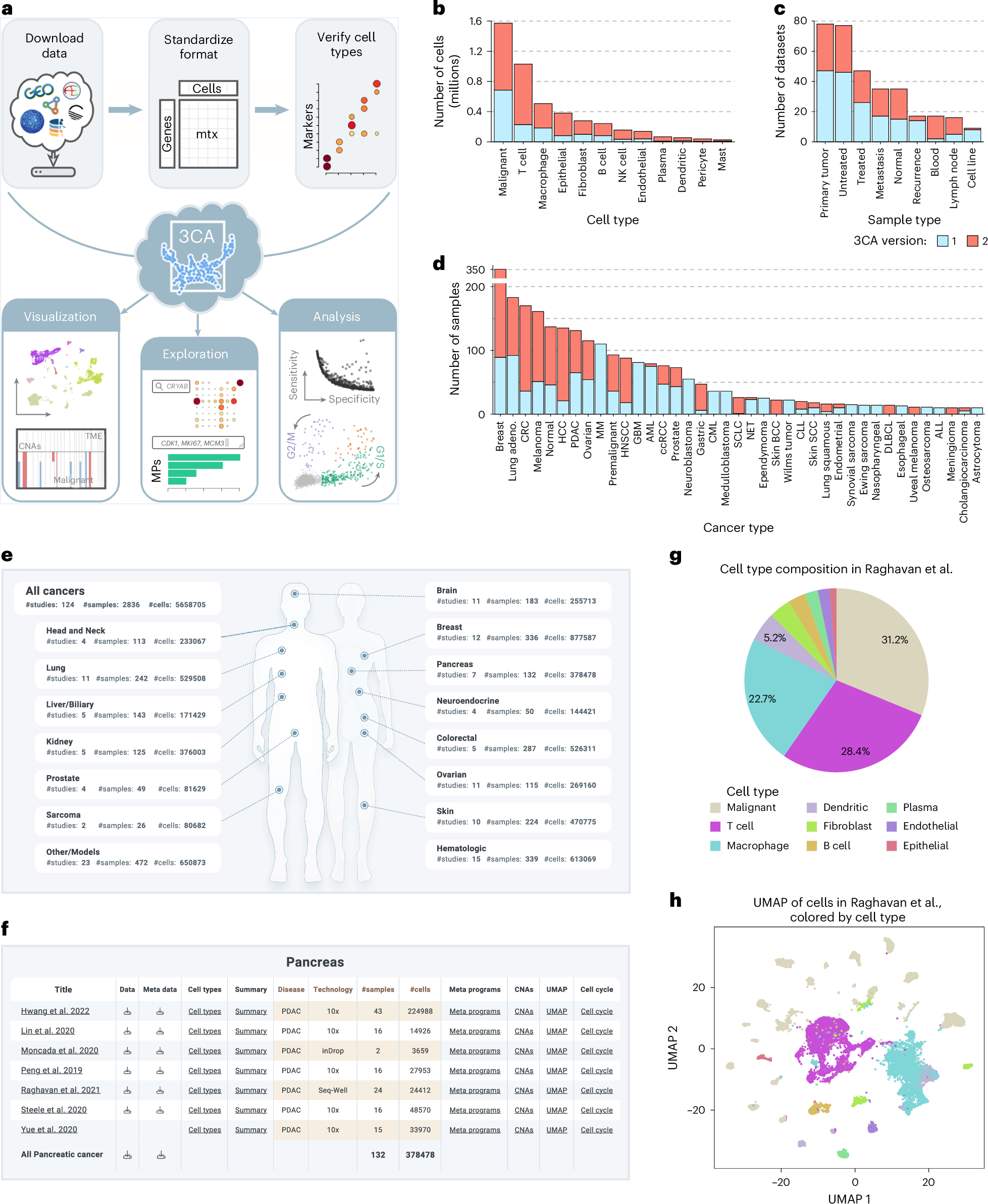
a, Scheme outlining the construction of 3CA and the features it contains. ‘Visualization’ features were included in the initial version of the 3CA website7 but all ‘exploration’ and ‘analysis’ features are new to this extended version. b, Stacked bar chart showing, for a selection of the most common cell types, the number of cells per cell type in each 3CA version. c, Stacked bar chart showing the number of datasets containing different sample types in each 3CA version. d, Stacked bar chart showing the number of samples per cancer type in each 3CA version. Cancer types with fewer than ten samples in total are not shown. HCC, hepatocellular carcinoma; PDAC, pancreatic ductal adenocarcinoma; MM, multiple myeloma; HNSCC, head and neck squamous cell carcinoma; GBM, glioblastoma multiforme; AML, acute myeloid leukemia; ccRCC, clear cell renal cell carcinoma; CML, chronic myeloid leukemia; SCLC, small cell lung cancer; NET, neuroendocrine tumor; BCC, basal cell carcinoma; CLL, chronic lymphocytic leukemia; DLBCL, diffuse large B cell lymphoma; ALL, acute lymphocytic leukemia. e, Screenshot of the 3CA website home page, summarizing the available datasets. f, Screenshot of the 3CA web page for pancreas, showing the available pancreatic cancer datasets with links and summary statistics. g, Pie chart showing the percentage of cells in the Raghavan et al. dataset assigned to each cell type. h, UMAP plot of all cells (points) in the Raghavan et al. dataset, colored by cell type.
With this expanded dataset, the team has mapped out common gene expression programs that appear repeatedly in different cancers and cell types. They also examined how gene activity changes depending on the tumor’s environment and the cell’s role—such as whether it’s actively dividing or not. The result is a detailed, interactive platform that any cancer researcher can access, opening up countless new opportunities to study tumor biology and identify potential therapeutic targets, including those involving extracellular vesicles, which play an important role in cell communication within tumors.
This atlas is more than just a database, it’s a powerful tool for uncovering the hidden rules of tumor behavior, helping researchers better understand how cancers grow, spread, and resist treatment.
Availability – https://www.weizmann.ac.il/sites/3CA/
Tyler M, Gavish A, Barbolin C, Tschernichovsky R, Hoefflin R, Mints M, Puram SV, Tirosh I. (2025) The Curated Cancer Cell Atlas provides a comprehensive characterization of tumors at single-cell resolution. Nature Cancer [Epub ahead of print]. [article]
Related Posts




Cancer is not just a single disease, it’s an ever-changing landscape of cells with different roles, mutations, and behaviors. Understanding this complexity at the level of individual cells is critical for developing more targeted and effective treatments. In recent years, scientists have turned to single-cell RNA sequencing to get a detailed look at how individual cancer cells behave. However, most of these studies have looked at only a few tumors at a time, which limits their usefulness when it comes to identifying patterns across cancer types.
Researchers from the Weizmann Institute of Science have taken a big step forward in solving this problem. They expanded a massive resource called the Curated Cancer Cell Atlas, which now includes 124 single-cell RNA-sequencing datasets from over 40 types of cancer, representing nearly 3,000 tumor samples. This collection allows scientists to explore gene expression patterns in cancer cells more deeply than ever before.
Overview of 3CA and data summary features
a, Scheme outlining the construction of 3CA and the features it contains. ‘Visualization’ features were included in the initial version of the 3CA website7 but all ‘exploration’ and ‘analysis’ features are new to this extended version. b, Stacked bar chart showing, for a selection of the most common cell types, the number of cells per cell type in each 3CA version. c, Stacked bar chart showing the number of datasets containing different sample types in each 3CA version. d, Stacked bar chart showing the number of samples per cancer type in each 3CA version. Cancer types with fewer than ten samples in total are not shown. HCC, hepatocellular carcinoma; PDAC, pancreatic ductal adenocarcinoma; MM, multiple myeloma; HNSCC, head and neck squamous cell carcinoma; GBM, glioblastoma multiforme; AML, acute myeloid leukemia; ccRCC, clear cell renal cell carcinoma; CML, chronic myeloid leukemia; SCLC, small cell lung cancer; NET, neuroendocrine tumor; BCC, basal cell carcinoma; CLL, chronic lymphocytic leukemia; DLBCL, diffuse large B cell lymphoma; ALL, acute lymphocytic leukemia. e, Screenshot of the 3CA website home page, summarizing the available datasets. f, Screenshot of the 3CA web page for pancreas, showing the available pancreatic cancer datasets with links and summary statistics. g, Pie chart showing the percentage of cells in the Raghavan et al. dataset assigned to each cell type. h, UMAP plot of all cells (points) in the Raghavan et al. dataset, colored by cell type.
With this expanded dataset, the team has mapped out common gene expression programs that appear repeatedly in different cancers and cell types. They also examined how gene activity changes depending on the tumor’s environment and the cell’s role—such as whether it’s actively dividing or not. The result is a detailed, interactive platform that any cancer researcher can access, opening up countless new opportunities to study tumor biology and identify potential therapeutic targets, including those involving extracellular vesicles, which play an important role in cell communication within tumors.
This atlas is more than just a database, it’s a powerful tool for uncovering the hidden rules of tumor behavior, helping researchers better understand how cancers grow, spread, and resist treatment.
Availability – https://www.weizmann.ac.il/sites/3CA/
Tyler M, Gavish A, Barbolin C, Tschernichovsky R, Hoefflin R, Mints M, Puram SV, Tirosh I. (2025) The Curated Cancer Cell Atlas provides a comprehensive characterization of tumors at single-cell resolution. Nature Cancer [Epub ahead of print]. [article]
Related Posts
Recent Posts
 RNAmel simplifies RNA sequencing data analysis with a reproducible, integrated platform
 Heart failure reshapes bone marrow to create inflammation-related immune memory
 Overlooked DNA regions surrounding ‘microexons’ hold missing pieces of autism’s genetic puzzle
 RiboBA improves detection of hidden protein-coding regions using ribosome profiling
 An anti-senescence gene may fight spinal disc deterioration
 Bulk RNA-seq Analysis: A Complete Beginner’s Guide
RNA-Seq Products & Services


Stay Connected